
Learn Egyptian Arabic Online: Speak the Cairo Dialect for Real Life
Learn Egyptian Arabic online through live private lessons built around the way people actually speak in Cairo. The course develops listening, response speed, sentence building, pronunciation, everyday grammar and social register so you can take part in a conversation instead of only recalling isolated phrases.
Absolute beginners, MSA learners, international spouses, heritage speakers, travellers, expats and professionals begin with a speaking-and-listening assessment. Your teacher then builds a route around the situations you actually need—family, travel, life in Egypt, work, media or heritage reconnection.
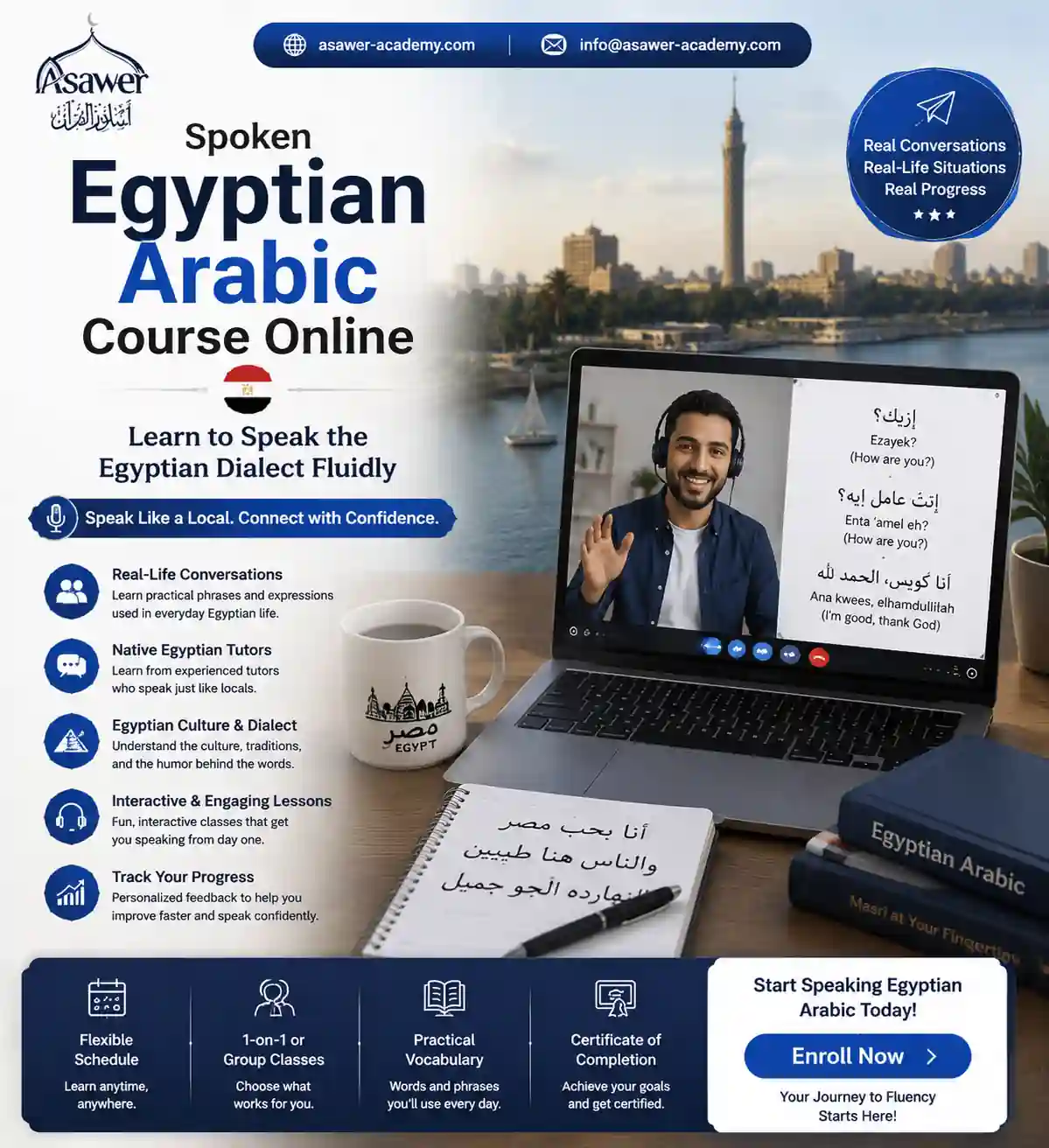
Everyday Cairene Arabic—Not Formal MSA and Not Random Slang
Egyptian Colloquial Arabic—Masri or Ammiya—is the spoken language used in ordinary conversations across Egypt, with meaningful regional and social variation. This course uses contemporary Cairo speech as a stable reference because learners frequently encounter it in family life, cities, workplaces, films, television and online content.
You learn pronunciation, reusable sentence patterns, high-frequency vocabulary and the social meaning of expressions. The teacher also compares Egyptian Arabic with MSA when comparison prevents confusion, but the two varieties are not mixed carelessly.
Arabic script is recommended for long-term independence, yet it does not have to block conversation. Beginners can use a controlled phonetic bridge while gradually building script recognition for messages, subtitles, dictionaries and wider Arabic study.
How We Turn Vocabulary into Real Egyptian Conversation
Every lesson moves through a simple communication loop: hear a useful phrase in context, notice the pattern, change one detail, answer a follow-up question and repair the conversation when something is missed.
Grammar appears when it unlocks real speech. Learners practise the common b-present, future with ha-, past forms, negation, attached pronouns, requests, connectors and conversation particles inside complete situations rather than as disconnected rules.
Listening grows alongside speaking. The teacher can contrast careful speech with more natural speed, train linked words and shortened expressions, then use short clips or voice notes when the student is ready.
Progress is measured through unfamiliar tasks: how much you understand, how quickly you respond, whether you can clarify and continue, and how widely you can reuse the language without rebuilding every sentence in English first.
Egyptian Arabic Curriculum: Six CEFR-Informed Learning Stages
The labels guide progression rather than promise a formal CEFR certificate. Each stage adds new situations, grammar and listening pressure while keeping real interaction at the centre.
A0 — Arrival in Cairo
Sounds, greetings, identity, numbers, essential needs and conversation-repair phrases so a beginner can survive the first short exchange.
A1 — Daily Cairo
Family, routine, food, shopping, directions and transport, with common present-time patterns and high-frequency requests.
A2 — Independent Life
Past and future events, housing, services, health, appointments, invitations and polite problem solving.
B1 — Relationships and Stories
Connected storytelling, opinions, advice, work, study, emotions and the particles that make Egyptian conversation sound less translated.
B2 — Media and Social Nuance
Faster listening, films, podcasts, idioms, humour, indirect meaning and movement between casual and more formal registers.
C1 — Professional and Cultural Depth
Longer discussion, negotiation, professional interaction, social topics and a specialist track for family, heritage, research, healthcare, business or media.
Egyptian Arabic for Family, Travel, Heritage, Work and Media
This course is useful when spoken interaction with Egyptians is the main goal. That includes learners with Egyptian spouses or relatives, heritage speakers who understand more than they can say, people moving to Egypt, travellers, professionals and Arabic students who need the spoken variety they hear outside formal textbooks.
If your immediate barrier is script rather than conversation, use Learn Arabic Reading Online. If you want a published four-skill Modern Standard Arabic sequence, compare Learn Arabic with Al-Takallum.
How Asawer Academy Teaches Egyptian Arabic Online
The free assessment separates passive understanding from active speaking. The teacher listens for pronunciation patterns, response delay, MSA–dialect mixing, vocabulary gaps and the situations where communication usually breaks down.
Regular lessons then use roleplay and changing details instead of one fixed dialogue. You hear a natural model, rebuild the pattern, react under time pressure, receive focused correction and reuse the same language later in a different situation. The target is conversation control—not an unrealistic promise to erase your accent.
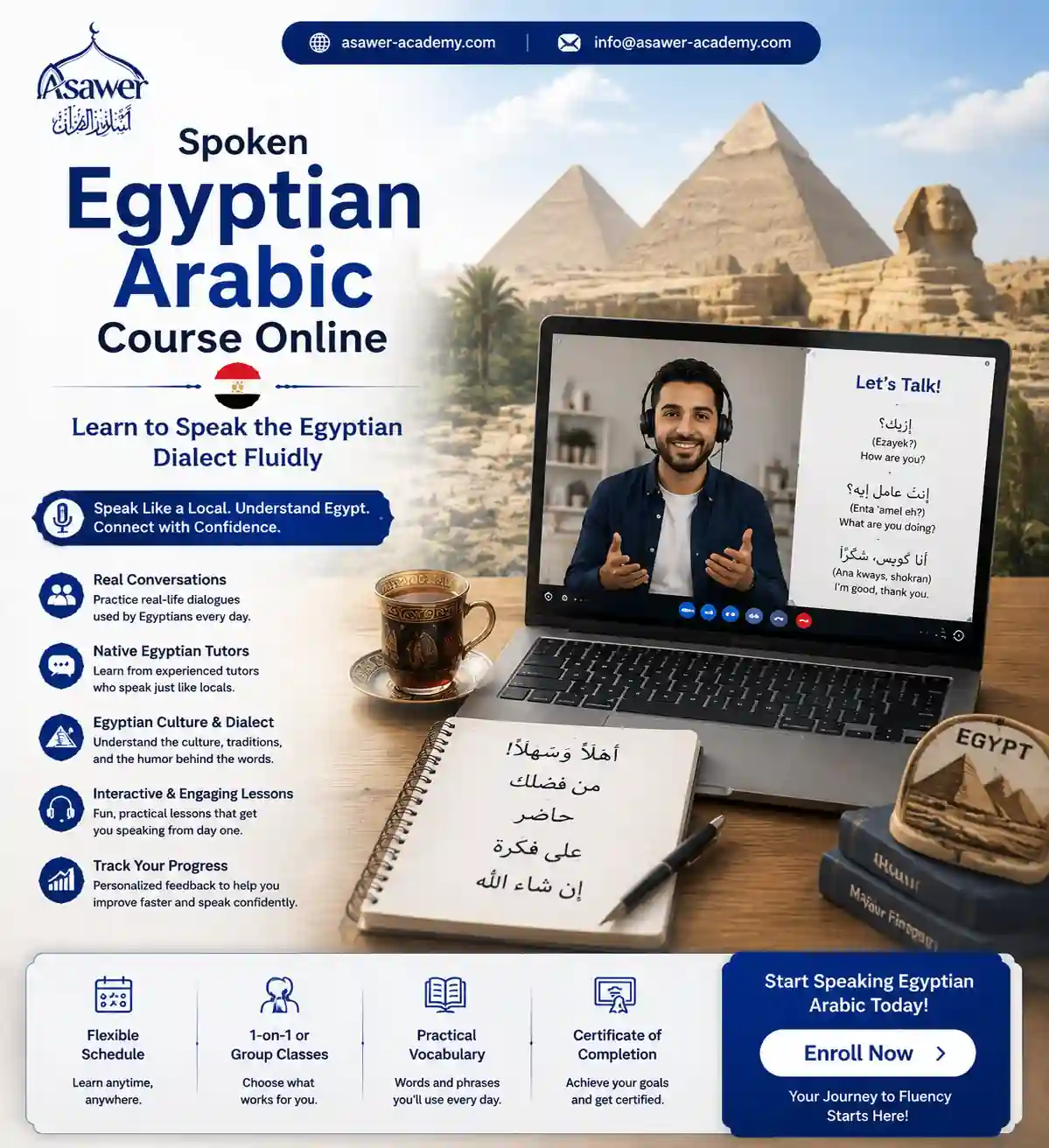
Why Learners Choose Asawer for Egyptian Arabic
A spoken-dialect course works best when native input, real interaction, cultural context and measurable conversation practice stay connected.
Cairo-Based Spoken Reference
Learn a clear everyday Cairene register while also developing awareness of regional, age and formality differences.
Free Speaking & Listening Assessment
The trial checks active speech, listening, pronunciation, script preference and the real situations you need before a level is chosen.
Live One-to-One Roleplay
Private lessons allow the teacher to interrupt, reformulate, slow down and retest the exact sentence that blocked your conversation.
Natural-Speed Listening Practice
Train rhythm, linked speech and shortened expressions instead of hearing only slow teacher pronunciation.
Functional Grammar for Speaking
Grammar is selected because it helps you build, change and understand real Egyptian sentences—not because it appears in a chapter list.
Family, Travel, Heritage & Work Tracks
Core language stays structured while roleplays and vocabulary adapt to the learner’s real-life mission.
Lesson Feedback & Monthly Reports
Follow response time, listening coverage, recurring errors, vocabulary range and the next conversation target.
Teacher Choice, WhatsApp & Scheduling
Request male or female teachers where available and use WhatsApp plus international scheduling support for a consistent routine.
Learn Egyptian Arabic Online FAQs
Clear answers about Cairo dialect, MSA, script, family, travel, media, pronunciation, progress and online lessons.
Egyptian Arabic, often called Masri or Ammiya, is the everyday spoken Arabic used across Egypt. This course uses contemporary Cairo speech as the main reference while acknowledging regional and social variation.
Choose Egyptian Arabic first when conversation with Egyptians is the immediate goal. Choose Fusha when formal reading, writing or wider standard communication is the priority. Many learners eventually study both for different purposes.
No. Script is recommended for long-term independence, but it does not need to delay speaking. A controlled phonetic bridge can support the earliest lessons while Arabic reading develops.
No. The course teaches a structured spoken system: pronunciation, grammar, high-frequency vocabulary, sentence patterns, listening and cultural register. Slang is introduced only when context makes it useful.
The course targets intelligibility, natural rhythm and appropriate expression. No responsible programme can guarantee that every non-native feature or accent will disappear.
Yes. The assessment can separate passive understanding, vocabulary retrieval, pronunciation and grammar gaps before building an active-speaking plan.
Yes, especially at higher levels. Short authentic clips can train listening speed, implied meaning, humour, idioms and cultural references.
The course can help learners recognize the Latin-letter-and-number spelling often used in informal messages, but Franco should remain a bridge rather than the learner’s permanent reading system.
The teacher checks listening, speaking, response speed, pronunciation, current MSA or dialect knowledge, script preference and the real situations in which you need Egyptian Arabic.
Yes, at the level you can manage. Day-one speaking may be a greeting, introduction, request or short answer rather than a long conversation.
Useful measures include listening coverage, response time, ability to repair a conversation, range of situations and how naturally the learner reuses grammar and vocabulary.
Yes. You can request a preferred teacher, subject to level, schedule, language support and availability.
Private one-to-one lessons are a core option, allowing the teacher to stop, reformulate and repeat exactly where the learner’s conversation breaks down.
Egyptian Arabic should not be expected to replace MSA literacy. The assessment may recommend a separate reading or Fusha track alongside the dialect.
No. They share much vocabulary and structure, but everyday Egyptian pronunciation, vocabulary and grammar differ from formal MSA used in news, books and formal writing.
Yes. A beginner can start with pronunciation, greetings, high-frequency sentence patterns and listening. Arabic script can be introduced from the beginning or gradually according to the learner’s goals.
The course uses a stable contemporary Cairo reference because it is widely encountered in urban conversation and media. Students also learn to notice variation rather than assuming every Egyptian speaks identically.
Yes, progressively. Lessons train linked speech, shortened high-frequency expressions, rhythm, stress and prediction so the learner depends less on unnaturally slow classroom speech.
Yes. A family track can prioritize visits, hospitality, phone calls, affection, family roles, invitations and the expressions used in your own relationships.
Yes. Travel and expat lessons can prioritize taxis, food, shopping, housing, directions, appointments, services and practical problem solving.
Yes, but grammar is taught as a tool for building and understanding real sentences. The course covers useful systems such as the b-present, future with ha-, negation, attached pronouns and common connectors.
Script can support notes, subtitles, messages, dictionaries and long-term independence. Learners who need conversation urgently can begin speaking while adding script deliberately.
Live one-to-one lessons use short input, pattern noticing, roleplay, follow-up questions, correction and reuse. The teacher changes details so the student learns to react rather than recite one memorized dialogue.
Homework can include short listening clips, shadowing, vocabulary in complete sentences, voice-note responses, a script task or preparation for a real-life roleplay.
There is no fixed honest timeline before assessment. Starting level, lesson frequency, listening exposure, independent practice and the situations you need all affect progress.
Yes. A change can be discussed when another teaching style, language fit or schedule would better support the learner.
International recurring times can be discussed according to teacher availability and the learner’s local schedule.
That depends on the next limitation: advanced conversation and media, formal Fusha, Arabic reading, writing or a published curriculum such as Al-Takallum.
Choose formal Arabic, reading or a published curriculum when your goal changes
Everything learners ask before an Egyptian Arabic course online
Start Your Free Trial Now
Asawer Academy
Asawer Academy specializes in teaching the Quran, Arabic, and Islamic Studies to non-Arabic speakers through live one-to-one online lessons..
