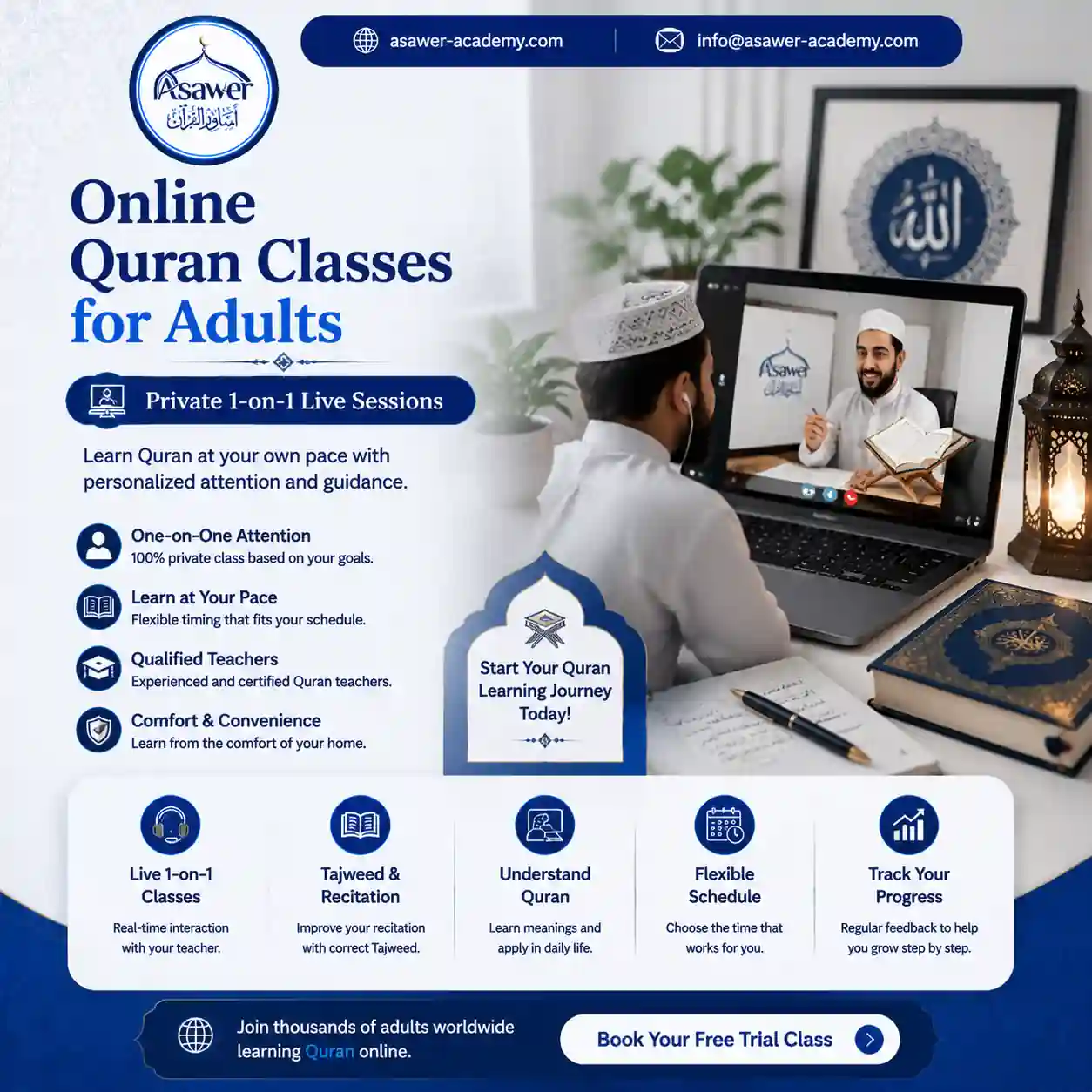
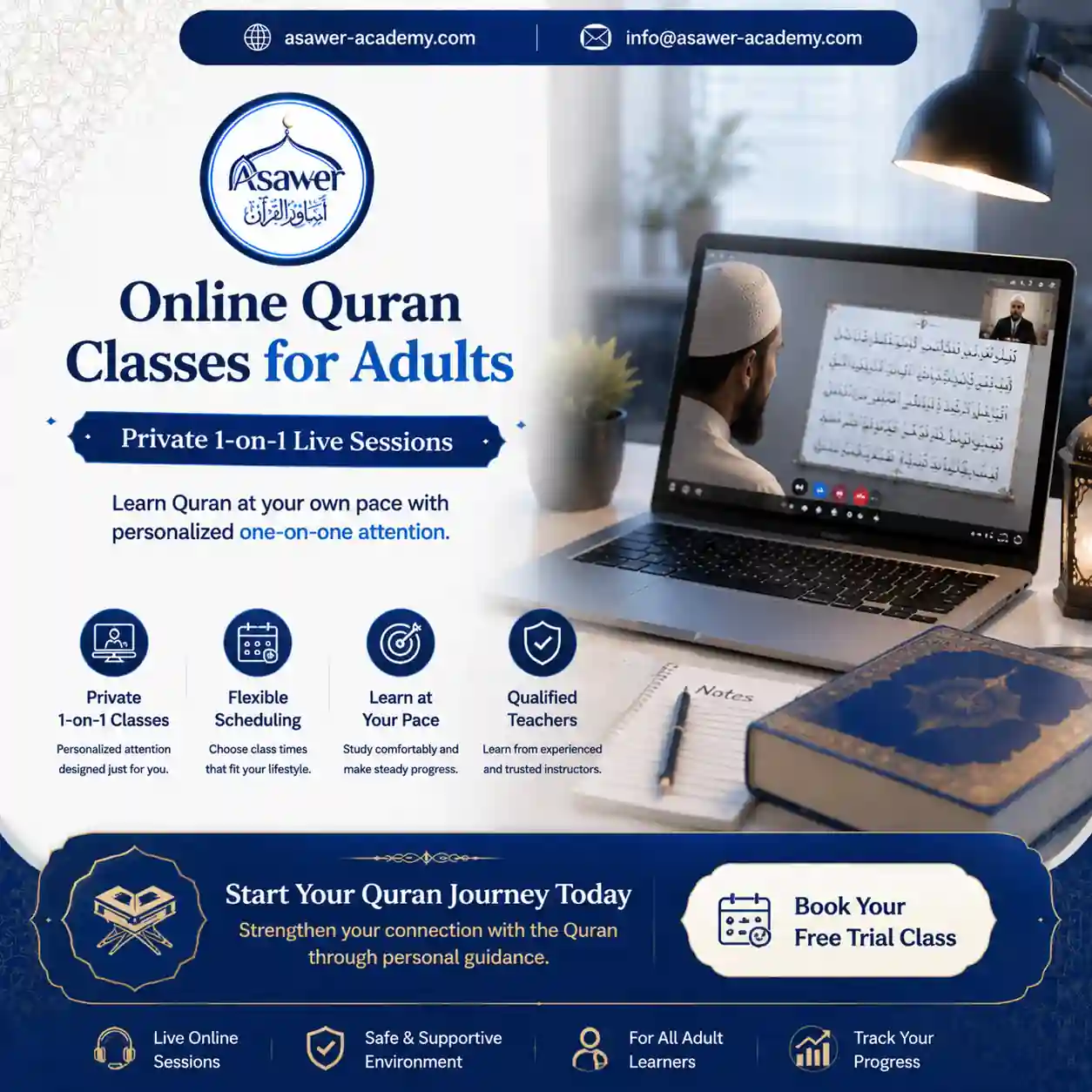
Quran Classes for Adults: Start at Your Real Level and Learn Without Embarrassment

Quran Classes for Adults should respect both your current level and your adult life. You may be starting from the Arabic alphabet, returning after years away, reading slowly, correcting Tajweed, rebuilding memorization or finally trying to understand the Surahs you recite every day.

Asawer Academy begins with a private assessment, not a public test. The teacher identifies the one skill that currently limits your progress, then builds a realistic plan around work, family, available practice time and your preferred male or female teacher.

Online Quran Learning for Adults at Every Starting Point

Adult learners often know more than they think in one area and less than they expect in another. You may recognize letters but still guess connected words. You may read fluently yet repeat one Makharij mistake across every page. You may know Tajweed terminology but not apply it consistently, or remember Surahs from childhood while struggling to read the same ayat from the Mushaf.

The course therefore does not place every adult on page one of the same book. The teacher diagnoses the current barrier and chooses the next useful skill. A complete beginner can start from letters, while a fluent reader can begin directly with recitation correction, Hifz or another suitable goal.

The adult format also avoids unnecessary embarrassment. Private lessons allow you to ask basic questions, repeat a difficult sound and work at your own pace without comparison to children or other adults.

How Asawer Academy Teaches Quran to Adult Learners

Each lesson begins with one clear target. The teacher may review the previous practice, listen to continuous recitation, correct a high-impact reading or Tajweed issue, and then retest the same skill in a new word or ayah.

Explanations use adult language. If a rule needs theory, the teacher explains enough theory to support actual recitation rather than turning the class into a long list of definitions. A beginner receives direct reading support; a stronger student receives more precise correction and independence.

Homework is deliberately realistic. A busy adult may receive a short daily reading target, one sound to retrain, selected ayat for Tajweed application, a memorization portion or a revision task. The goal is consistency across ordinary weeks, not a plan that only works when life is quiet.

Quran Classes for Adults: 6 Learning Tracks

The assessment may recommend one primary track or connect two related goals. The tracks remain separate enough that the lesson never becomes an overloaded mixture of reading, Tajweed, Hifz and Tafseer all at once.

Track 1 — Quran Reading from Scratch

Start with Arabic letters, connected forms, Harakat, Sukoon, Shaddah, Madd and basic Mushaf recognition when reading access is the main barrier.

Track 2 — Fluency & Mushaf Confidence

For adults who can decode but read slowly, work on smoother recognition, fewer repeated pauses, stronger word linking and more confident continuous reading.

Track 3 — Makharij & Practical Tajweed

Correct the pronunciation and Tajweed rules that repeatedly affect real recitation, including selected Makharij, Sifaat, Noon and Meem rules, Madd, Qalqalah and Waqf.

Track 4 — Memorization & Revision

Build a sustainable Hifz routine for short Surahs, selected passages, Juz Amma or recovery of forgotten memorization while protecting recent and older review.

Track 5 — Meaning of Short Surahs & Prayer Recitations

Understand Al-Fatihah, commonly recited Surahs, Salah expressions and key Quranic vocabulary so daily recitation carries clearer meaning.

Track 6 — Specialist Next Step

When one goal becomes the main focus, move into a dedicated Hifz, Tafseer, Ijaza or Ten Qiraat route rather than keeping every advanced subject inside one general adult course.

Who Can Join Quran Classes for Adults?

The course is suitable for complete beginners, returning learners, new Muslims, busy professionals, university students, parents, older learners and adults who already read but want more accurate Tajweed or a structured memorization plan.

A sister can request a female teacher, and adults who work shifts can discuss recurring times that fit their routine. The academy still encourages consistency because changing the schedule every week makes review and teacher continuity harder.

If memorization becomes your main goal, move into the Online Quran Memorization pathway. If understanding becomes the main goal, review the Quran Tafseer Course Online.

How Asawer Academy Builds an Adult Quran Plan

The free trial is used to identify the adult learner’s real bottleneck. The teacher listens for letter and vowel errors, slow decoding, weak word connection, Makharij habits, Tajweed application, memorization gaps and the amount of independent practice the learner can realistically maintain.

The regular plan then prioritizes one measurable next step. Progress may mean reading a passage with fewer pauses, correcting a repeated sound, applying one Tajweed rule consistently, retaining a memorized Surah or understanding the meaning of a daily recitation. The lesson remains private, practical and respectful so the learner can improve without being treated like a child or rushed toward an artificial completion date.

Why Adults Choose Asawer Academy for Quran Learning

Adult learners need privacy, precise correction and a plan that fits work and family without lowering the academic standard.

Adult-Paced Male & Female Teachers

Most of our teaching team come from Al-Azhar backgrounds, and many hold Quranic Ijazahs plus relevant teaching qualifications, with male and female options.

Private Level Assessment

Your first lesson checks the actual reading, Tajweed, Hifz or understanding gap instead of assuming age or previous course names describe your level.

One-to-One Without Group Pressure

Private live lessons give you time to repeat, ask basic questions and receive correction without comparison to other learners.

Goal-Based Learning Tracks

Reading, fluency, Tajweed, memorization and short-Surah understanding are kept clear so one useful goal leads each stage.

Realistic Homework for Adult Life

Practice can be short reading, one pronunciation target, selected Tajweed ayat, Hifz or review that fits the time you actually have.

Feedback After Every Lesson

You can see what changed, which errors repeated, what to practise and what the next measurable target will be.

Monthly Progress Reports

Broader reporting helps you compare reading accuracy, fluency, Tajweed application, memorization or understanding over time.

Teacher Change, WhatsApp & Flexible Scheduling

Adults can discuss teacher changes when needed and use WhatsApp plus international scheduling support around work and family.

Quran Classes for Adults FAQs

Answers to the questions adult beginners, returning learners, new Muslims and busy professionals usually ask before starting.

No. Adults can begin with the Arabic alphabet, sounds and joining. The starting level is based on what you can do now, not your age.

Yes. The private one-to-one format lets you make mistakes and ask questions without reciting in front of a group.

No. Complete beginners can start from letters and vowel signs. Arabic-language study can be added later if your goal also includes deeper understanding.

Essential pronunciation correction can begin immediately, but advanced rule study should not replace basic reading development. The teacher balances both according to your actual recitation.

Yes. The course can concentrate on one primary track when that is the main need, and the assessment helps prevent unrelated subjects from overcrowding the lesson.

Basic meanings of short Surahs and prayer recitations can be included. A learner wanting systematic Tafseer should move into the dedicated Quran Tafseer Course Online.

There is no responsible fixed answer before assessment. Progress depends on starting level, lesson frequency, practice, pronunciation habits and how fluency is defined.

The suitable duration depends on your track, attention, schedule and amount of live recitation needed. The assessment helps determine a practical format.

Scheduling and rescheduling options depend on the selected plan and notice policy. A stable recurring time is still useful when possible.

Yes. A change can be requested when another teaching style, schedule or language fit would better support your learning.

Yes. Homework is kept focused and may include reading a passage, listening, a Tajweed correction target, memorization or revision.

Yes. Feedback can show what was studied, recurring mistakes, assigned practice and the next goal, with broader monthly progress reporting.

It may be possible when your levels and goals are close, but individual assessment is useful because adult reading gaps often differ even within the same family.

When one goal becomes dominant, Asawer can recommend a dedicated Noorani, Hifz, Tafseer, Ijaza or Ten Qiraat route instead of keeping everything in one general course.

No. Foundational reading skills may be similar, but explanation, pacing, practice expectations and feedback are adapted for adult learners.

The teacher listens to your reading or recitation, identifies repeated barriers such as letters, blending, fluency, Makharij or Tajweed, and discusses your goal and schedule.

Yes. Reverts can begin with Al-Fatihah, prayer Surahs, pronunciation, Quran reading and essential meanings without assumptions about previous Islamic education.

The course can focus on Makharij, selected Sifaat and repeated Tajweed errors inside real Quran passages rather than returning you automatically to a beginner book.

Yes. Adults can memorize short Surahs, selected passages or follow a longer Hifz plan when reading and revision capacity are suitable.

The adult course can strengthen recitation and Tajweed, but a formal Ijaza route has separate readiness and teacher-authorization requirements.

Choose a frequency you can sustain consistently. A realistic schedule with short practice between classes is usually better than an intensive plan that is repeatedly missed.

Yes. Morning, evening or weekend recurring times can be discussed according to teacher availability and your time zone.

Yes. Adult learners can request a male or female teacher according to comfort, subject, language, schedule and availability.

One-to-one private lessons are a core option so the teacher can hear your exact recitation and adjust the pace to one learner.

Progress should be visible in fewer repeated mistakes, smoother reading, more accurate pronunciation, better Tajweed application, stronger recall or clearer understanding depending on your track.

A phone, tablet or computer, stable internet and a quiet place are usually enough. Headphones can help when pronunciation needs close listening.

Yes. Many parents improve their own reading and Tajweed, but your lessons should still follow your adult skill gaps rather than becoming a child-teaching course.

Yes. International recurring times can be discussed around local work and family routines, subject to teacher availability.

FREQUENTLY ASKED QUESTIONS

Questions adult learners and families ask before enrolling

Clear answers about starting late, schedules, female teachers, missed lessons, Tajweed, family support and realistic progress.

No. Adult beginners can begin with letters, sounds, vowels and joining. The teaching language and pace are adapted for adults, and the private format removes the pressure of learning in front of a group.

The reading sequence may use proven foundational material, but explanations, pacing, examples and feedback are adapted to adult learners. The teacher focuses on your specific gaps rather than treating age as the level.

The classes are private and designed to be respectful. The trial is an assessment, not a public test, and errors are used to decide the next learning target.

You can request a female or male teacher according to your preference. The academy confirms the match based on subject, language, level and schedule availability.

You can discuss suitable recurring times during registration. Evening, morning or weekend options depend on teacher availability and the time zone.

Before enrolment, we explain the notice period, make-up eligibility and rescheduling rules that apply to the selected plan.

There is no responsible fixed answer before assessment. Progress depends on the starting level, lesson frequency, practice, pronunciation habits and the definition of fluency. The teacher sets shorter measurable milestones instead.
The suitable duration depends on the learning track, attention, schedule and practice needs. The academy confirms the lesson length and frequency in the recommended plan.
Some essential pronunciation correction can begin immediately, but advanced Tajweed should not replace basic reading development. The teacher balances both according to the errors heard during assessment.
Yes. Many parents improve their own reading and Tajweed so they can model correct practice and understand a child’s feedback. Your own course remains an adult learning plan rather than parent training.
Yes, with the learner’s agreement. Each adult should normally receive an individual assessment because reading level, comfort and goals may differ. Ask the academy about paired study only when both learners have a similar level.
A phone, tablet or computer, a stable internet connection and a quiet place are usually sufficient. Headphones can help the teacher hear pronunciation more clearly.

Start Your Free Trial Now

Fill out the form below and we’ll contact you shortly.

Asawer Academy

Asawer Academy specializes in teaching the Quran, Arabic, and Islamic Studies to non-Arabic speakers through live one-to-one online lessons..

📞

Phone / WhatsApp

+20 102 830 2494
✉️

Email Address

info@asawer-academy.com
🌐

No credit card required. We'll confirm your lesson via email and phone.
