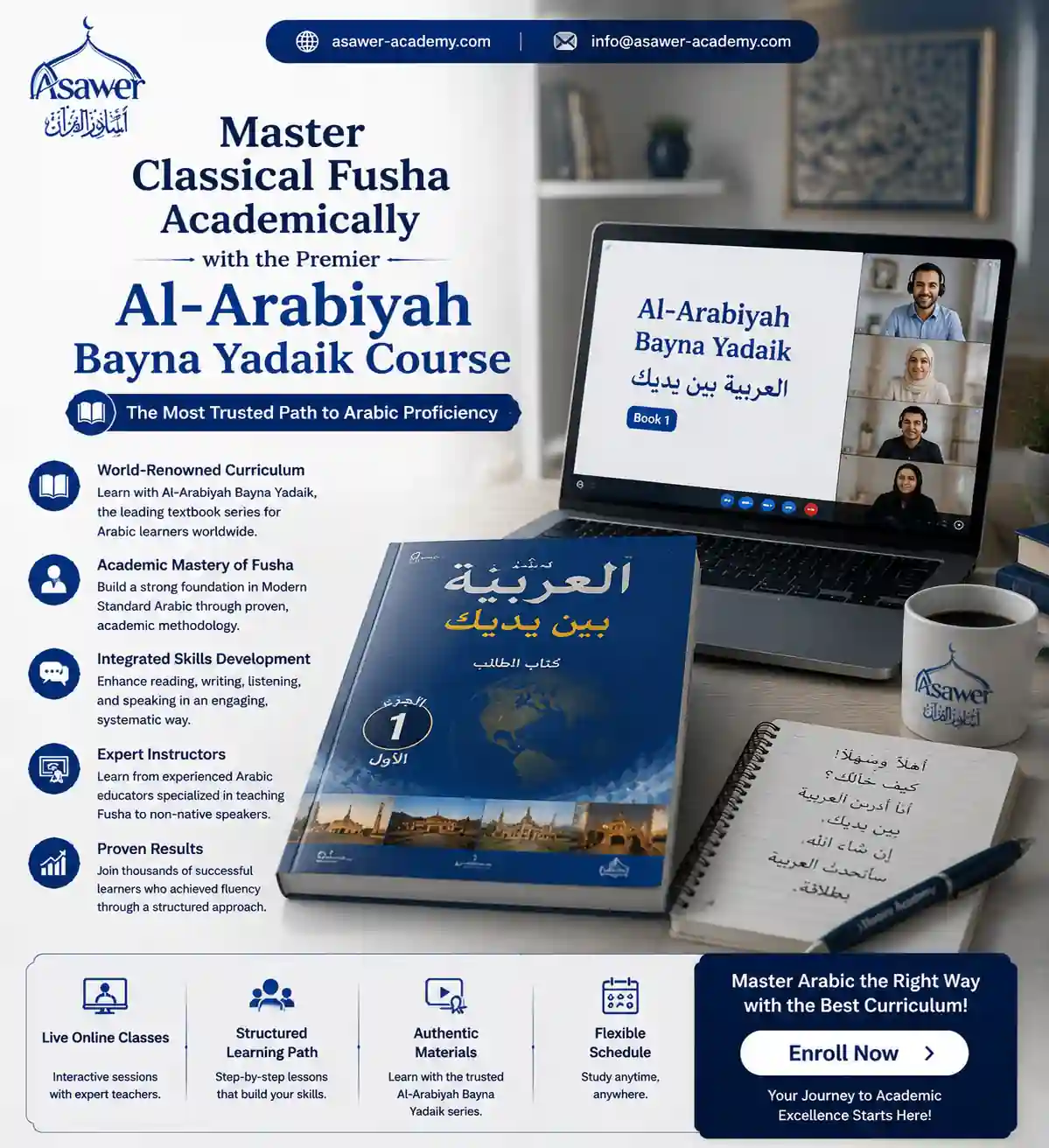
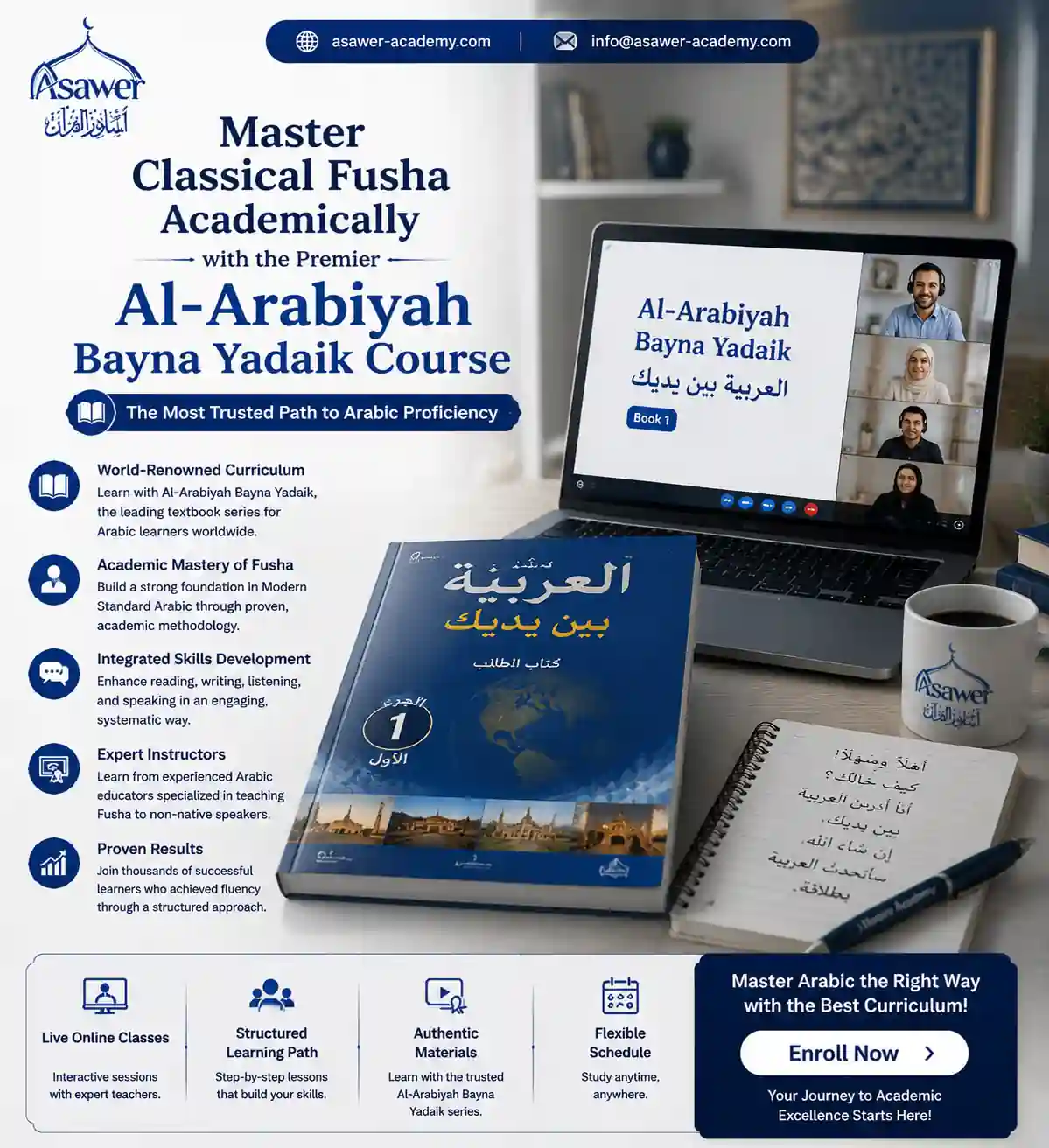
Al-Arabiyah Bayna Yadaik Course Online: Study the Complete Eight-Volume Series with Live Guidance

Study the complete Al-Arabiyah Bayna Yadaik Course through live one-to-one teaching that keeps the official curriculum sequence while making every dialogue, grammar pattern, listening text and writing task usable beyond the exercise page.

The expanded Arabic Between Your Hands series contains four student levels, two volumes per level and 64 units. A placement assessment identifies the exact level, part and unit where you should begin, including learners who already read Quranic script but still need general vocabulary, listening, speaking and writing.

What Is the Al-Arabiyah Bayna Yadaik Course?

Al-Arabiyah Bayna Yadaik—Arabic Between Your Hands—is a published Standard Arabic curriculum for non-native speakers. The expanded sequence contains four student levels, two volumes per level and a total of 64 curriculum units.

The series is designed around three connected outcomes: linguistic competence, communicative competence and cultural competence. That means vocabulary and grammar are not treated as the finish line; they support listening, speaking, reading, writing and meaningful language use.

Asawer keeps the published book sequence visible while using live private teaching to make the material active. The learner is placed into the correct level, part and unit instead of automatically starting from page one.

How Asawer Turns Each Bayna Yadayk Unit into Active Language

The printed page is the starting point, not the destination. A lesson begins with the dialogue, image, audio or situation so the learner understands the communicative purpose before analysing the language.

After comprehension, the teacher changes person, number, tense, place or reason so the learner rebuilds the target structure instead of memorizing one fixed answer.

The final step is transfer. The learner may complete a roleplay, a new listening or reading example, a voice-note response, a summary or a writing task that is not copied word-for-word from the textbook.

Review and placement remain evidence-based. The goal is to enter the correct unit and leave it able to use the language across all four skills—not simply to finish its exercises.

Al-Arabiyah Bayna Yadaik Curriculum: Four Levels, Eight Student Volumes and 64 Units

The expanded series reorganizes Arabic Between Your Hands into four levels, with two student volumes in each level. The type of work changes as the learner advances—from dialogue and controlled production toward intensive reading, summary, research and extended expression.

Level 1 — Beginner | Books 1A & 1B

16 units and 144 core lessons. Dialogues, vocabulary, grammar structures, sounds, listening, speaking, reading and controlled writing build the first communicative foundation.

Level 2 — Intermediate | Books 2A & 2B

16 units and 208 core lessons. Denser dialogues, comprehension texts, grammar notes, listening and speaking, guided expression, handwriting and dictation.

Level 3 — Advanced | Books 3A & 3B

16 units and 112 core lessons. Intensive reading, vocabulary and expressions, language rules, listening, oral and written expression and dictation.

Level 4 — Proficient | Books 4A & 4B

16 units and 112 core lessons. Summary, advanced expression, research writing, extended reading and higher-level language analysis.

Who Benefits Most from the Arabic Between Your Hands Curriculum?

The course suits non-native learners who want a long, structured Fusha pathway with a published sequence and regular practice in all four skills. It can work for absolute beginners, Quran readers who need general-language development, heritage learners and returning students who want to re-enter at a tested level.

The material is extensive, so it fits learners who value continuity and are ready to study one curriculum over multiple books rather than changing resources every few weeks.

If you prefer a flexible formal-Arabic route not tied to one textbook, use Learn Arabic Fusha Online. If you want another published four-skill sequence, compare Al-Takallum. If script decoding is still the main barrier, start with Learn Arabic Reading Online.

How Asawer Academy Teaches Al-Arabiyah Bayna Yadaik

We follow the published sequence but do not reduce the lesson to reading answers from the page. The teacher begins with context and comprehension, then turns the target vocabulary and grammar into changed sentences, roleplay and follow-up questions.

Each unit ends with evidence that the language can transfer: a new dialogue, a related reading or listening task, a voice response, short summary or writing activity. Progress is reviewed across listening, speaking, reading and writing so promotion depends on performance rather than attendance alone.

Why Learners Choose Asawer Academy for Bayna Yadayk

The published series already gives a strong sequence. Asawer adds precise placement, one-to-one interaction, transfer beyond the page and visible performance across the four skills.

Exact Book & Unit Placement

The free assessment checks the learner’s actual four-skill profile so the course can begin at the correct level, part and unit.

Complete Eight-Volume Path

Follow the expanded four-level series from beginner to proficient without changing curriculum every few weeks.

Live One-to-One Interaction

Turn textbook dialogues and exercises into questions, roleplay, description and spontaneous follow-up with immediate correction.

Listening, Speaking, Reading & Writing

Every level must leave evidence in all four skills; grammar and vocabulary support performance rather than replace it.

Structure Transformation

Change person, tense, number, place or reason so a grammar pattern becomes productive language instead of one memorized answer.

Transfer Beyond the Page

Finish units with new texts, roleplays, voice tasks, summaries or writing that the book did not supply word-for-word.

Lesson Feedback & Level Checkpoints

Track unit evidence, recurring errors, part reviews and readiness to move into the next part or level.

Teacher Choice, WhatsApp & Scheduling

Request male or female teachers where available and discuss recurring international times for a long multi-book route.

Al-Arabiyah Bayna Yadaik Course FAQs

Detailed answers about the eight student volumes, four levels, 64 units, four skills, audio, placement, materials, pacing and Asawer’s teaching method.

Al-Arabiyah Bayna Yadaik, also called Arabic Between Your Hands, is a comprehensive Standard Arabic series for non-native speakers. It develops linguistic, communicative and cultural competence through listening, speaking, reading, writing, vocabulary, sounds and grammar.

There is one teacher book for each of the four levels, giving four teacher books alongside the eight student volumes.

The four levels contain 64 units in total: 16 units per level.

The official profile records 3,325 target vocabulary items across the full four-level sequence.

Yes. The series starts from beginner level, and an alphabet foundation can support learners who do not yet read Arabic.

Not automatically. Quran reading can give useful script skills, but general vocabulary, listening, conversation and writing still need assessment before placement.

Yes. Listening, speaking, reading and writing are developed throughout the series, with vocabulary, pronunciation and grammar supporting those skills.

Yes. The series includes dialogues, speaking exercises and oral expression. Asawer extends these with roleplay, follow-up questions and transfer tasks beyond the printed exercise.

The official series includes audio materials. The exact licensed audio access included with the selected course package is confirmed before enrolment.

The teacher uses context, comprehension, structure transformation and transfer beyond the page so the learner performs the language instead of only checking answers.

Progress is reviewed through unit performance, oral and written transfer tasks, part checkpoints and level-promotion evidence rather than page completion alone.

Private lessons can skip proven material and spend less time on skills already strong, but faster pacing should not remove the need to demonstrate mastery.

Bayna Yadayk follows a fixed published multi-book curriculum. A flexible Fusha course can select materials around a specific academic, professional or media goal.

Yes. Recurring times can be discussed for learners in the USA, Canada, UK, Australia and other regions according to teacher availability.

The expanded edition has four student levels, each divided into Part 1 and Part 2, creating eight student volumes.

No. Earlier editions were organized differently. The expanded 2014 edition is structured as four levels with two student parts per level.

The official expanded structure records 576 core lessons across the four levels, plus testing lessons used for placement and achievement.

It teaches Standard Arabic and does not use a regional spoken dialect as the course language.

No. Placement can identify the correct level, part and unit. A returning learner may enter later if earlier skills are genuinely secure.

The series is widely used with adult non-native learners. Older teenagers may also be suitable when the assessment confirms that the textbook format and workload fit them.

Grammar structures are introduced progressively through dialogues, texts and exercises. Asawer adds transformation tasks so the learner uses the structure with changed information.

Yes. Writing grows from controlled work in Level 1 to guided expression, handwriting and dictation in Level 2, then summary, research and advanced writing in Levels 3 and 4.

No unauthorized copies are distributed. The course plan explains whether the learner needs a physical book or licensed digital access.

The teacher checks script, listening, speaking, reading, grammar and writing samples to identify the correct level, part, unit and immediate skill target.

The official full-series plan is extensive, so there is no honest universal completion date. Placement, weekly hours, independent study and private pacing all affect the calendar.

Both are structured four-skill Fusha series for non-native speakers, but they use different unit designs, sequencing and classroom feel. Placement and learning style help determine the better fit.

Yes. A preferred teacher can be requested subject to level, schedule, teaching experience and availability.

Continue to the next part or level when the four skills and core language targets are stable. After the series, learners may move into advanced Fusha, academic Arabic, classical study or a specialist goal.

FREQUENTLY ASKED QUESTIONS

Everything learners ask about Arabic Between Your Hands

Clear answers about the books, levels, units, lessons, vocabulary, duration, dialect, materials and Asawer’s teaching method.

It is a comprehensive Standard Arabic series for non-native speakers. It develops linguistic, communicative and cultural competence through listening, speaking, reading, writing, vocabulary, sounds and grammar.

The expanded edition has four student levels, each divided into two parts, creating eight student volumes. It also has four teacher books, making twelve core books in the full teaching set.

No. The earlier edition was published as three books. The updated 2014 edition was expanded and reorganised into four levels and eight student volumes.

The four student levels contain 64 units and 576 core lessons. The official profile adds 24 testing lessons, for a total of 600 lessons.

The official profile records 3,325 target vocabulary items across the four levels.

The series uses Standard Arabic and does not teach a regional spoken dialect. Learners needing everyday Egyptian conversation should choose a separate dialect course.

Yes. The series begins from zero, and an alphabet booklet can support learners who do not yet read Arabic.

The official publisher describes adults as the main audience. Older teenagers may be accepted when the free assessment confirms that the textbook format and language level are suitable.

No. A placement assessment can identify whether you are ready for Book 2, 3 or 4, although gaps may need targeted repair.

The official curriculum scale is 600 teaching hours. The calendar depends on weekly hours, placement and independent study, so there is no honest universal completion date.
Yes. Dialogue, speaking exercises, oral expression and communicative tasks are present throughout the series, while later books require longer discussion and advanced expression.
Yes. Grammar structures are integrated progressively with dialogue, listening, reading and expression. Books 3 and 4 use more advanced language rules and analysis.
Yes. Book 1 develops controlled writing; Book 2 includes guided expression, handwriting and dictation; Books 3 and 4 expand written expression, summary, research and advanced writing.
The official series includes audio materials. Any licensed audio access included in the selected course package is explained before enrolment.
Students use legally obtained materials. Before enrolment, the course plan explains whether a printed book or licensed digital access is required; copyrighted PDFs are not distributed without permission.
The teacher uses four stages: context, comprehension, structure transformation and transfer beyond the page. The goal is to perform the language, not only finish exercises.
Progress is reviewed through placement, unit performance, oral tasks, written tasks, part checkpoints and level-promotion evidence.
Any available course-completion certificate and its attendance or assessment requirements are confirmed before enrolment.

Start Your Free Trial Now

Fill out the form below and we’ll contact you shortly.

Asawer Academy

Asawer Academy specializes in teaching the Quran, Arabic, and Islamic Studies to non-Arabic speakers through live one-to-one online lessons..

📞

Phone / WhatsApp

+20 102 830 2494
✉️

Email Address

info@asawer-academy.com
🌐

No credit card required. We'll confirm your lesson via email and phone.
