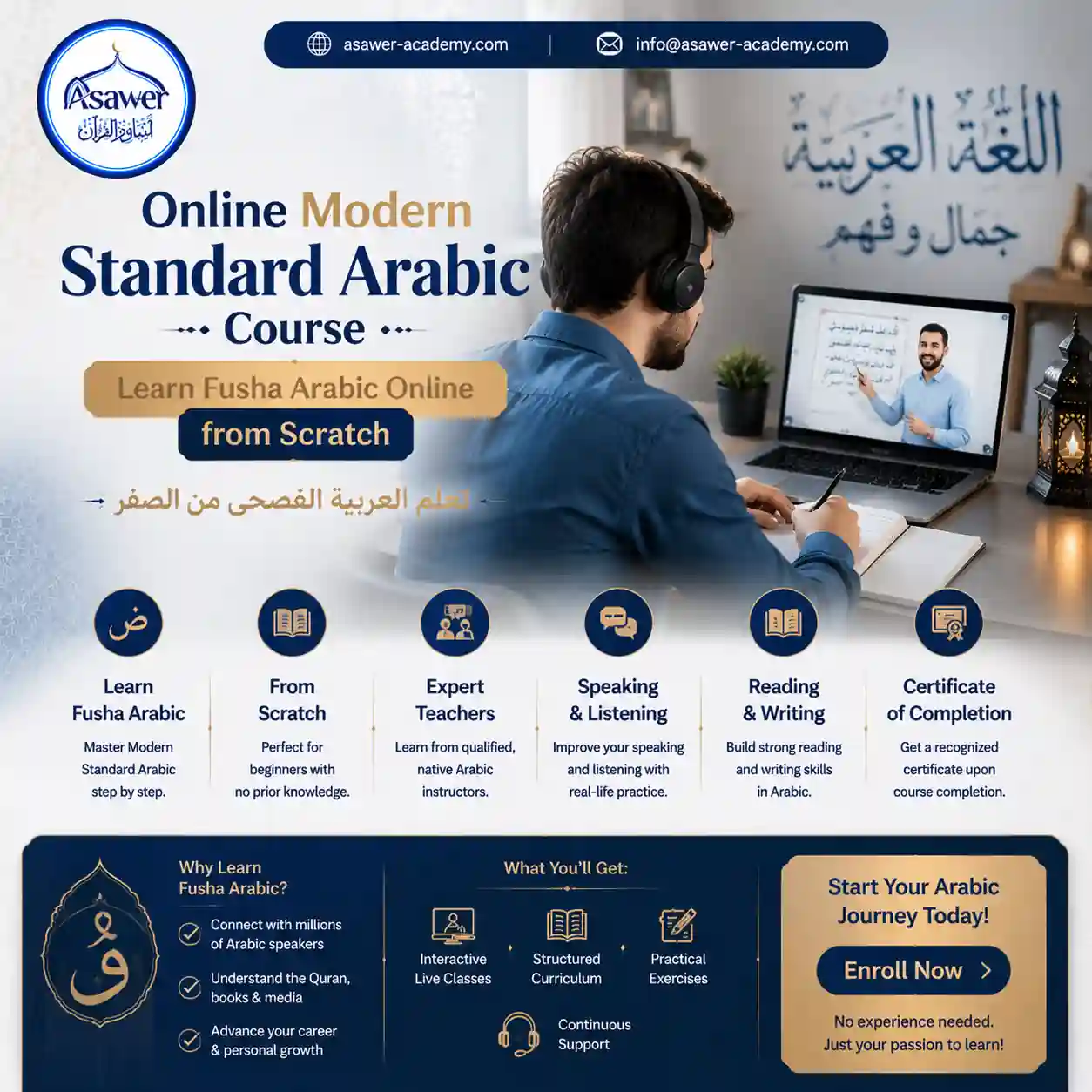
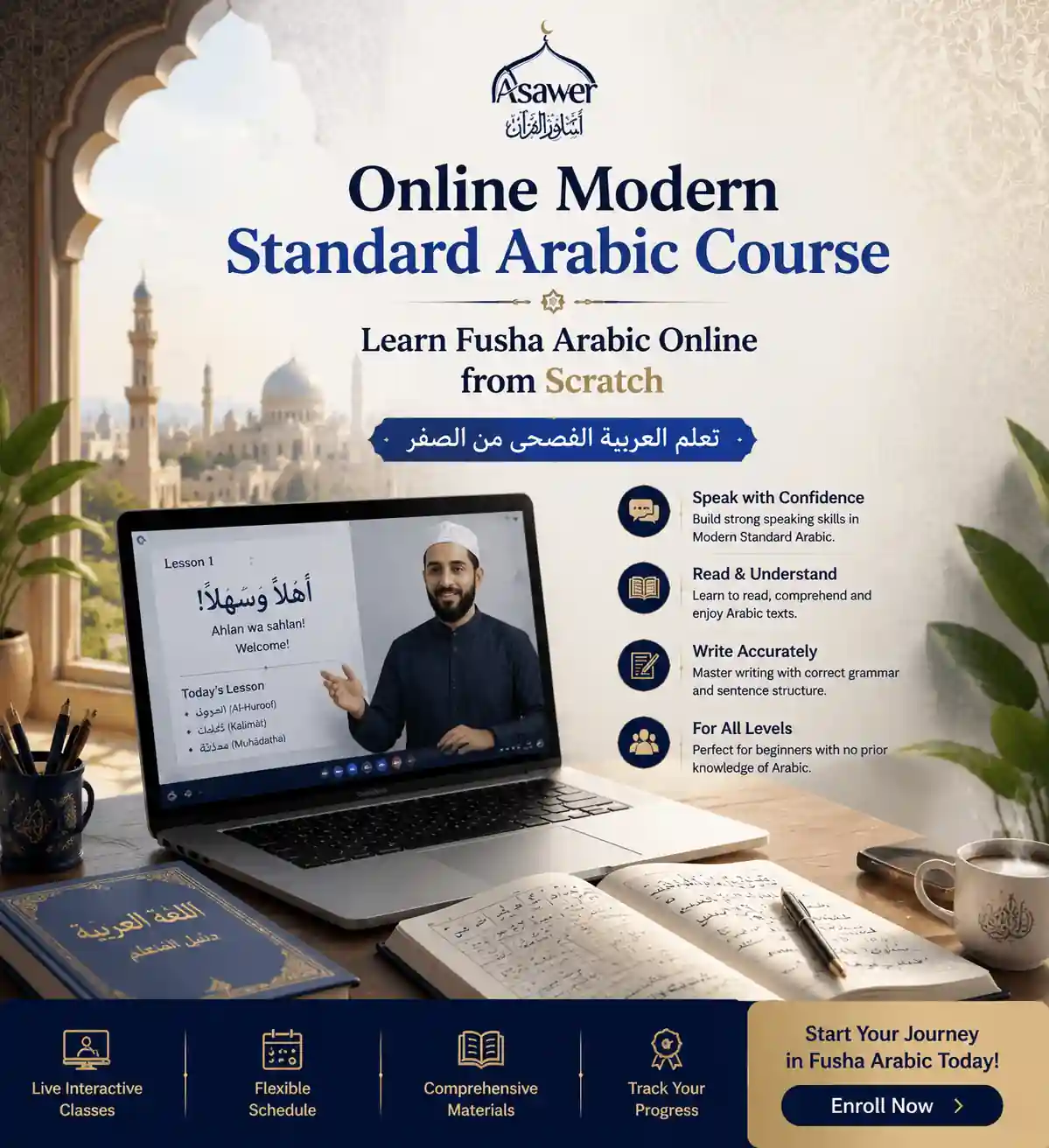
MODERN STANDARD ARABIC FOR MEDIA, STUDY, WORK, READING AND FORMAL COMMUNICATION

Learn Arabic Fusha Online: Choose a Formal-Arabic Route for Your Real Goal

This is Asawer Academy’s broad Modern Standard Arabic pathway for learners who know the result they need but do not want to commit to one published textbook series before assessment. Private lessons build the formal Arabic required for study, professional communication, media, heritage learning, structured conversation or a later bridge into classical texts. The teacher selects tasks and materials around the learner’s purpose, current level and strongest gap. When a published sequence is the best fit, the assessment may recommend the dedicated Al-Takallum or Al-Arabiyyah Bayna Yadayk programme; this page remains the flexible outcome-led Fusha route.
The programme is suitable for absolute beginners, university students, professionals, heritage learners, new Muslims and adults who want more than isolated grammar rules. Your free assessment identifies your current script, listening, vocabulary, sentence-building, reading and writing level before the teacher builds a personal Fusha route.
Asawer Academy video overlay.webp

Open the Fusha World Access Map

اِفْهَمْ • تَحَدَّثْ • اِقْرَأْ • اُكْتُبْ • نَاقِشْ
The course trains formal Arabic as a usable system—not a grammar museum.

Cross-Regional Formal Arabic

Use one shared formal system for books, education, news and communication across Arabic-speaking countries.

Grammar Inside Meaning

Learn sentence patterns after they appear in useful speech, listening, reading and writing.

Media and Text Navigation

Move from controlled material toward headlines, reports, interviews and longer informational texts.

Personal Purpose Route

Academic, professional, heritage or Islamic-study goals shape projects and vocabulary.
Learn Arabic Fusha Online
WHAT FUSHA OPENS

One formal language—many doors into the Arabic-speaking world

Modern Standard Arabic is the formal written and public variety used across education, books, newspapers, official documents, news broadcasting and many professional or cross-regional contexts. It is not the everyday home dialect of every Arab speaker, and a serious course should explain that difference instead of promising that Fusha replaces local conversation.
The value of Fusha is range. A learner can use the same formal base to read across countries, understand structured media, study Arabic materials, write clearly and participate in formal discussions. Dialect and classical Arabic remain connected but separate learning goals.
THE FUSHA WORLD ACCESS SYSTEM

Six language domains that grow together

01

Sound and Script

Letters, vowels, pronunciation contrasts, reading flow and listening discrimination.
02

Sentence Engine

Nominal and verbal sentences, questions, negation, time, agreement and connectors.
03

Interaction

Introduce, ask, explain, respond, clarify, present and discuss in formal Arabic.
04

Reading and Media

Graded texts, articles, reports, headlines, interviews and informational reading.
05

Writing and Presentation

Forms, paragraphs, summaries, emails, reports, arguments and presentation language.
06

Culture and Register

Know when Fusha fits, how formal tone changes and where dialect or classical Arabic begins.
THE FUSHA LEVEL MAP

Six CEFR-informed stages and thirty practical missions

The level labels guide the learning route and describe classroom progression; they are not presented as an external accredited qualification.
A0

Launch

Script, pronunciation, classroom language, identity, numbers and first sentence patterns.
A1

Daily Formal Arabic

Family, routine, food, places, study and short controlled interaction.
A2

Independent Communication

Past and future, services, travel, health, plans, messages and short reports.
B1

Connected Expression

Narration, opinion, comparison, work, education, culture and paragraph writing.
B2

Media and Academic Arabic

News, interviews, articles, presentations, argument and professional writing.
C1

Precision and Public Voice

Nuanced discussion, synthesis, formal presentation, advanced reading and specialist projects.
THE 30-MISSION CURRICULUM

A complete route from first contact to advanced formal communication

Open each level to see the situations, grammar, texts, writing tasks and evidence of progress.
Mission 1: Arabic Sounds and Script
Letter recognition, short and long vowels, connected forms and high-impact pronunciation differences.

Mission 2: Classroom and Learning Language
Understand instructions, ask for repetition, confirm meaning and use basic study vocabulary.

Mission 3: Identity and Introductions
Name, country, language, profession or study, personal pronouns and simple nominal sentences.

Mission 4: Numbers, Time and Essential Information
Phone numbers, dates, clock time, prices and basic factual exchange.

Mission 5: First Reading and Writing
Short fully vowelled sentences, labels, forms and a controlled personal introduction.

Milestone: read and produce a short introduction and manage essential classroom interaction.
Mission 6: Family and Description
Possession, adjectives, demonstratives, gender and describing people or objects.

Mission 7: Daily Routine and Present Time
Frequent verbs, simple present meaning, time expressions and sentence sequence.

Mission 8: Food, Shopping and Requests
Quantities, preference, polite requests, prices and simple comparisons.

Mission 9: Places, Directions and Transport
Location, movement, prepositions, questions and city vocabulary.

Mission 10: Study and Communication
Simple email or message, short dialogue, reading a notice and giving basic information.

Milestone: manage familiar formal exchanges and write a short connected paragraph.
Mission 11: Past Events and Future Plans
Common past forms, future expression, sequence and time reference.

Mission 12: Travel, Housing and Services
Bookings, forms, complaints, maintenance and practical requests.

Mission 13: Health and Advice
Symptoms, obligation, ability, permission and simple advice.

Mission 14: Invitations, Appointments and Social Plans
Arrange, accept, decline, postpone and explain a reason politely.

Mission 15: Short Reports and Summaries
Read a short informational text, identify key points and write a brief summary.

Milestone: handle a practical formal conversation and produce a useful multi-sentence message or report.
Mission 16: Narrative and Biography
Tell connected events, describe background and use time connectors.

Mission 17: Opinion, Reason and Comparison
Agree, disagree, justify, compare and qualify a statement.

Mission 18: Work and Education
Responsibilities, goals, experience, study systems and professional interaction.

Mission 19: Culture and Society
Discuss customs, cities, family change and social topics with respectful language.

Mission 20: Paragraph and Presentation Structure
Topic sentence, support, example, conclusion and short oral presentation.

Milestone: sustain a connected discussion and write an organised paragraph or short presentation script.
Mission 21: Headlines and News Structure
Identify topic, source, reported event and high-frequency media vocabulary.

Mission 22: Interviews and Lectures
Follow main points, speaker attitude, examples and transitions in structured audio.

Mission 23: Article Analysis
Separate claim, evidence, explanation and conclusion in a formal text.

Mission 24: Professional Writing
Formal email, memo, short report, application or proposal according to learner goals.

Mission 25: Argument and Discussion
Present a position, respond to another view and use formal linking expressions.

Milestone: follow selected authentic media and produce a structured formal response.
Mission 26: Complex Reading and Synthesis
Compare sources, identify nuance and combine information into one clear account.

Mission 27: Formal Presentation and Q&A
Structure a longer presentation, signal sections and answer follow-up questions.

Mission 28: Advanced Writing and Revision
Develop argument, cohesion, tone, editing and audience awareness.

Mission 29: Register and Style
Choose neutral, academic, journalistic or professional formal Arabic according to purpose.

Mission 30: Specialist Project
Academic, professional, media, heritage or Islamic-studies project with teacher feedback.

Milestone: communicate formally with precision, structure and flexible vocabulary across a specialist context.
THE ARABIC REGISTER SWITCHBOARD

Fusha is central—but it is not every form of Arabic

Clear boundaries prevent the learner from expecting one course to solve unrelated communication goals.

Modern Standard Arabic

The core course: contemporary formal Arabic for media, education, books, official communication and structured public speaking.

Classical Arabic

Older literary and scholarly language with vocabulary and structures that need dedicated heritage-text study.

Quranic Arabic

A specialised classical register connected to Quran vocabulary, rhetoric and recitation; not identical to a modern Fusha course.

Spoken Dialects

Regional everyday conversation used at home and in ordinary social life; best learned in a separate dialect track.
THE FUSHA SENTENCE ENGINE

Grammar becomes useful when the learner can rebuild the sentence

The course teaches grammar as a decision system. The learner identifies what the sentence is doing, notices the pattern, changes one element and uses the result in speech, reading or writing.
Online Modern Standard Arabic Course Learn Fusha Arabic Onlineh
THE FUSHA MEDIA LADDER

Authentic Arabic should arrive with support—not as a shock test

Listening and reading progress from controlled input toward selected real material.
01

Teacher-Designed Audio

Clear speech, controlled vocabulary and one defined listening purpose.
02

Graded Formal Content

Short dialogues, presentations and learner-level informational texts.
03

Supported Authentic Media

Selected clips with preview, transcript, repetition and focused questions.
04

Independent Navigation

Headlines, reports, lectures and articles chosen according to level and goal.
Online Modern Standard Arabic Course
THE FORMAL WRITING DESK

Writing develops from useful information to organised argument

Learners often write difficult sentences before they can organise a simple message. The course builds writing through purpose, models, revision and recurring correction.
FOUR PURPOSE ROUTES

The same Fusha system can serve very different lives

The core level remains coherent while texts, projects and specialist vocabulary adapt.
01

Academic and University

Reading, lectures, notes, summaries, presentations and research-related language.
02

Professional and Diplomatic

Formal interaction, email, meetings, reports, public communication and sector vocabulary.
03

Heritage and Identity

Repair reading, grammar and formal-expression gaps when family dialect is stronger.
04

Islamic and Classical Bridge

Build modern formal Arabic while adding a separate vocabulary and text plan for religious study.
PROGRESS ACROSS FOUR EVIDENCE AREAS

Level promotion requires performance—not only lesson attendance

O

Oral Control

Accuracy, response organisation, pronunciation and ability to maintain formal interaction.
L

Listening Coverage

Main idea, details, speaker purpose and ability to follow longer structured audio.
R

Reading Depth

Fluency, vocabulary inference, argument structure and use of evidence from text.
W

Written Precision

Organisation, grammar, spelling, cohesion, tone and successful revision.
FUSHA IS A POWERFUL FORMAL LANGUAGE—NOT A PROMISE TO REPLACE EVERY DIALECT

Clear goals make the course more useful and more trustworthy

What Fusha Is Strong For

What Needs Another Track

PRIVATE FUSHA LEARNING ACROSS TIME ZONES

Scheduling for the USA, Canada and Australia

US

United States

Discuss university, professional or family schedules across US zones and a sustainable weekly workload.
CA

Canada

Confirm local-time teacher availability, language support and continuity across the selected Fusha route.
AU

Australia

Check AEST, ACST or AWST compatibility and a recurring time suitable for active speaking and writing.
FREQUENTLY ASKED QUESTIONS

Everything learners ask before a Fusha Arabic course online

Clear answers about MSA, dialect, grammar, media, children, heritage learners, duration and assessment.
Fusha is the formal standard variety of Arabic. In a modern course, it usually means Modern Standard Arabic used in education, books, media, official writing and structured public communication.
In most course searches, Fusha refers to Modern Standard Arabic. Classical and Quranic Arabic are closely related but have specialised vocabulary, style and study goals.
It is used in formal speech, education, news, presentations and cross-regional settings. Most people use local dialects in ordinary home and street conversation.
Choose Fusha first when reading, formal writing, education, media or cross-regional Arabic is the main goal. Choose a dialect first when immediate family or local daily conversation is the priority.
Yes. The A0 route begins with script, sounds, essential classroom language, introductions, numbers and first sentence patterns.
Yes. Speaking, listening, reading and writing are developed together, with grammar and vocabulary supporting the tasks.
Yes. Grammar is taught through useful sentence patterns and reading or writing needs. More detailed analysis can be added for academic goals.
Yes, progressively. Beginner levels use controlled material, while B2 and C1 introduce selected headlines, reports, interviews and lectures.

There is no responsible fixed answer before assessment. Starting level, lesson frequency, independent practice and the required proficiency all affect the timeline.

Children and teenagers can join when the free assessment confirms that the course format suits their age, current level and goals. Lesson length, teacher matching and materials are then adjusted to the learner.

Yes. Heritage learners can strengthen formal grammar, reading and writing when family dialect comprehension is stronger than Fusha.

Yes. Fusha can build general Arabic foundations, while Quranic vocabulary, Tajweed and classical text study remain separate linked tracks.

A preferred teacher can be requested. The final match depends on level, schedule, teaching experience and availability.

The course uses a personalized selection of books and digital materials based on your level, age, and learning goals. Materials may include teacher-prepared lessons, vocabulary and grammar worksheets, graded reading texts, dialogues, audio recordings, transcripts, speaking activities, writing assignments, review exercises, and selected authentic content such as articles, headlines, interviews, and presentations.

When a published Arabic textbook is suitable for your learning path, your teacher will recommend or use the appropriate book. The exact books and materials are confirmed after your placement assessment.

Progress is reviewed through oral control, listening coverage, reading depth and written precision on unfamiliar tasks, with the next learning target recorded after each stage.

Any available course-completion certificate and its attendance or assessment requirements are confirmed before enrolment. The course does not present its CEFR-informed labels as an external accredited qualification.

Asawer Academy

Asawer Academy specializes in teaching the Quran, Arabic, and Islamic Studies to non-Arabic speakers through live one-to-one online lessons.

📞

Phone / WhatsApp

+20 102 830 2494
✉️

Email Address

[email protected]
🌐

No credit card required. We'll confirm your lesson via email and phone.
