A PUBLISHED MODERN STANDARD ARABIC SERIES, ADAPTED TO PRIVATE LIVE LEARNING

Learn Arabic with Al-Takallum: Follow the Published Four-Level Series with Live Expansion

The Al-Takallum course follows a defined published Modern Standard Arabic sequence from Starter through Intermediate. Each unit begins with its own theme, vocabulary, dialogue or presentation and grammar progression, so the learner always knows which book, section and outcome is being studied. Asawer Academy does more than explain the printed exercises. The teacher adds live role-play, pronunciation work, extra listening, teacher-made slides, review tasks and speaking or writing transfer activities while preserving the order of the official series. This course is for learners who want the accountability and continuity of Al-Takallum itself—not a flexible Fusha programme assembled from unrelated resources.
Asawer Academy turns the published curriculum into private live lessons. The placement assessment identifies whether you need the Starter foundation, Elementary communication, Pre-Intermediate independence or Intermediate media and discussion work—then the teacher adapts pacing, correction and practice without removing the sequence that makes the series coherent.
Asawer Academy video overlay.webp

Open the Al-Takallum Language Studio

اسْمَعْ • تَكَلَّمْ • اِقْرَأْ • اُكْتُبْ
Every skill supports the next, while the teacher keeps one clear communicative target for each lesson.

Speaking

Reuse vocabulary and structures in questions, roleplays, presentations and guided discussion.

Listening

Understand dialogues, narratives and progressively more authentic audio through context and repeated listening.

Reading

Move from controlled texts to cultural, media and heritage-related material with comprehension strategies.

Writing

Develop functional forms, connected paragraphs, spelling and increasingly independent written expression.
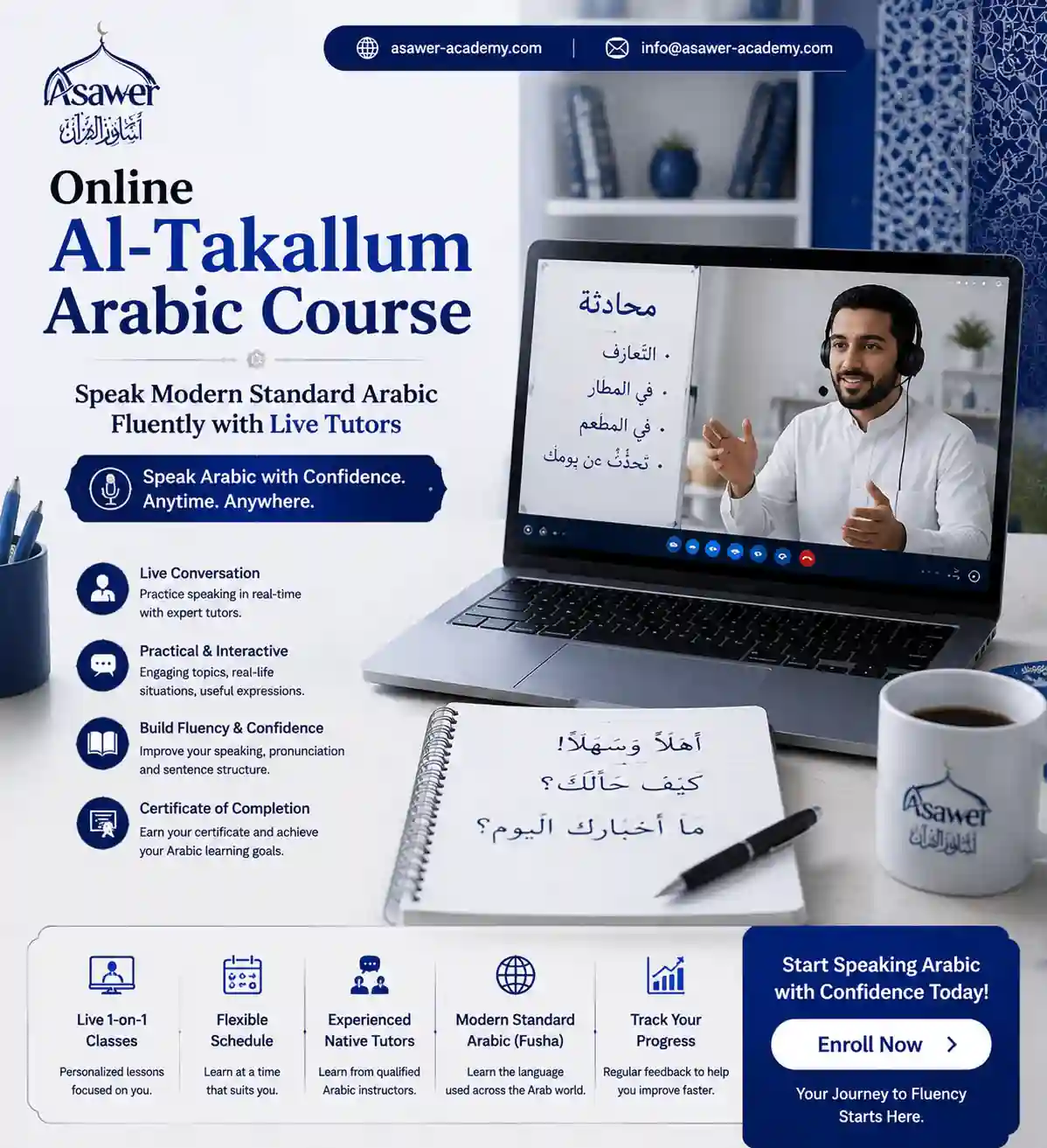
Online Al Takallum Arabic Course Speak Modern Standard Arabic Fluently with Live Tutors
WHY ARABIC LEARNERS OFTEN STALL

Knowing a grammar rule does not automatically create a sentence you can understand, say, read or write

Some learners can analyse a sentence but hesitate when asked a simple question. Others memorize dialogues but cannot change the person, time or reason. A student may read slowly with full vowel marks yet lose meaning, or write isolated correct sentences that do not form a connected paragraph.
Al-Takallum is strongest when the teacher preserves the connection between input and use. Vocabulary appears inside a meaningful situation; grammar explains a pattern the learner has already met; listening and reading deepen the same theme; speaking and writing require the learner to reconstruct the language independently.
THE AL-TAKALLUM UNIT ENGINE

Six connected stations inside one communicative theme

The private teacher can change the time spent at each station while preserving the skill sequence.
01

Vocabulary Scene

Images, high-frequency words and a clear situation activate the unit before detailed explanation.
02

Dialogue or Presentation

The new language appears in a natural conversation, short presentation or contextual text.
03

Grammar from Use

Frequent structures and recurring learner errors are analysed after the pattern has meaning.
04

Listening, Sounds and Speaking

The learner discriminates sounds, understands the message and uses the expressions orally.
05

Reading and Wasl

Guided comprehension and connected reading develop speed, phrasing and pronunciation.
06

Writing and Transfer

Functional or creative writing shows whether the learner can organise the unit language independently.
THE OFFICIAL CORE SERIES MAP

Four published stages from first Arabic contact to intermediate independent use

A1

Starter

Four sections: language preparation, sound and script, essential structures and short introductions.
A2

Elementary

Eight units for daily communication, including family, study, food, time, routine and weather.
B1

Pre-Intermediate

Eight units that expand independence through travel, housing, health, work, visits, sport and memory.
B2

Intermediate

Eight units for description, culture, humour, nature, proverbs, history, education and media-rich discussion.
FULL LEVEL CURRICULUM

The actual themes, skill growth and writing outcomes

Open each stage to see the official core structure and the milestone the learner should demonstrate.

Section 1: Language Preparation
A visual and listening introduction to high-frequency people, objects, actions and classroom language before the learner is expected to decode everything.

Section 2: Arabic Sound and Script
Letters in their positions, short and long vowels, Shaddah, Tanween, sun and moon letters, similar sounds and progressive handwriting practice.

Section 3: Essential Structures and Vocabulary
Demonstratives, basic questions with هل، من، ما and أين, simple answers, conjunctions, prepositions, adjectives, days, months, seasons and numbers.

Section 4: Introductions
Greetings, welcome and farewell, asking about wellbeing, name and country.

Level evidence: read and write controlled beginner material, understand essential classroom language and complete a short personal introduction.

Unit themes:
1. Introductions
2. Family
3. Study
4. Food
5. Times and Prices
6. Holidays
7. Daily Life
8. Weather and Clothes

Each unit connects vocabulary, dialogue or presentation, commonly used grammar, listening, sound discrimination, conversation, reading, connected reading and writing.

Writing development: personal data, phone numbers, guided paragraphs, spelling and Naskh handwriting models.

Level evidence: manage familiar exchanges, understand controlled audio and texts, and write connected beginner paragraphs with guidance.

Unit themes:
1. Travelling through Cairo
2. Housing
3. Health
4. Shopping
5. Work
6. Places to Visit
7. Sport
8. Memories

Vocabulary and grammar expand, dialogues become richer, and the four skills require greater independence.

Functional writing: arrival cards, hotel forms, short advertisements, instructions, lists, CV sections and travel reports.

Writing system: regular spelling work and introduction to Ruq‘ah handwriting alongside continued Naskh control.

Level evidence: explain experiences, handle practical formal situations, participate in a guided discussion and produce useful documents and multi-paragraph writing.

Unit themes:
1. Describing People
2. Religious Festivals and Occasions
3. Very Funny
4. Nature
5. Different Cultures
6. Proverbs, Expressions and Wisdom
7. Historical Figures
8. Education

The level expands morphology, syntax, free oral expression, artistic appreciation, cultural discussion and authentic media listening.

Reading and writing: analyse ideas, discuss style, use evidence, organise extended paragraphs and compare Naskh with Ruq‘ah.

Level evidence: follow the main message of selected authentic media, sustain structured discussion and write organised texts on cultural and social topics.

CHOOSE THE ARABIC YOU ACTUALLY NEED

Modern Standard Arabic, dialect and classical Arabic solve different communication problems

Modern Standard Arabic — The Course Core

Al-Takallum teaches contemporary Fusha used in formal education, media, public communication and modern writing. It builds a shared formal Arabic base rather than a regional home dialect.

Spoken Dialects — A Separate Goal

Egyptian, Levantine and other dialects are essential for local everyday conversation, but their grammar and vocabulary should not be mixed randomly into the Al-Takallum sequence.

Classical and Quranic Arabic — A Related Path

The course strengthens reading and grammar foundations that can support classical study, but specialised Quranic, Hadith or heritage-text work needs its own vocabulary and textual training.
THE PRIVATE FOUR-SKILL LESSON

The book supplies the curriculum; the teacher turns it into active language

A private Al-Takallum lesson should not become a teacher reading the page aloud. The learner needs enough input to understand the new pattern, then increasing responsibility for producing it.
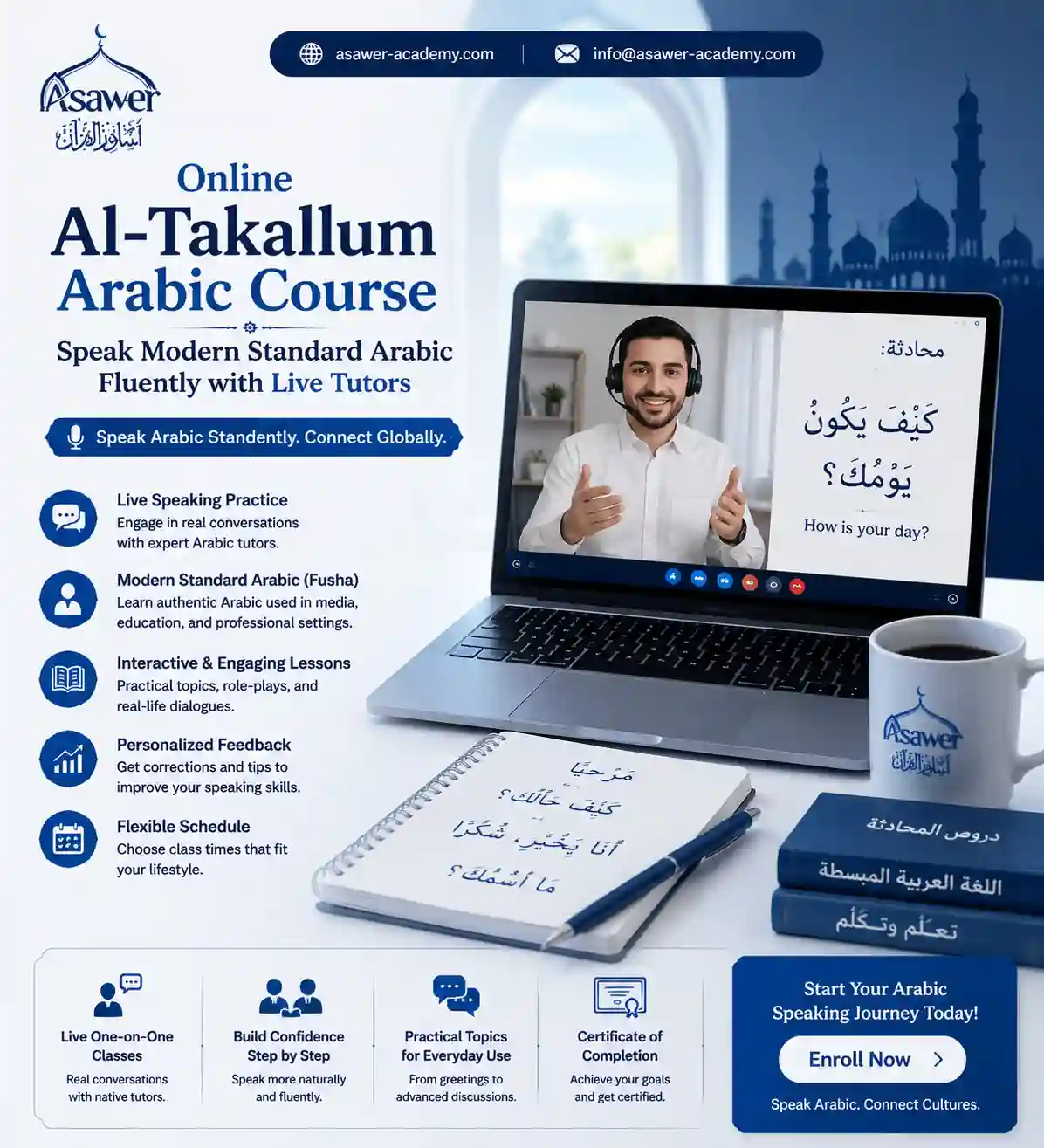
Online Al Takallum Arabic Course Speak Modern Standard Arabic Fluently
FOUR LEARNER ROUTES

The same published series can solve different formal-Arabic gaps

The assessment changes pacing and supplementary tasks without replacing the core sequence with random topics.
01

Adult Beginner

Build script, pronunciation and practical Fusha without embarrassment or unconnected grammar memorisation.
02

University or School Student

Follow a published sequence, strengthen all four skills and prepare for academic Arabic tasks.
03

Revert or Islamic Studies Learner

Develop modern Arabic communication and reading while keeping classical or Quranic goals in a separate linked plan.
04

Heritage Learner

Repair formal grammar, reading and writing gaps when spoken family Arabic is stronger than academic Fusha.
PROGRESS ACROSS FOUR SKILLS

Moving up a level requires evidence—not only attendance or page completion

S

Spoken Control

Use the level grammar and vocabulary in questions, description, roleplay and discussion.
L

Listening Coverage

Understand the main message, important details and unfamiliar words supported by context.
R

Reading Independence

Read with suitable phrasing, identify the main idea and use text evidence in answers.
W

Written Organisation

Spell accurately, connect sentences and complete the functional or creative task for the level.
HONEST PACING BUILDS MORE TRUST THAN A FLUENCY COUNTDOWN

Use the series as a pathway—not a fast-results slogan

A Published Curriculum Has Real Depth

Books, Audio and Copyright

Online Al Takallum Arabic Course
THE WRITING LADDER

Arabic writing grows from useful forms to organised expression

The series deliberately delays demanding writing until the learner has vocabulary, patterns and reading models to support it. The writing strand then expands across the four levels.
STRUCTURED ARABIC ACROSS GLOBAL TIME ZONES

Private Al-Takallum lessons for the USA, Canada and Australia

Flexible scheduling should preserve a stable learning rhythm and teacher continuity.
US

United States

Discuss recurring times across US zones, lesson frequency and a weekly review plan that fits work or university.
CA

Canada

Confirm local-time availability, teacher language, travel pauses and continuity across a long published curriculum.
AU

Australia

Check AEST, ACST or AWST compatibility and a time suitable for active speaking, listening and writing.
FREQUENTLY ASKED QUESTIONS

Everything learners ask before studying Arabic with Al-Takallum

Clear answers about levels, units, duration, books, dialect, grammar, audio, children, media and certification.

It is a structured Modern Standard Arabic curriculum for non-native speakers. The core published set develops speaking, listening, reading and writing from Starter through Intermediate levels.

The series focuses on contemporary Modern Standard Arabic. Egyptian or other spoken dialects should be studied as a separate track when everyday local conversation is the main goal.

The core course route covers Starter A1, Elementary A2, Pre-Intermediate B1 and Intermediate B2. Any Upper-Intermediate continuation is confirmed separately before enrolment.

Starter is arranged in four sections. Elementary, Pre-Intermediate and Intermediate contain eight units each.

Yes. The Starter stage introduces high-frequency words, Arabic sounds and script, essential structures, numbers and short introductions.

Yes. The Starter stage includes letter forms, short and long vowels, Shaddah, Tanween, sun and moon letters, similar sounds and progressive writing.

Al-Takallum is most suitable for older children, teenagers and adults who are ready to follow a structured four-skill textbook. Asawer accepts younger learners from age four, but they are usually placed in a more child-focused Arabic programme after the free assessment.

The official series FAQ recommends an experienced teacher. Audio and books help, but a teacher is needed to correct pronunciation, guide tasks and adapt the sequence.

There is no universal completion date for the full series. Duration depends on the learner’s placement, weekly lesson frequency, independent practice, attendance and demonstrated progress. Private teaching can adjust pacing and skip securely mastered material, but Asawer does not promise instant fluency, a native accent or completion by a fixed date.

Yes, through introductions, questions, dialogues and controlled speaking tasks. The range and independence of speaking grow progressively across levels.

Yes. Grammar is selected for frequency and practical use, with attention to common learner errors. Morphology becomes more prominent at the intermediate stages.

Listening practice is included in the learning plan. The teacher may use licensed publisher audio, teacher-recorded examples or live modelling according to the material available for the learner’s level. Copyrighted files are not distributed without permission.

Yes. Starter develops letter writing; Elementary works with spelling and Naskh; Pre-Intermediate adds regular spelling and Ruq‘ah; Intermediate compares and develops both scripts.

The Intermediate level includes authentic material from news, television and film. Media comprehension develops gradually and should not be promised to beginners immediately.

Students use a legally obtained copy of the relevant Al-Takallum student book and workbook. Asawer provides teacher-created lesson notes, review tasks and supplementary worksheets. Publisher audio or digital access is included only when licensed access is specifically confirmed before enrolment.

Any available course-completion certificate and its attendance or assessment requirements are confirmed before enrolment. Finishing pages alone does not determine proficiency.

Asawer Academy

Asawer Academy specializes in teaching the Quran, Arabic, and Islamic Studies to non-Arabic speakers through live one-to-one online lessons.

📞

Phone / WhatsApp

+20 102 830 2494
✉️

Email Address

[email protected]
🌐

No credit card required. We'll confirm your lesson via email and phone.
