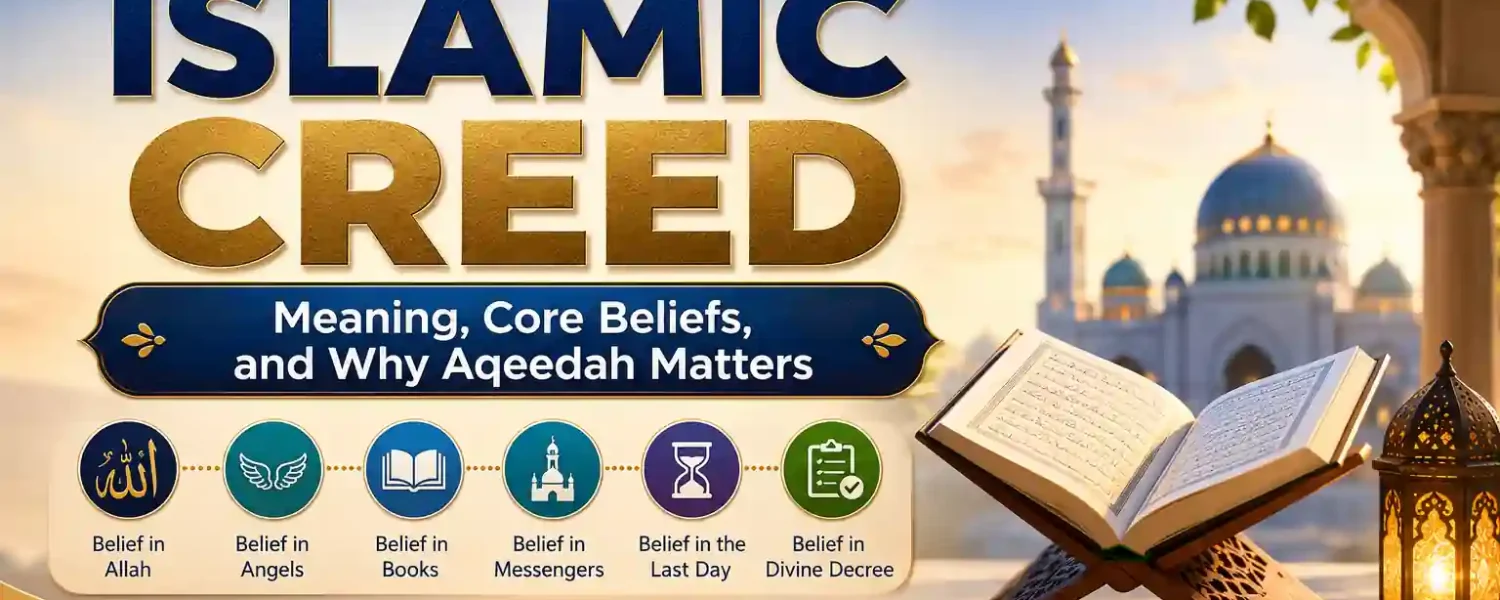
Islamic Creed is the foundation of a Muslim’s faith. It explains what Muslims believe about Allah, revelation, prophets, angels, the Last Day, and divine decree. In Arabic, Islamic Creed is often called Aqeedah, which refers to a belief that is firmly held in the heart. Aqeedah is not only a subject to study. It shapes how a Muslim understands life, worship, character, choices, and responsibility before Allah.
Quick answer: Islamic Creed means the core beliefs that every Muslim holds with certainty. These beliefs include faith in Allah, His angels, His books, His messengers, the Last Day, and divine decree. Together, they form the six pillars of Iman.
What Is Islamic Creed?
Islamic Creed means the essential beliefs that form the foundation of Islam. These beliefs answer the most important questions in life: Who created us? Why are we here? What happens after death? How should we live? What is our relationship with Allah?
Islamic Creed is not separate from daily life. A person’s belief affects how they worship, speak, behave, treat others, and make decisions. When belief is strong and clear, actions become more meaningful.
Islamic Creed = the foundation of Muslim belief
For children and beginners, Islamic Creed should be taught in a simple and warm way. It should not feel like a list of difficult terms. It should help the learner know Allah, trust Him, love Him, and understand the purpose of worship.
Teacher observation: Children understand Islamic Creed better when abstract ideas are connected to everyday examples. Instead of only saying “Allah is the Creator,” ask them to look at the sky, their body, food, family, and nature, then guide them to think about Allah’s creation and care.
What Does Aqeedah Mean?
The Arabic word Aqeedah is connected to the idea of something firmly tied or strongly held. In Islamic learning, Aqeedah refers to beliefs that are settled in the heart with certainty.
This means Aqeedah is not a passing thought or a weak opinion. It is a firm belief that guides the heart and the mind.
Aqeedah is belief held firmly in the heart.
For example, when a Muslim believes that Allah sees and knows everything, this belief affects behavior. The person becomes more careful with speech, more honest in private, and more aware that every action matters.
Why Islamic Creed Matters
For learners who want Aqeedah connected with worship, Seerah, Hadith, manners, and everyday Muslim life, Asawer’s Islamic Studies course hub brings the available structured learning routes together.
Islamic Creed matters because it gives direction to worship and meaning to life. Without correct belief, religious actions can become habits without deep understanding. With correct belief, prayer, fasting, charity, Quran learning, and good manners become connected to a clear purpose.
Aqeedah helps a Muslim understand that life is not random. Allah created us with purpose, sent guidance through His messengers, and will hold people accountable on the Last Day.
Islamic Creed also helps protect the heart from confusion. Children and adults hear many ideas from school, media, friends, and online platforms. A clear foundation helps them understand their identity and respond to questions with confidence and calmness.
The Six Pillars of Iman
The core beliefs of Islam are often explained through the six pillars of Iman. These are the beliefs every Muslim must accept.
| Pillar of Iman | Meaning | Child-Friendly Explanation |
|---|---|---|
| Belief in Allah | Believing that Allah is the only true God, Creator, Provider, and Sustainer. | Allah made us, cares for us, and deserves our worship. |
| Belief in Angels | Believing that Allah created angels who obey Him and carry out His commands. | Angels are unseen servants of Allah. |
| Belief in the Books | Believing in the books Allah revealed to His messengers. | Allah sent guidance to people. |
| Belief in the Messengers | Believing that Allah sent prophets and messengers to guide humanity. | The prophets taught people how to worship Allah and live rightly. |
| Belief in the Last Day | Believing that people will be resurrected and judged by Allah. | Our choices matter, and Allah is just. |
| Belief in Divine Decree | Believing that Allah knows, wills, and decrees all things with perfect wisdom. | Allah knows everything, and we trust His wisdom. |
These six pillars help Muslims understand the unseen world, the purpose of life, and the path to Allah. They are the heart of Islamic Creed.
Islamic Creed vs the Five Pillars of Islam
Many students confuse the six pillars of Iman with the five pillars of Islam. Both are essential, but they are not the same.
The six pillars of Iman are about what a Muslim believes in the heart. The five pillars of Islam are the main acts of worship a Muslim performs.
| Point | Iman | Islam |
|---|---|---|
| Main Focus | Inner belief and certainty | Outward actions and worship |
| Known Through | Six pillars of Iman | Five pillars of Islam |
| Examples | Belief in Allah, angels, books, messengers, Last Day, and Qadr | Shahada, prayer, zakat, fasting, and Hajj |
| Simple Image | The roots of the tree | The visible branches and fruits |
A strong tree needs healthy roots and visible fruit. In the same way, a Muslim needs correct belief and sincere action. Belief gives worship meaning, and worship strengthens belief.
Tawheed: The Foundation of Islamic Creed
The foundation of Islamic Creed is Tawheed, which means the oneness of Allah. Tawheed means believing that Allah alone is the Creator, Allah alone deserves worship, and Allah alone has perfect names and attributes.
Tawheed = believing in the oneness of Allah
Tawheed is not only a word Muslims say. It changes how a person lives. A Muslim who understands Tawheed knows that worship is for Allah alone, reliance is upon Allah, and ultimate success comes from pleasing Allah.
For children, Tawheed can be explained through simple questions:
- Who created everything?
- Who gives us food, water, and life?
- Who deserves our prayer and worship?
- Who hears us when we make dua?
These questions help children connect belief to real life.
The Three Categories of Tawheed
Many Islamic teachers explain Tawheed through three important categories. These categories help students understand different aspects of belief in Allah.
| Category | Meaning | Simple Example for Children |
|---|---|---|
| Tawheed al-Rububiyyah | Believing that Allah alone is the Lord, Creator, Provider, and Controller of everything. | Allah created the sky, earth, people, animals, and everything we have. |
| Tawheed al-Uluhiyyah | Believing that Allah alone deserves worship. | We pray, make dua, and worship Allah alone. |
| Tawheed al-Asma was-Sifat | Believing in Allah’s names and attributes in a way that suits His majesty. | Allah is The Most Merciful, The All-Knowing, and The All-Hearing. |
This structure helps children and adults understand that belief in Allah includes knowledge, worship, love, trust, and obedience.
How Aqeedah Shapes Character and Daily Life
Islamic Creed is not meant to stay only in books. It should appear in behavior. When a Muslim believes that Allah sees everything, honesty becomes important even when no one is watching. When a Muslim believes in the Last Day, choices become more responsible. When a Muslim believes in Allah’s mercy, the heart finds hope after mistakes.
Aqeedah shapes daily life in many ways:
- It teaches sincerity because worship is for Allah.
- It builds patience because Allah knows every difficulty.
- It strengthens honesty because Allah sees what people do not see.
- It gives courage because a believer relies on Allah.
- It creates responsibility because every person will return to Allah.
Parent tip: When teaching children Aqeedah, connect belief to behavior. For example, say: “Because Allah sees us, we tell the truth,” or “Because Allah is Merciful, we ask Him for forgiveness.”
Why Children Need to Learn Islamic Creed
Children need Islamic Creed because it gives them a clear identity and a strong spiritual foundation. A child who knows Allah, understands the purpose of worship, and learns the pillars of Iman can grow with more confidence and stability.
Islamic Creed also helps children understand that Islam is not only rules. Islam is built on knowing Allah, loving Him, trusting Him, and following His guidance.
For young learners, Aqeedah should be taught gradually. Parents and teachers should avoid making lessons too abstract. Stories, examples, questions, and daily reminders are often more effective than long lectures.
Simple Aqeedah Questions for Children
- Who created us?
- Why do we worship Allah?
- Who are the angels?
- Why did Allah send prophets?
- What is the Quran?
- What happens after this life?
- How do we show that we believe in Allah?
These questions can open meaningful conversations at home or in class.
How Parents Can Teach Aqeedah at Home
Parents do not need to turn Aqeedah into a complicated lesson. The best teaching often happens through small daily conversations.
1. Use Everyday Examples
When your child sees rain, food, animals, or the sky, remind them that Allah created and provides everything.
2. Connect Worship to Belief
When teaching prayer, explain that we pray because Allah created us and deserves our worship.
3. Teach Allah’s Names Gradually
Start with names children can understand, such as Ar-Rahman, Ar-Raheem, Al-Khaliq, and As-Samee.
4. Use Prophet Stories
The stories of the prophets help children see Aqeedah in action. They show patience, trust in Allah, courage, and calling people to Tawheed.
5. Keep the Tone Loving
Aqeedah should not be taught through fear alone. Children need to learn about Allah’s greatness, mercy, knowledge, justice, and care.
Teaching reminder: A child may memorize the six pillars of Iman quickly, but real understanding grows slowly. Repetition, examples, and warm discussion are more helpful than pressure.
How Asawer Academy Supports Islamic Learning
Asawer Academy helps Muslim families build stronger Quran, Arabic, and Islamic learning foundations through online classes. For children, learning works best when the teacher explains ideas clearly, uses age-appropriate examples, and connects Islamic knowledge to daily life.
When students study Quran, Arabic, prophet stories, or Islamic basics, they also need to understand the beliefs behind those lessons. This is why Islamic Creed is an important foundation for meaningful learning.
If your child needs support with Quran reading, Arabic learning, Islamic basics, or understanding faith in a simple way, you can book a trial class and discuss the suitable learning path for your child.
Book Your Free Trial Class Now at Asawer Academy
FAQ About Islamic Creed
What is Islamic Creed?
Islamic Creed is the foundation of Muslim belief. It includes belief in Allah, His angels, His books, His messengers, the Last Day, and divine decree.
What does Aqeedah mean?
Aqeedah means a firm belief held in the heart. In Islam, it refers to the core beliefs that a Muslim accepts with certainty.
What are the six pillars of Iman?
The six pillars of Iman are belief in Allah, His angels, His books, His messengers, the Last Day, and divine decree.
What is the difference between Iman and Islam?
Iman focuses on inner belief, while Islam includes outward acts of worship such as Shahada, prayer, zakat, fasting, and Hajj.
What is Tawheed?
Tawheed means believing in the oneness of Allah. It is the foundation of Islamic Creed and means that Allah alone is the Creator and the only One worthy of worship.
What are the three categories of Tawheed?
The three categories are Tawheed al-Rububiyyah, Tawheed al-Uluhiyyah, and Tawheed al-Asma was-Sifat.
Why is Islamic Creed important for children?
Islamic Creed helps children understand who Allah is, why they worship Him, and how their beliefs guide their actions and character.
How can parents teach Aqeedah at home?
Parents can teach Aqeedah through simple conversations, daily examples, Allah’s names, prophet stories, and connecting worship to belief.
Should children memorize the six pillars of Iman?
Yes, memorizing the six pillars is helpful, but children should also understand their meanings through examples and discussion.
Is Aqeedah only a subject for advanced students?
No. Aqeedah can be taught to children and beginners in a simple way. The depth of explanation can increase as the student grows.
Does Asawer Academy teach Islamic basics for children?
Asawer Academy supports Muslim families with Quran, Arabic, and Islamic learning foundations through online classes suitable for different ages and levels.
Can I book a trial class for my child?
Yes. You can book a free trial class so a teacher can understand your child’s level and recommend a suitable learning plan.