FIVE FOUNDATIONS, AGE-APPROPRIATE PRACTICE AND A CLEAR HOME PLAN FOR PARENTS

Five Pillars of Islam Course for Kids: Build Worship Readiness Through Meaning and Practice

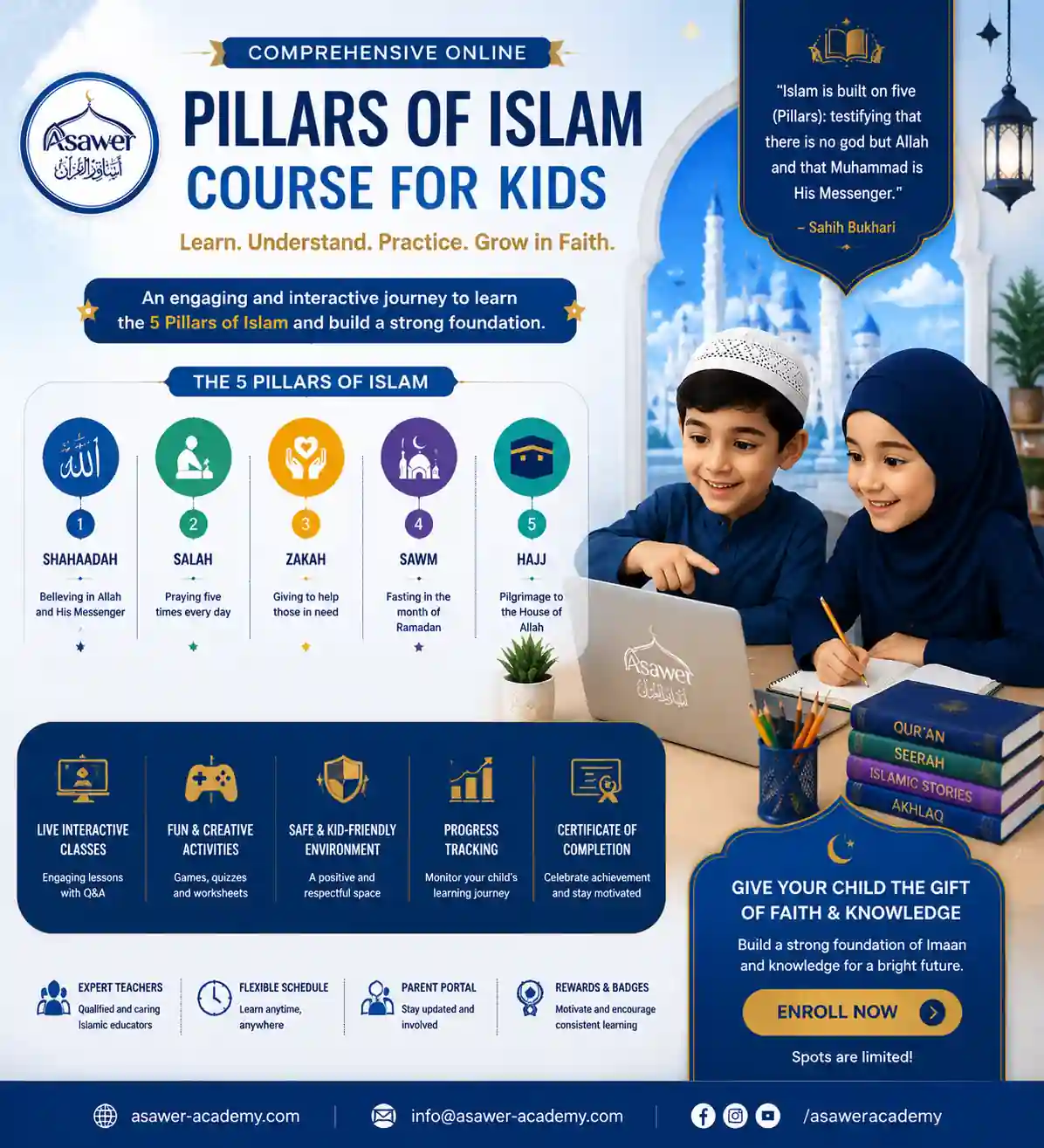
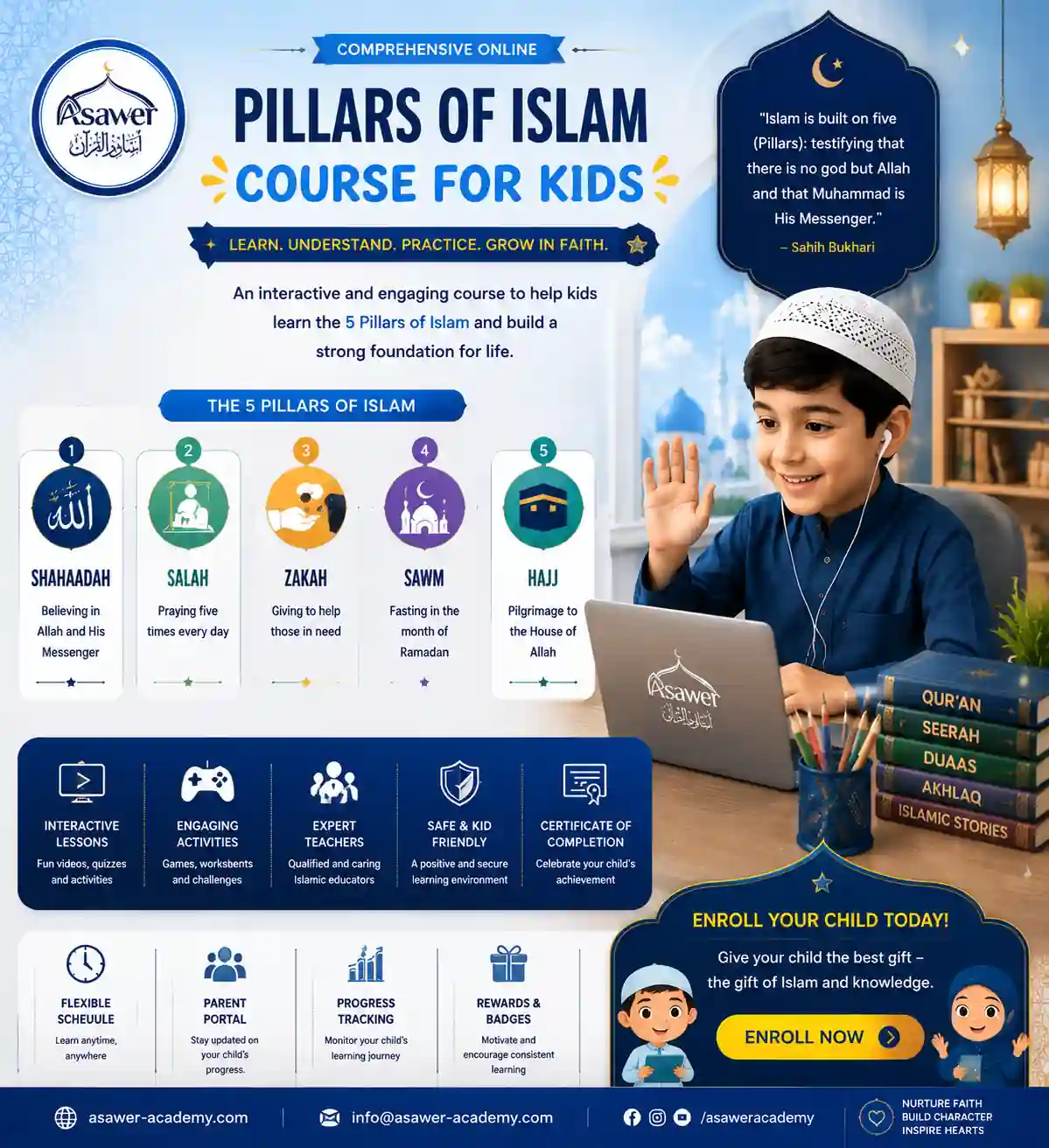
This focused course teaches Shahadah, Salah, Zakah, Sawm and Hajj as the central outward foundations of Muslim practice. Children learn what each pillar means, who is responsible for it, which conditions matter and how an age-appropriate action can be practised safely at home. Unlike the broad Islamic Studies programme, this page stays centred on worship readiness. Lessons use Quran and authentic Sunnah foundations, demonstrations, family practice cards and respectful explanations of ability and recognised Fiqh differences.
The course is designed for children, young teens, new-Muslim families and parents refreshing the basics with their children. The free trial identifies age, Islamic knowledge, prayer readiness, family practice, language level and any questions that need a qualified teacher rather than a generic worksheet.
Asawer Academy video overlay.webp
مَعْنًى • اسْتِعْداد • عِبادَة • عادَة
Every pillar becomes one understandable belief and one realistic practice step.
5
PILLARS
4
AGE PATHWAYS
22
CURRICULUM UNITS
1
PARENT HOME PLAN

Meaning Before Memory

Children explain what each pillar means instead of only reciting its name and order.

Practice with Readiness

The teacher demonstrates worship while respecting age, ability, health and family guidance.

Fiqh with Clarity

Core agreements are taught clearly; valid differences are not presented as mistakes or confusion.

Parent Partnership

Families receive one short habit, question and review routine for each learning stage.
Comprehensive Online Pillars of Islam Course for Kids
THE FIRST FOUNDATION

The Five Pillars of Islam are not the same as the Six Pillars of Iman

Children frequently mix the two lists. The Five Pillars describe the central outward foundations of Muslim worship and practice. The Six Pillars of Iman describe foundational beliefs such as belief in Allah, His angels, books, messengers, the Last Day and divine decree.
The course teaches this distinction early so the child can organise Islamic knowledge instead of memorising disconnected lists.
THE WORSHIP READINESS LADDER

Children are trained gently before legal responsibility

The course does not speak to a six-year-old exactly like an accountable adult, and it does not treat every pillar as identical in conditions.
01

Recognise

Name the pillar, its basic meaning and where it appears in Muslim life.
02

Understand

Explain who performs it, why it matters and the main conditions in simple language.
03

Practise Safely

Rehearse age-appropriate parts with parent and teacher guidance without shame or coercion.
04

Grow in Responsibility

Build consistency and deeper rulings as the learner approaches maturity and accountability.
FOUR AGE-RESPONSIVE PATHWAYS

The same pillar needs a different explanation at each developmental stage

5–7

Names, Love and First Habits

Simple meanings, short stories, prayer movements, Ramadan belonging and a visual Hajj journey.
8–10

Meaning and Guided Practice

Wudu/Salah sequence, charity choices, safe fasting preparation and basic conditions.
11–13

Responsibility and Reasoning

Puberty readiness, intention, valid excuses, Zakah concepts and respectful Fiqh differences.
14+ / Family

Practice and Evidence

More complete worship review, Quran/Hadith evidence, family alignment and new-Muslim questions.
THE 22-UNIT FIVE PILLARS CURRICULUM

From first meanings to family practice and puberty readiness

Explore the complete 22-unit curriculum, from foundational meanings to age-appropriate family practice.
1. What Is Islam?
Submission to Allah, worship, the meaning of a pillar, and why a strong structure needs connected foundations.

2. Islam, Iman and Ihsan
Separate the five practices from the six beliefs; introduce intention, ability and gradual responsibility.

Evidence of learning: sort examples into belief, worship and character without treating them as unrelated parts of Islam.
3. La ilaha illa Allah
Only Allah deserves worship; children distinguish worship from love, respect or ordinary requests to people.

4. Muhammadur Rasul Allah
Believing, loving and following the Messenger ﷺ; what it means to accept his guidance.

5. Shahadah in Daily Life
Intention, avoiding showing off, asking Allah, following revelation and speaking about Islam respectfully.

Evidence of learning: explain both parts of the Shahadah in the learner’s own words and give one daily example.
6. Why Muslims Pray
Connection with Allah, five daily times, preparation and the difference between obligation and child training.

7. Purification Readiness
Cleanliness, basic Wudu sequence, what requires parent/teacher guidance and when a separate practical course is needed.

8. The Prayer Map
Qiblah, intention, standing, recitation, bowing, prostration and sitting as an organised sequence.

9. Words and Meanings
Takbir, Al-Fatihah themes, Tasbih and Tashahhud at an age-appropriate level.

10. Building a Prayer Habit
Adhan awareness, family routine, missed-practice reflection, Khushu and encouragement without humiliation.

Evidence of learning: prepare for prayer, sequence the main actions and explain why Salah matters.
11. Allah Owns and Entrusts
Property, gratitude, responsibility and the difference between generosity, Sadaqah and obligatory Zakah.

12. Who Pays and Who Receives?
Age-appropriate introduction to wealth, Nisab, passage of time where relevant and the Quranic recipient categories without asking children to issue rulings.

13. A Child’s Charity Practice
Sharing, private giving, family charity planning, dignity of recipients and avoiding performative generosity.

Evidence of learning: distinguish Zakah from voluntary charity and make one respectful giving decision.
14. Why Muslims Fast Ramadan
Worship, Taqwa, Quran, gratitude, community and the Ramadan day.

15. Intention, Suhur and Iftar
Basic sequence, manners and family routines without turning Ramadan into food-only celebration.

16. Who Is Excused?
Children before accountability, illness, travel and other categories introduced carefully; medical and detailed Fiqh questions go to qualified adults.

17. Safe Practice for Children
Short voluntary practice only with parent guidance, hydration/health awareness, honesty when tired and no shame for not completing an adult fast.

Evidence of learning: explain the purpose of fasting and make a safe Ramadan plan with a parent.
18. The Call of Ibrahim and the Ka‘bah
Tawheed, Makkah, the sacred house and the meaning of pilgrimage.

19. The Hajj Journey Map
Ihram, Talbiyah, Tawaf, Sa‘i, ‘Arafah, Muzdalifah, Mina and sacrifice as a simplified ordered journey.

20. Ability, Unity and Return
Hajj for those able, physical and financial preparation, equality, patience and returning with better worship.

Evidence of learning: place the main Hajj stations in order and explain why Hajj is not required from every person immediately.
21. The Five Pillars Work Together
Shahadah gives direction; Salah orders the day; Zakah purifies wealth; Sawm trains restraint; Hajj gathers worship, sacrifice and unity.

22. My Family Practice Passport
Create a personal map with one meaning, one evidence point, one current practice and one future goal for every pillar.

Final evidence: teach the five pillars to another family member accurately, identify age/ability conditions and choose a realistic next course.
THE PILLAR PRACTICE LESSON

A child should explain, demonstrate, choose and reflect

Pillars of Islam Course for Kids
FIQH CLARITY AND CHILD SAFETY

Teach certainty clearly and differences respectfully

Core Agreement

The five pillars, their central meanings and major conditions are taught from Quran and authentic Sunnah with qualified review.

Valid Fiqh Difference

Details such as some prayer positions, Wudu questions or local practice may differ among recognised schools. The teacher follows the academy policy and aligns with parents where appropriate.

Child Readiness

Young children rehearse worship gently. They are not shamed for adult-level performance, and puberty-related duties are introduced with privacy and parent awareness.

Health and Ability

Fasting, Hajj and some worship situations depend on health and ability. The course does not replace a doctor, local scholar or personalised legal ruling.
THE FIVE PILLARS PARENT BRIDGE

Short family consistency is more useful than repeating the full lesson

1

One Family Question

Ask what the pillar means and where the child saw it during the week.
1

One Small Practice

Choose a prayer preparation, charity, Ramadan or gratitude habit suitable for the child.
5

Five-Minute Review

Use one card: name, meaning, who performs it, one condition and one action.
1

One Teacher Question

Record a Fiqh, safety or family-practice question instead of guessing at home.
Comprehensive Online Pillars of Islam Course
PROGRESS A PARENT CAN OBSERVE

Knowing the list is only the first checkpoint

PRIVATE ISLAMIC LEARNING ACROSS TIME ZONES

Scheduling for families in the USA, Canada and Australia

The best time supports attention, prayer routines and a short parent follow-up.
US

United States

Discuss school and weekend schedules, local mosque practice and the family’s prayer or Ramadan goals.
CA

Canada

Confirm local-time teacher availability, parent feedback and a stable practice rhythm.
AU

Australia

Check AEST, ACST or AWST compatibility and safeguarding expectations for private online lessons.
FREQUENTLY ASKED QUESTIONS

What parents ask before a Five Pillars course for kids

Clear answers about age, responsibility, prayer, fasting, Zakah, Hajj, Fiqh differences and parent involvement.

They are Shahadah, Salah, Zakah, fasting Ramadan and Hajj for those able. They are central outward foundations of Muslim worship and practice.

No. The Five Pillars concern central practices of Islam. The Six Pillars of Iman describe foundational beliefs.

The course includes age-responsive pathways beginning with early-child foundations. The free assessment confirms a suitable lesson length, teacher match and learning route for the child.

Children are taught and trained gradually. Legal responsibility is connected to maturity, while Zakah, fasting and Hajj also have specific conditions such as wealth, health and ability.

Yes, at a foundational and age-appropriate level. A learner needing detailed correction or complete Fiqh may need a separate practical Salah course.

Selected essential prayer words and meanings are taught according to the child’s age, reading ability and current worship goals, with the memorisation target agreed after assessment.

Children learn ownership, gratitude, obligatory Zakah versus voluntary charity, basic conditions and the dignity of recipients without being asked to issue legal calculations.

Practice must be voluntary, gradual and guided by parents. Health, age and individual ability matter, and the course does not give medical advice.

It teaches the main journey, locations, meaning and order at an introductory level. Detailed rulings require more advanced study.

The course uses the Quran, authenticated Sunnah and qualified Fiqh explanation. Recognised differences and questions requiring specialist review are clearly labelled.

The course teaches agreed essentials clearly and labels recognised Fiqh differences respectfully, while family practice is discussed when appropriate.

It may work when age, attention and knowledge are close. Separate classes are better when prayer readiness or puberty-related questions differ.

Yes. The family pathway can explain each pillar without assuming prior knowledge and can separate immediate practice from later detailed study.

Use one question, one small practice, a five-minute review and one saved teacher question. Avoid turning every lesson into a long test.

A preference can be requested. The final match depends on child-teaching experience, language, schedule and availability.

The exact learning resources depend on the child’s route. Any worksheets, prayer cards, Hajj maps, recordings, parent notes or platform access are explained before enrolment.

Progress is measured through naming the pillars, explaining meaning, identifying conditions, demonstrating age-appropriate practice and making sound choices in simple situations.

The 22-unit map is a curriculum framework. Duration depends on age, lesson length, prior knowledge, practice and lesson frequency.

No course can guarantee worship or behaviour. The teacher provides knowledge and guided practice; family routine, maturity and the child’s own growth also matter.

Asawer Academy

Asawer Academy specializes in teaching the Quran, Arabic, and Islamic Studies to non-Arabic speakers through live one-to-one online lessons.

📞

Phone / WhatsApp

+20 102 830 2494
✉️

Email Address

[email protected]
🌐

No credit card required. We'll confirm your lesson via email and phone.
