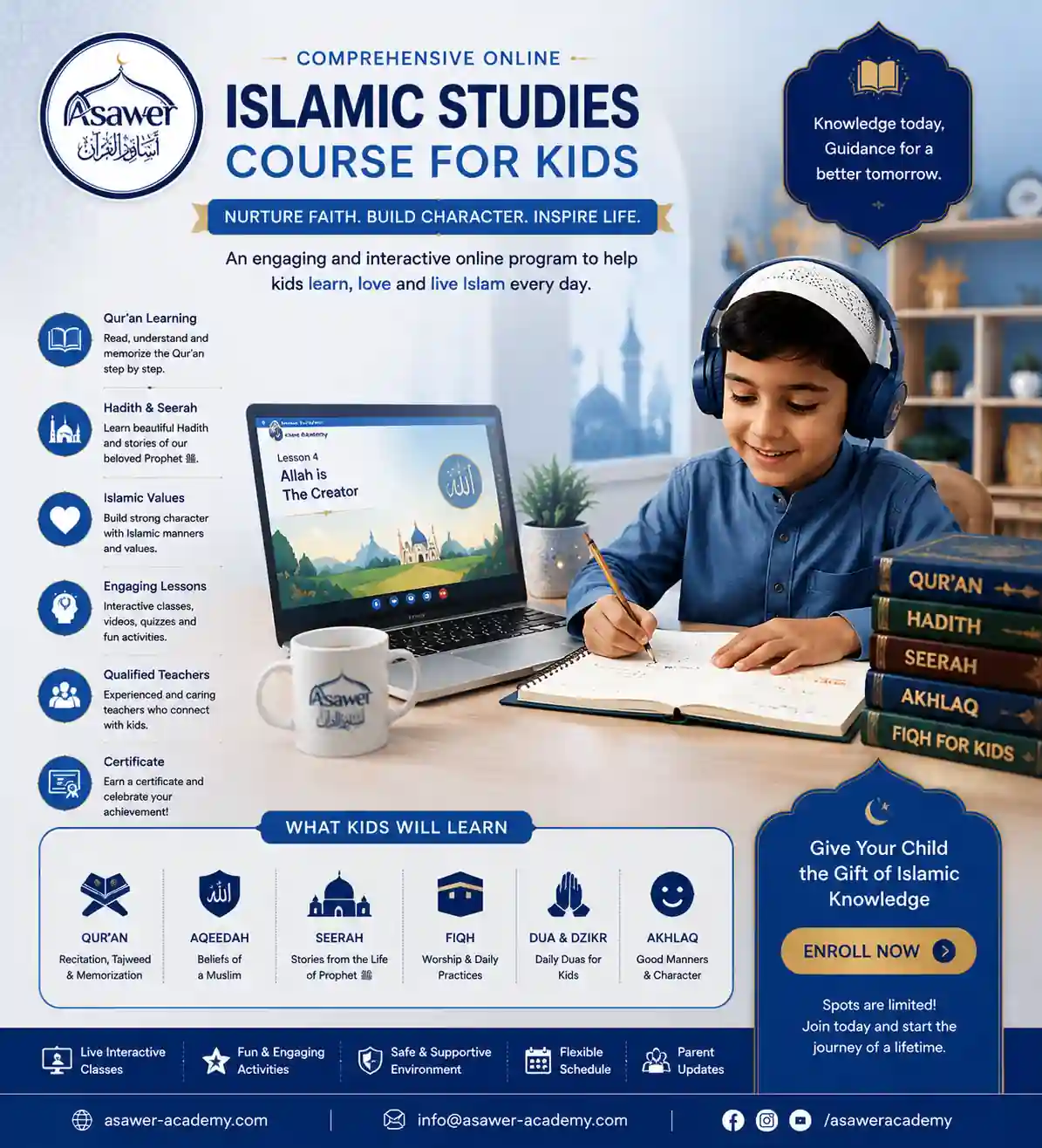
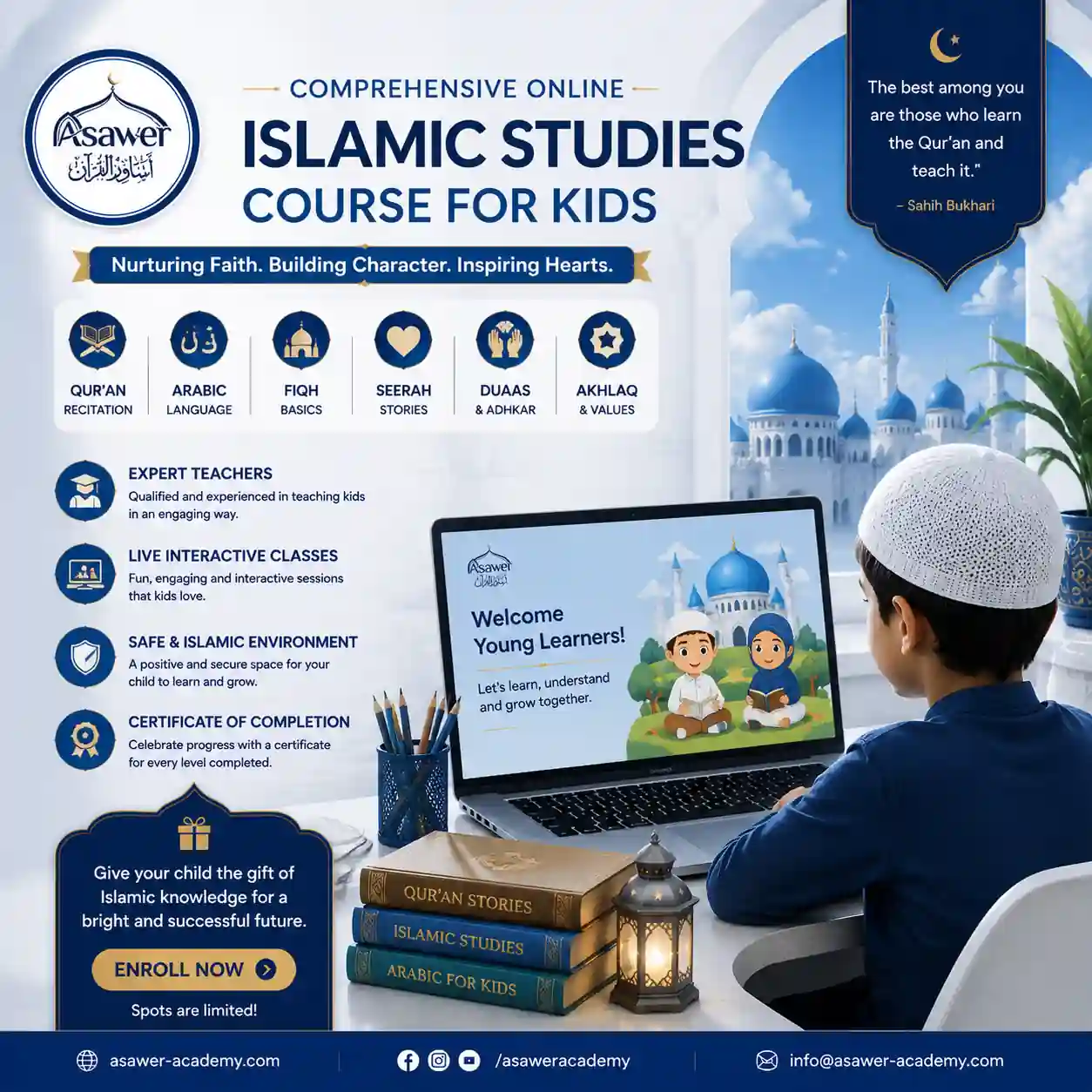
Online Islamic Studies for Kids: Build a Connected Foundation for Belief, Worship, Character and Muslim Life

Give your child one organised Islamic map instead of disconnected facts from worksheets, videos and occasional lessons. Online Islamic Studies for Kids connects Aqeedah, worship, Quran meaning, Hadith, Seerah, manners, daily duas and Muslim identity through a spiral curriculum that grows with age.

The free assessment checks age, previous learning, prayer readiness, Quran level, family practice, language and current questions before selecting the right stage and balance of explanation, demonstration, discussion and home application.

Eight Domains That Form One Connected Islamic Foundation

The curriculum gives each subject a clear place: Aqeedah explains what Muslims believe; Fiqh explains worship and responsibility; Quran and Hadith provide guidance and evidence; Seerah shows revelation lived in history; Akhlaq shapes choices; Duas build remembrance; identity lessons connect faith to school and online life.

The purpose is breadth with coherence. Children learn enough of each domain to build a usable map, then move into a specialist course when one subject needs greater depth.

Anchor, Organise, Apply and Refer

Each lesson begins with a Quran verse, authentic Hadith, established event or clear Islamic principle. The learner then places the idea inside the correct domain, applies it to a scenario or demonstration and identifies what can be practised safely now.

Questions are welcomed rather than punished. The teacher distinguishes a belief question from Fiqh, safety, family or emotional issues and involves parents or qualified professionals when the question goes beyond a general lesson.

Islamic Studies for Kids Curriculum: Four Age-Responsive Stages Across Eight Learning Domains

The 32-unit spiral curriculum revisits the same domains at deeper levels. The learner grows from recognition and routine into evidence, responsibility, judgment and independent study planning.

Stage 1 — Roots | Ages 5–7

Love and belonging, first Aqeedah meanings, prayer participation, manners, short Prophetic stories, Quran respect and daily duas.

Stage 2 — Builders | Ages 8–10

Pillars of Iman and Islam, Wudu/Salah map, Quran themes, Hadith basics, Seerah timeline, friendship and digital manners.

Stage 3 — Navigators | Ages 11–13

Tawheed and worship, puberty readiness, Fiqh conditions, Quran context, source confidence, peer pressure and online identity.

Stage 4 — Ready | Ages 14–16

Worldview, how Fiqh works, personal worship audit, Quran meaning, Hadith evidence, history, ethics and a long-term study plan.

A Broad Foundation for Children Who Need Structure Before Specialisation

The course suits complete beginners, children with scattered weekend-school knowledge, young Muslims growing up in non-Muslim environments and learners who need one connected foundation before choosing a specialist subject.

A child who specifically needs worship readiness can move into the Five Pillars Course. A learner who needs deeper Prophetic biography can use the Seerah Course.

How Asawer Academy Connects Islamic Knowledge to Daily Life

The lesson does not jump randomly from Aqeedah to manners to a story. It identifies the source, places the idea inside the correct Islamic subject and then uses a demonstration, scenario, discussion or short reflection matched to age.

Parents receive a simple follow-up structure rather than a second curriculum to teach: one concept, one practice, one observation and one teacher question. This keeps home reinforcement realistic.

Why Parents Choose Asawer Academy for Islamic Studies for Kids

A broad child curriculum needs age progression, authentic sources, question safety, practical worship and parent visibility—not a collection of unrelated Islamic facts.

Eight Connected Learning Domains

Aqeedah, worship, Quran, Hadith, Seerah, manners, Duas and identity are organised into one map.

Four Age-Responsive Stages

The same foundation returns with deeper questions, evidence and responsibility as the child matures.

Question-Safe One-to-One Lessons

Children have space to ask about school, friends, worship, online life and doubts without ridicule.

Source & Fiqh Clarity

Quran, authentic Hadith and scholarly explanation are distinguished; recognised differences are labelled respectfully.

Practical Worship & Scenarios

Children demonstrate, sort, choose and explain rather than only copy notes or memorize definitions.

Parent Learning Dashboard

Families receive one concept, one practice, one observation and one question for follow-up.

Visible Stage Progress

Learners must organize, explain, demonstrate, verify and know when referral is needed before moving on.

Teacher Choice & Global Scheduling

Male or female teacher requests and international recurring times can be discussed according to availability.

Online Islamic Studies Course for Kids FAQs

Detailed answers about curriculum breadth, age stages, Aqeedah, worship, Seerah, Hadith, Duas, difficult questions, safety and parent involvement.

It connects Aqeedah, worship and Fiqh, Quran meaning, Hadith and Sunnah, Seerah and Islamic history, manners, duas and Muslim identity in one broad foundation.

Yes. A child can begin with first beliefs, prayer belonging, simple Prophetic stories, manners and daily duas without previous Islamic school experience.

Yes, from simple Tawheed and the Pillars of Iman to age-appropriate worldview questions and source-aware discussion.

Yes as domains inside the broad foundation. The dedicated specialist courses provide greater narrative and source depth.

Yes, with meaning, occasion and a practical routine instead of memorization alone.

Yes. Questions are treated as learning signals. Some issues require source checking, parent involvement or referral to a qualified scholar or professional.

Families should receive clear teacher identity, observation/recording arrangements, private-messaging boundaries and a route for raising concerns.

Use a simple dashboard: one concept, one practice, one observation and one teacher question.

Materials depend on the route and age. Any worksheets, notes, recordings, platform access or reports should be explained before enrolment.

No course can guarantee spiritual or behavioural change. It can provide knowledge, guided practice and a family structure for reinforcement.

A preferred male or female teacher can be requested. Final matching depends on age, subject depth, language, schedule and teacher availability.

Private one-to-one lessons are a core option, allowing the teacher to adjust pace, examples, questions and review to one learner.

Progress is checked through explanation, recall, evidence use, practical application and performance on a new example rather than attendance alone.

Homework can include a short reading, recall task, family discussion, worksheet, practical demonstration or review question matched to the course and learner.

The course uses age-responsive stages for children and young teens. The free assessment confirms the suitable stage.

No. Quran reading teaches recitation. Islamic Studies teaches meaning, belief, worship, evidence, history, character and daily Muslim life.

Yes at a foundation level. A learner needing detailed worship correction may later move into the focused Five Pillars or another Fiqh route.

Yes. Children learn selected authentic narrations, what Hadith and Sunnah mean and why source confidence matters.

Core agreed foundations are taught clearly. Recognised differences are labelled respectfully and family practice can be discussed where appropriate.

With age-appropriate language, privacy and parent awareness, using the academy’s safeguarding boundaries.

Yes when age, knowledge and attention are close. Separate classes are better when prayer readiness, questions or pace differ.

Through recall, organisation, explanation, demonstration, decision-making, verification and knowing when a question needs referral.

The same domains return with greater evidence, responsibility and independence as the child grows, rather than repeating the same beginner facts every year.

The teacher can recommend a specialist Seerah, Hadith, Duas, Prophets or Five Pillars course instead of compressing advanced depth into the general programme.

Yes. A change can be discussed when another teaching style, subject fit, language or schedule would better support the learner.

Yes. Recurring international times can be discussed according to teacher availability and the learner’s school, work or family routine.

There is no responsible fixed duration before assessment. Age, route, lesson frequency, prior knowledge, review and the depth selected all affect completion.

The learner receives a clearer next step: continue to a deeper level, move to a specialist subject, strengthen a weak foundation or maintain a review plan.

FREQUENTLY ASKED QUESTIONS

What parents ask before a complete Islamic Studies course for children

Clear answers about curriculum, age, Quran, Aqeedah, Fiqh, safety, questions and family involvement.
It covers Aqeedah, worship and Fiqh, Quran meaning, Hadith and Sunnah, Seerah and Islamic history, manners, duas and Muslim identity through one structured curriculum.
The course uses age-responsive stages for children and young teens. The free assessment confirms whether the broad children’s route or a separate older-teen plan is the better fit.
Yes. The assessment can start a child with first beliefs, prayer belonging, stories, manners and daily duas without assuming previous Islamic school experience.
No. Quran reading focuses on Arabic recitation. Islamic Studies focuses on meaning, belief, worship, evidence, history, character and daily life. The two can be studied together.
Yes, from simple Tawheed and the Pillars of Iman to age-appropriate worldview questions. Agreed foundations are taught clearly, while advanced or disputed questions are referred for qualified review.
It includes foundational practice and understanding. A child needing detailed correction or advanced Fiqh may need the specialist Pillars or Salah path.
Yes, as connected domains inside the broad curriculum. The separate specialist courses provide greater narrative and source depth.
Yes. Children learn selected authentic narrations, what Hadith and Sunnah mean and why source confidence matters.
Yes, with meaning, occasion and one practical routine rather than memorisation alone.
Core agreed foundations are taught clearly. Recognised differences should be labelled respectfully according to the academy policy and family context.
Yes. The course includes a question-safe process. Complex issues may require source checking, parent involvement or referral to a qualified scholar or professional.
Puberty-related topics are taught with age-appropriate language, privacy and parent awareness, with sensitive questions handled through the academy’s safeguarding process.
Before classes begin, families receive clear information about teacher identity, observation and recording arrangements, private messaging boundaries and how concerns are reported.
It may work when age, knowledge and attention are close. Separate classes are better when prayer readiness, questions or pace differ.
Use the four-box dashboard: one concept, one practice, one observation and one teacher question.
Progress is reviewed through recall, organisation, explanation, demonstration, decision-making, verification and knowing when a question needs qualified referral.
The exact learning resources depend on the child’s route and level. Any worksheets, parent notes, recordings, platform access, reports or completion document are explained before enrolment.
The 32-unit map is a framework. Duration depends on age, stage, lesson length, frequency, previous knowledge and family practice.
No course can guarantee spiritual or behavioural transformation. It provides knowledge, guided practice and a family learning structure.

Start Your Free Trial Now

Fill out the form below and we’ll contact you shortly.

Asawer Academy

Asawer Academy specializes in teaching the Quran, Arabic, and Islamic Studies to non-Arabic speakers through live one-to-one online lessons..

📞

Phone / WhatsApp

+20 102 830 2494
✉️

Email Address

info@asawer-academy.com
🌐

No credit card required. We'll confirm your lesson via email and phone.
