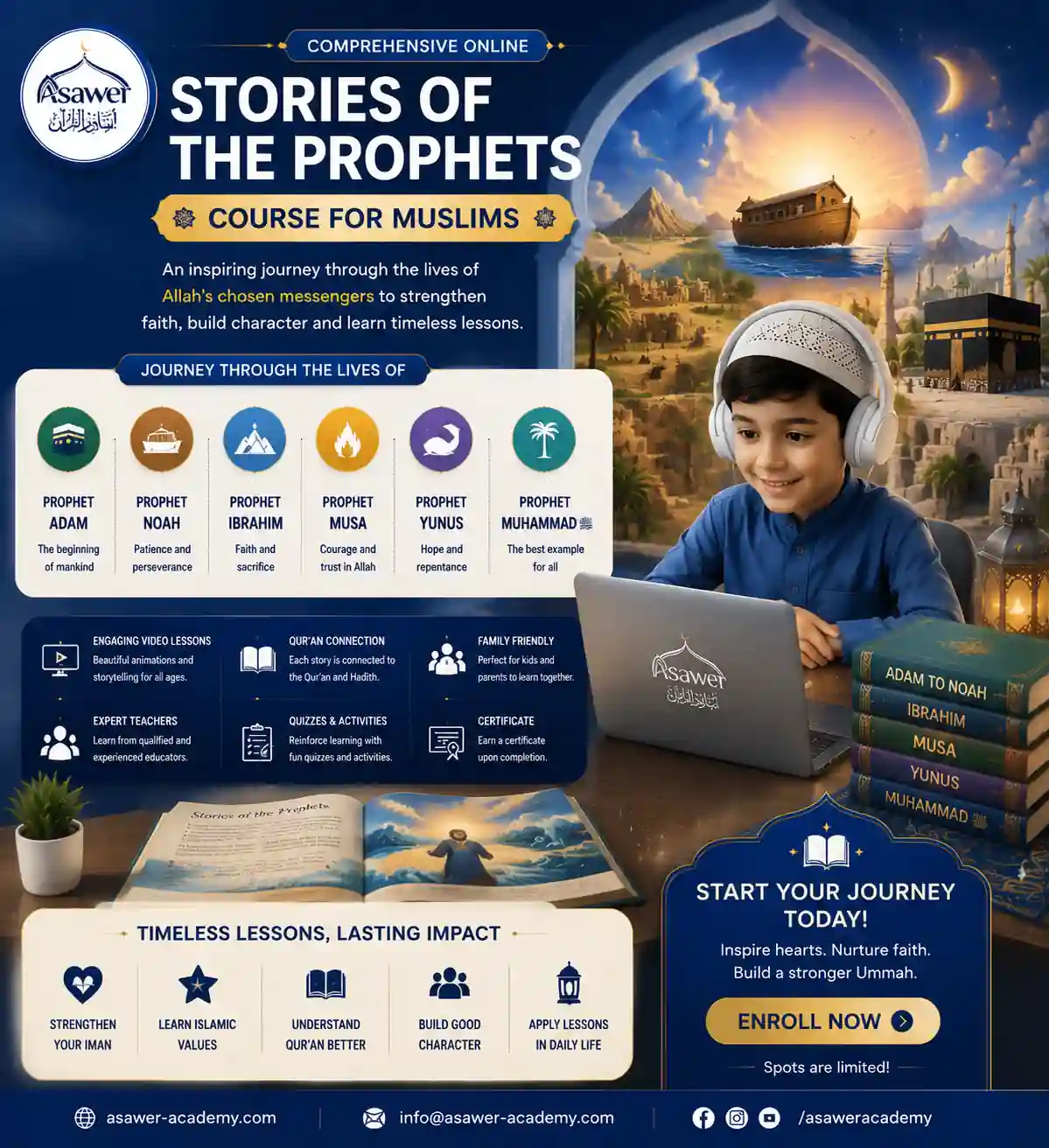
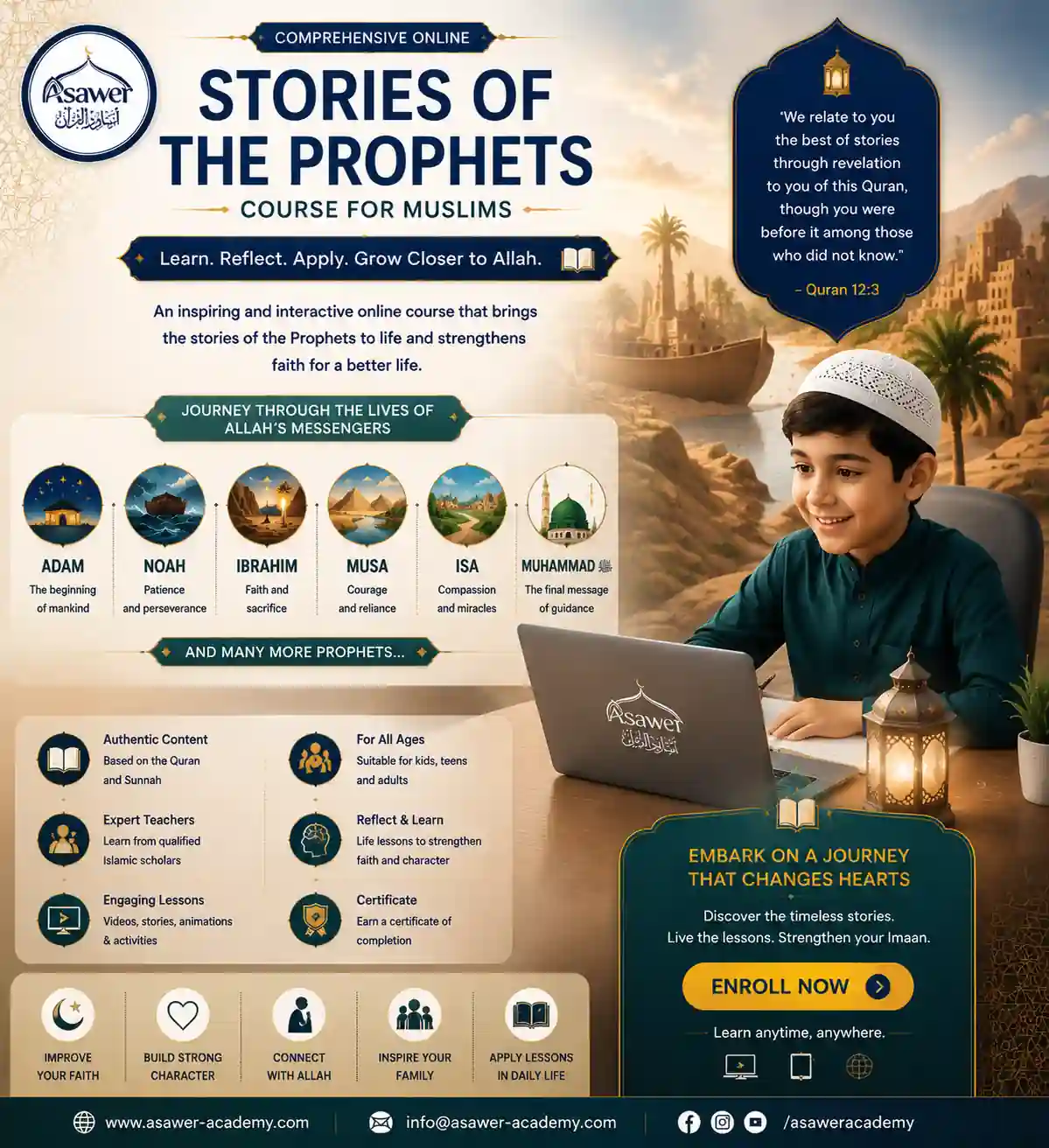
Online Stories of the Prophets Course: Study Quranic Narratives Through Revelation, Trial and Response

Study the major Stories of the Prophets through the Quran and authentic Sunnah without turning revelation into entertainment or a collection of unverified details. Each lesson asks four questions: What does the source actually establish? What trial occurred? How did the Prophet respond? What belief or character lesson is genuinely supported?

The course is designed for children, teens, families, new Muslims and adults. The free trial identifies age, Islamic background, attention span, language and the learner’s questions before choosing the right story depth and review style.

Prophetic Stories as Revelation, Guidance and a Connected Faith Map

The Quran does not tell Prophetic stories merely to preserve names and dramatic events. The narratives teach Tawheed, revelation, worship, repentance, patience, courage, justice, mercy and trust in Allah.

Students learn to separate the Quranic event from later storytelling additions, locate the story inside a broader prophetic line and understand why similar themes return across different Prophets.

The course therefore protects both authenticity and relevance: the learner knows what happened, why it matters and what the evidence actually allows us to conclude.

From Source to Story, Then from Story to One Supported Action

The teacher begins with the Quranic passage or authenticated report, clarifies the sequence and vocabulary, then checks whether the learner can explain the event without adding invented details.

Children may use maps, objects, timelines, matching activities and retelling. Older learners compare passages, discuss source confidence and trace repeated themes such as Tawheed, Da‘wah, trial and relief.

Every lesson closes with one belief point, one character lesson and one realistic practice step. Application never becomes a claim that the text says more than it actually says.

Stories of the Prophets Curriculum: Six Quranic Journeys from Adam to the Final Messenger

The curriculum groups established narratives into six journeys so learners can see the prophetic line and repeated Quranic themes without pretending that every story has equal historical detail.

Journey 1 — Creation, Adam and Human Responsibility

Creation, the honour and test of Adam, repentance, human choice and the first family lessons without speculative detail.

Journey 2 — Nuh, Hud and Salih

Long-term Da‘wah, rejection, patience, accountability and how revelation corrects a community.

Journey 3 — Ibrahim and His Family

Tawheed, argument against idolatry, migration, trust, sacrifice and the prophetic family line through Ismail and Ishaq.

Journey 4 — Yaqub, Yusuf and Family Trial

Dreams, jealousy, separation, chastity, patience, leadership, forgiveness and the ethics of family conflict.

Journey 5 — Musa, Harun and Bani Isra’il

Calling Pharaoh, signs, the Exodus, covenant, leadership, community testing and the repeated need for guidance.

Journey 6 — Later Prophets to Isa and the Final Messenger

Selected narratives of Ayyub, Dawud, Sulayman, Yunus, Zakariyya, Yahya and Isa, then the place of Muhammad ﷺ as the final Messenger.

A Different Depth for Children, Teens, Families and Adults

Young learners need short, emotionally safe stories and clear actions. Preteens can compare choices and retell evidence. Teens and adults can examine recurring Quranic themes, source confidence and the relationship between stories more analytically.

Learners who want the complete life of Prophet Muhammad ﷺ should continue to the Online Seerah Course. Families needing a broad foundation across belief, worship and manners can use the Islamic Studies Course for Kids.

How Asawer Academy Keeps Prophetic Stories Accurate and Age-Responsive

The teacher distinguishes Quran, authentic Hadith and recognised explanation from popular storytelling. If a detail is disputed or weak, it is not quietly presented as revelation.

Age changes the lesson design. A young child may retell one safe scene and one value; a teen may compare choices and Quranic passages; an adult can examine source confidence and broader themes. The same story therefore grows in depth without changing its foundation.

Why Families Choose Asawer Academy for Stories of the Prophets

A strong Prophets course needs authentic sources, careful storytelling, age-appropriate depth and a way to carry one supported lesson into family life.

Quran & Authentic Sunnah First

Narratives begin from revelation and dependable sources rather than entertainment-based retellings.

Age-Responsive Story Depth

Children, teens and adults can study the same Prophet with different vocabulary, detail and questioning.

No Prophet Depictions Needed

Maps, objects, landscapes, timelines and calligraphy can support learning without portraying Prophets.

Source Confidence Labels

Learners can tell the difference between established revelation, recognised explanation and uncertain storytelling.

Belief + Character + Action

Every story closes with one belief point, one supported character lesson and one realistic practice step.

Retelling & Understanding Checks

Students explain the sequence in their own words and identify what the source actually establishes.

Parent Review Bridge

Families can review one event, one lesson and one home action without re-teaching the entire class.

Teacher Choice & Global Scheduling

Male or female teacher requests and international recurring times can be discussed according to availability.

Online Stories of the Prophets Course FAQs

Detailed answers about authenticity, age, Prophet depictions, sources, moral lessons, parent involvement and the difference between Qasas al-Anbiya and Seerah.

It is a source-aware study of major prophetic narratives found in the Quran and authentic Sunnah, taught through the pattern of revelation, trial, Prophetic response and supported lessons for faith and character.

The route can include Adam, Nuh, Hud, Salih, Ibrahim, Lut, Ismail, Ishaq, Yaqub, Yusuf, Ayyub, Shuayb, Musa, Harun, Dawud, Sulayman, Yunus, Zakariyya, Yahya, Isa and others whose stories are established in revelation.

Quranic passages come first, followed by authentic Prophetic narrations and recognised scholarly explanation. Popular story details are not treated as established simply because they are widely repeated.

The course can use maps, landscapes, objects, timelines and calligraphy without depicting Prophets themselves.

Yes. Older learners can study source confidence, repeated Quranic themes, historical context and the relationship between the Prophets’ missions in greater depth.

Each lesson identifies what the source states, the trial, the Prophetic response, the belief or character principle and one supported application. Dramatic details never replace evidence.

Yes. Key Quranic passages are located and explained at a level suitable for the learner, without turning the course into a full Tafseer programme.

Yes, but the moral is tied to the revealed narrative. Patience, repentance, courage, gratitude, trust and truthfulness are extracted carefully rather than attached as generic slogans.

The course uses thematic Quranic journeys with a broad prophetic timeline. It avoids pretending that every event can be dated with modern historical precision.

Yes when age, attention and background are close. Separate classes are better when one learner needs significantly more detail or different sensitive framing.

A preferred male or female teacher can be requested. Final matching depends on age, subject depth, language, schedule and teacher availability.

Private one-to-one lessons are a core option, allowing the teacher to adjust pace, examples, questions and review to one learner.

Progress is checked through explanation, recall, evidence use, practical application and performance on a new example rather than attendance alone.

Homework can include a short reading, recall task, family discussion, worksheet, practical demonstration or review question matched to the course and learner.

No. Seerah follows the connected life of Prophet Muhammad ﷺ from Makkah to Madinah. Stories of the Prophets studies the wider prophetic line and Quranic narratives of earlier Messengers and Prophets.

The teacher can map all 25 named Prophets, while the depth given to each story depends on age, route and the amount of reliable narrative detail available.

The teacher distinguishes revelation, stronger historical explanation and material whose status is uncertain. Learners are not encouraged to present unverified details as Quranic fact.

Yes. Younger learners receive shorter story segments, simple vocabulary, one belief point and one practical action rather than adult-level historical detail.

Yes. The course can introduce the prophetic line, Tawheed, revelation, worship and major Quranic themes without assuming previous Islamic study.

The goal is not verbatim memorization. Learners should be able to retell the established sequence, identify the main message and connect one supported lesson to daily life.

Sensitive material is selected and framed according to age, emotional readiness and the actual learning goal. Unnecessary adult detail is avoided.

A short family bridge can review the event, one belief lesson, one character choice and one practical action without asking parents to re-teach the full class.

The prophetic line reaches the final Messenger ﷺ, but his complete life is reserved for the dedicated Seerah course so the two pages keep distinct depth and search intent.

No. The course can be taught in English, while key Arabic names and Quranic expressions are introduced gradually.

Yes. A change can be discussed when another teaching style, subject fit, language or schedule would better support the learner.

Yes. Recurring international times can be discussed according to teacher availability and the learner’s school, work or family routine.

There is no responsible fixed duration before assessment. Age, route, lesson frequency, prior knowledge, review and the depth selected all affect completion.

The learner receives a clearer next step: continue to a deeper level, move to a specialist subject, strengthen a weak foundation or maintain a review plan.

FREQUENTLY ASKED QUESTIONS

What parents and learners ask before a Prophets course online

Clear answers about sources, age groups, illustrations, chronology, sensitive topics, parent involvement and progress.
It is a live Islamic studies course that teaches major Quranic narratives, authentic lessons of faith and age-appropriate practical application.
Children are a primary audience, while separate pathways support teens, families, new Muslims and adults. Lesson depth, vocabulary and sensitive details are adapted to age and readiness.
The core journey covers the major Quranic narratives from Adam through Nuh, Ibrahim, Yusuf, Musa, Dawud, Sulaiman, Yunus, Isa and the final Messenger ﷺ, with other named Prophets included where revelation provides sufficient detail.
No. The Quran states that some messengers were related and others were not. The course avoids inventing complete stories for Prophets whose details are not established.
The source order is Quran, authentic Hadith and reliable tafsir or Seerah. Disputed or Israelite details are omitted or clearly labelled rather than presented as revelation.
Selected verses may be read, translated or paraphrased according to the learner’s Arabic and Quran-reading level.
No. Course visuals use maps, landscapes, architecture, objects, calligraphy and timelines without depicting Prophets or angels.
The teacher reduces graphic detail, uses age-appropriate vocabulary and focuses on belief, choice, safety and character. Parents can raise sensitivities before class.
The course uses a learning sequence and broad prophetic journey, but it does not claim certainty about every historical date or the exact order of all Prophets.
It includes a final-message bridge and recurring prophetic themes. The full life of Prophet Muhammad ﷺ belongs to the separate Seerah course.
A live teacher checks understanding, answers questions, separates reliable evidence from embellishment and adapts the lesson and home action to the learner.
Use the Parent Home Bridge: one question before class, a three-part retell after class, one weekly habit and a five-minute Friday review.
It may work when age, attention and knowledge are close. One-to-one teaching is better when sensitivities, pace or questions differ significantly.
Yes. The adult or family path can introduce the prophetic line, Tawheed, Quran connections and basic source awareness without assuming prior study.
A preference may be requested. The final match depends on teaching experience, language, age group, schedule and availability.
The exact learning resources depend on the selected route. Any worksheets, parent notes, recordings, progress reports, platform access or completion document are explained before enrolment.
The route depends on age, lesson length, selected stories and depth. The 24-unit map is a curriculum framework, not a guaranteed completion date.
The course teaches beliefs, choices and habits, but no course can guarantee behavioural transformation. Parents and teachers reinforce small consistent actions.

Start Your Free Trial Now

Fill out the form below and we’ll contact you shortly.

Asawer Academy

Asawer Academy specializes in teaching the Quran, Arabic, and Islamic Studies to non-Arabic speakers through live one-to-one online lessons..

📞

Phone / WhatsApp

+20 102 830 2494
✉️

Email Address

info@asawer-academy.com
🌐

No credit card required. We'll confirm your lesson via email and phone.
