
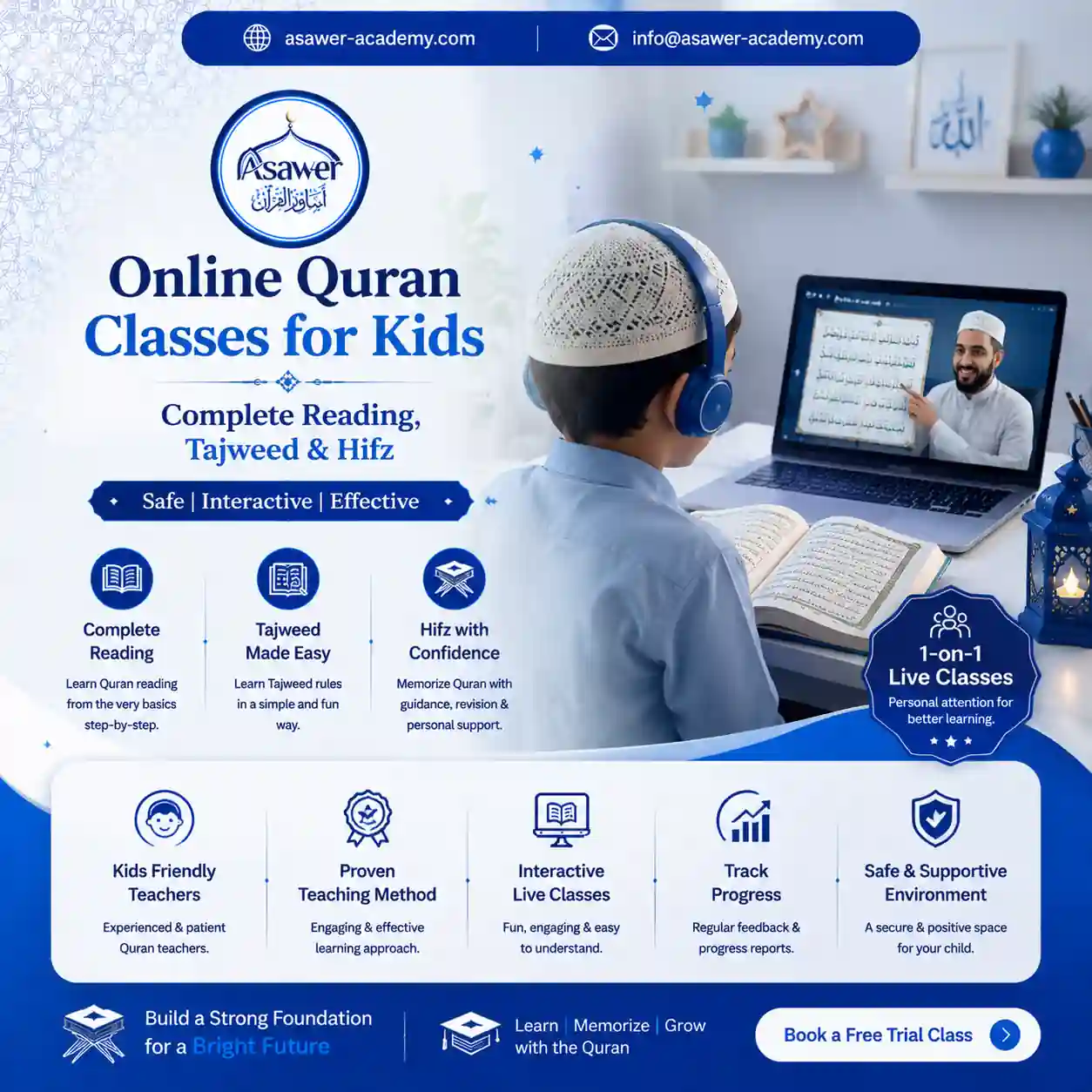
PRIVATE QURAN LEARNING DESIGNED AROUND YOUR CHILD—NOT A GENERIC AGE LABEL

Online Quran Classes for Kids: A Parent-Guided Route to the Right Quran Skill

Online Quran classes for kids should begin by identifying the child’s immediate learning need—not by placing every learner into the same reading, Tajweed and memorisation syllabus. Some children need a first Quran-reading method, others can read but require fluency or pronunciation correction, and some are ready for a structured Hifz and revision plan. Asawer Academy uses the free assessment to recommend the most suitable route, teacher style and lesson length for the child’s age, attention and current Quran level. This page helps parents understand the complete child-learning experience: private one-to-one teaching, age-responsive activities, parent-visible goals, homework after the lesson and a clear next milestone. When the assessment identifies a specialist need, the family is directed to the relevant Noorani Qaida, Noor Al Bayan, Baghdadiyyah, Tajweed or integrated Quran pathway instead of receiving a generic course.
Asawer Academy’s online Quran classes for kids are planned as private live lessons for children who may be starting with Arabic letters, rebuilding slow reading, learning practical Tajweed, memorizing short Surahs or repairing weak revision. The free trial helps the family choose a realistic path before regular classes begin.
Asawer Academy video overlay.webp

See the Parent-First Learning Experience

The trial should answer four questions
Where is my child now? What is the next skill? How will home review work? How will I know whether the plan is working?

Private 1-to-1 Attention

The teacher can correct the child’s exact reading and adjust pace without comparison to a group.

Age-Aware Teaching

A young beginner, school-age reader and teen Hifz student should not receive the same lesson design.

Male or Female Teacher Request

Families can request a preferred teacher, subject to level, language and schedule availability.

Parent Visibility

The family should understand the current goal, home practice and the next milestone.
Online Quran Classes for Kids Complete Reading
THE PARENT’S REAL DECISION

A child can attend many lessons and still have no stable Quran learning system

Some children memorize by listening but cannot read the same verses from the Mushaf. Some finish a Qaida book yet continue guessing at words. Others receive new Surahs every week while older memorization quietly weakens. A child may also begin to resist class because correction feels like constant failure or because the lesson asks for more attention than their age can sustain.
The solution is not more pressure and it is not a page full of promises. The course needs a clear priority: build the reading foundation, stabilize fluency, correct the sounds that matter now, or protect memorization through revision. The teacher should know which goal comes first and the parent should know how to support it at home.
THE CHILD’S QURAN JOURNEY

Four learning zones—with movement based on readiness

A child may work in more than one zone, but each lesson should have one clear primary objective.
01

Recognize and Decode

Arabic letters, sounds, vowels, joining, Sukoon, Shaddah, Madd foundations and early Quranic words.
02

Read with Growing Fluency

Reduce guessing and repeated pauses through guided reading, familiar patterns and immediate correction.
03

Recite with Practical Tajweed

Improve Makharij and apply selected rules inside the verses the child is reading and memorizing.
04

Memorize and Retain

Add a realistic new portion while protecting recent and older Surahs through a planned revision cycle.
FIVE CHILD LEARNING PROFILES

The free trial should identify the profile—not sell the same syllabus to every family

Open each profile to see the likely focus, lesson design and parent-visible milestone.
Typical needs: short attention span, early letter recognition, confidence with the teacher and a positive first association with Quran learning.

Lesson focus:
• Arabic shapes and sounds through brief, repeated activities.
• Simple visual matching and guided pronunciation.
• Short Surahs or Duas through listening where suitable.
• Movement between tasks before attention drops.
• Parent nearby for technical and emotional support.

Parent milestone: the child recognizes the current letters or sounds, joins the lesson with less resistance and completes a small home task without conflict.

This child recognises some Arabic but cannot yet decode unfamiliar Quranic words reliably. The trial checks visual recognition, vowel reading, joining, sound production and the learner’s response to different teaching methods.

The parent receives a method recommendation rather than a duplicated mini-curriculum on this page: Noorani Qaida for a concentrated sound-to-Mushaf sequence, Noor Al Bayan for broader phonics and literacy, or Baghdadiyyah for structured Tahajji and word construction. The chosen course page then explains the exact levels, book sequence and readiness evidence.

Typical needs: smoother reading, accurate vowels, fewer pauses, stronger word recognition and confidence with longer verses.

Lesson focus:
• Repeated reading of carefully selected passages.
• Correction of high-impact letter and vowel errors.
• Phrase reading and basic breath awareness.
• Stopping and restarting at suitable points.
• A short independent reading target between classes.

Parent milestone: the child reads the same passage more smoothly after practice and makes fewer repeated errors.
Typical needs: clearer Makharij, stable application of current rules and correction of habits formed during earlier reading.

Lesson focus:
• Letters most relevant to the child’s actual errors.
• Ghunnah, Qalqalah, Madd and selected heavy/light letters.
• Noon Sakinah, Tanween and Meem Sakinah introduced progressively.
• Tajweed applied inside current reading and Hifz.
• Avoiding long theory lists the child cannot use.

Parent milestone: the child can produce the corrected sound in the target verses and begins recognizing the mistake independently.
Typical needs: realistic new memorization, accurate recitation and protection of older portions.

Lesson focus:
• New lesson matched to reading and available home review.
• Recent revision from the latest learning period.
• Older revision from earlier Surahs or Juz.
• Similar verses, transitions and common hesitation points.
• Meaning or key vocabulary where it supports connection and retention.

Parent milestone: the child maintains the assigned portion and follows a revision cycle instead of depending on last-minute repetition.
AGE CHANGES THE METHOD, NOT THE CHILD’S WORTH

A 5-year-old, a 9-year-old and a 14-year-old need different lesson architecture

Age bands guide attention, language and responsibility, while the assessment still determines the academic level.

Ages 4–6: Short, Visual and Relationship-First

The lesson may use brief activities, repetition, praise and simple goals. A parent should remain nearby, especially during early sessions, while the free assessment confirms a suitable lesson length and starting route.

Ages 7–10: Foundation and Habit Building

Children can usually sustain a clearer routine: reading practice, one pronunciation target, short memorization and a manageable home task. Progress should remain visible and encouraging.

Ages 11–15: Responsibility and Deeper Skill

Older children and teens can receive more direct feedback, practical Tajweed explanation, structured Hifz review and greater responsibility for independent practice—without treating them as adults.
THE 1-TO-1 LESSON ENGINE

Every class should have a visible beginning, middle and next step

Children stay engaged when the teacher knows what the lesson is trying to accomplish. The exact balance changes by age and track, but the session should not feel like an endless correction stream.
For younger children, the teacher may switch activities more often. For older learners, the lesson can include longer recitation, a clearer error explanation and responsibility for recording the home target.
Online Quran Classes for Kids Complete Reading, Tajweed
MEMORIZATION THAT PROTECTS WHAT WAS ALREADY LEARNED

How Parents Can See Whether a Child’s Hifz Plan Is Balanced

On the children’s page, the important question is not how many new Surahs appear on the schedule. Parents need to know whether the assigned portion matches the child’s reading ability, whether earlier memorisation is still being checked and what review can be completed at home without conflict. After the lesson, the family should be able to identify three items: the small new target, the recent material that must remain active and the older Surah or passage selected for rotating revision. When memorisation becomes the main long-term goal, the dedicated integrated Quran course provides the fuller reading, Tajweed and Hifz framework.
A

New Portion

A small, accurate target matched to the child’s reading and available home practice.
B

Recent Review

Material learned in the latest period, repeated often enough to become more stable.
C

Older Revision

Earlier Surahs or Juz revisited on a rotating plan so success is not only recent.

When revision weakens, new memorization may need to slow down

This is not punishment. It protects the child from building a larger amount of unstable Hifz and helps the family restore confidence through achievable review.
PARENT VISIBILITY WITHOUT MICROMANAGING THE CHILD

A useful progress update answers four simple questions

01

Current Skill

The exact reading, Tajweed or Hifz target being worked on now.
02

Observed Error

The mistake or hesitation pattern the teacher is correcting.
03

Home Practice

A short task that the child and parent can understand without guessing.
04

Next Milestone

The condition for moving forward, rather than only a page number or attendance count.
SAFE ONLINE LEARNING STARTS WITH CLEAR PARENT INFORMATION

Trust should be explained—not implied

Before a child begins, families receive clear information about safeguarding, privacy, lesson recording, parent observation and communication with teachers.

Child Safeguarding Questions

Privacy and Technology Questions

learn quran online for kids
ENGAGEMENT WITHOUT TURNING QURAN INTO A REWARD MACHINE

Children need warmth, variety and achievable success—alongside respectful discipline

Games, visual tools and praise can help a child participate, especially at the beginning. They should support the Quran skill rather than distract from it. The child still needs repetition, listening, correction and practice—but those tasks can be presented in portions the child can complete.
A child who resists every session may need a different lesson length, teacher style, time of day, learning target or home routine—not simply more pressure.
DESIGNED FOR MUSLIM FAMILIES ACROSS TIME ZONES

Scheduling for children in the USA, Canada and Australia

A flexible option should still protect routine, sleep, school commitments and teacher continuity.
US

United States

Discuss after-school, evening or weekend times across Eastern, Central, Mountain and Pacific routines, subject to teacher availability.
CA

Canada

Confirm stable local-time lessons, language needs, family travel and the policy for missed or rescheduled classes.
AU

Australia

Check AEST, ACST or AWST compatibility and whether the teacher can maintain a recurring time around school and bedtime.
FREQUENTLY ASKED QUESTIONS

Questions parents ask before choosing online Quran classes for kids

Clear answers about age, teacher choice, progress, safety, siblings, Hifz, motivation and realistic timelines.

The suitable starting age depends on the child’s attention, communication and ability to join an online lesson.Children can join after a short readiness assessment that considers attention, communication and ability to participate online; the suitable lesson length is recommended during the trial.

No. A child can begin with Arabic letter recognition and sounds. The assessment determines whether the first path should be Noorani Qaida, Noor Al Bayan, another reading foundation or direct Mushaf practice.

The suitable lesson length is recommended after the trial according to age, attention and course track.

Families can request a male or female teacher. The academy confirms the final match according to the child’s level, teaching needs, language and schedule availability.

Parents of younger learners may discuss observation and camera arrangements during the trial. The agreed setup is confirmed before regular lessons begin.

The lesson can use shorter activities, repetition, visuals, praise and simple goals. Engagement should support the Quran skill rather than replace reading, listening and correction.

A stable internet connection and a suitable phone, tablet or computer are generally enough. A larger screen and headphones can make reading and pronunciation feedback easier.

Parents receive feedback on the current skill, recurring errors, home task and next milestone. The communication method for the selected plan is confirmed before enrolment.

There is no responsible fixed answer before assessment. Progress depends on starting level, age, lesson frequency, home practice and the definition of fluency. Short measurable milestones are more useful.

Yes, when the balance is appropriate. Essential pronunciation can be corrected during memorization, while detailed Tajweed study should not overwhelm a child whose reading is still unstable.

The teacher may reduce new memorization and strengthen recent and older revision. Slowing down can protect long-term Hifz and rebuild confidence.

A shared format may work when the children’s ages, levels and learning pace are close. Both children are assessed before a shared plan is recommended; otherwise, separate one-to-one lessons provide more precise correction.

Discuss the issue early. The cause may be teaching style, lesson length, time of day, difficulty or weak teacher–child trust. Ask about Asawer’s teacher-change and support process.

Families receive the assigned teacher’s profile and the academy’s safeguarding, observation and communication arrangements before classes begin. Recording is not assumed; the selected plan states whether it is available, who can access it and how consent is handled.

Asawer Academy

Asawer Academy specializes in teaching the Quran, Arabic, and Islamic Studies to non-Arabic speakers through live one-to-one online lessons.

📞

Phone / WhatsApp

+20 102 830 2494
✉️

Email Address

[email protected]
🌐

No credit card required. We'll confirm your lesson via email and phone.
