
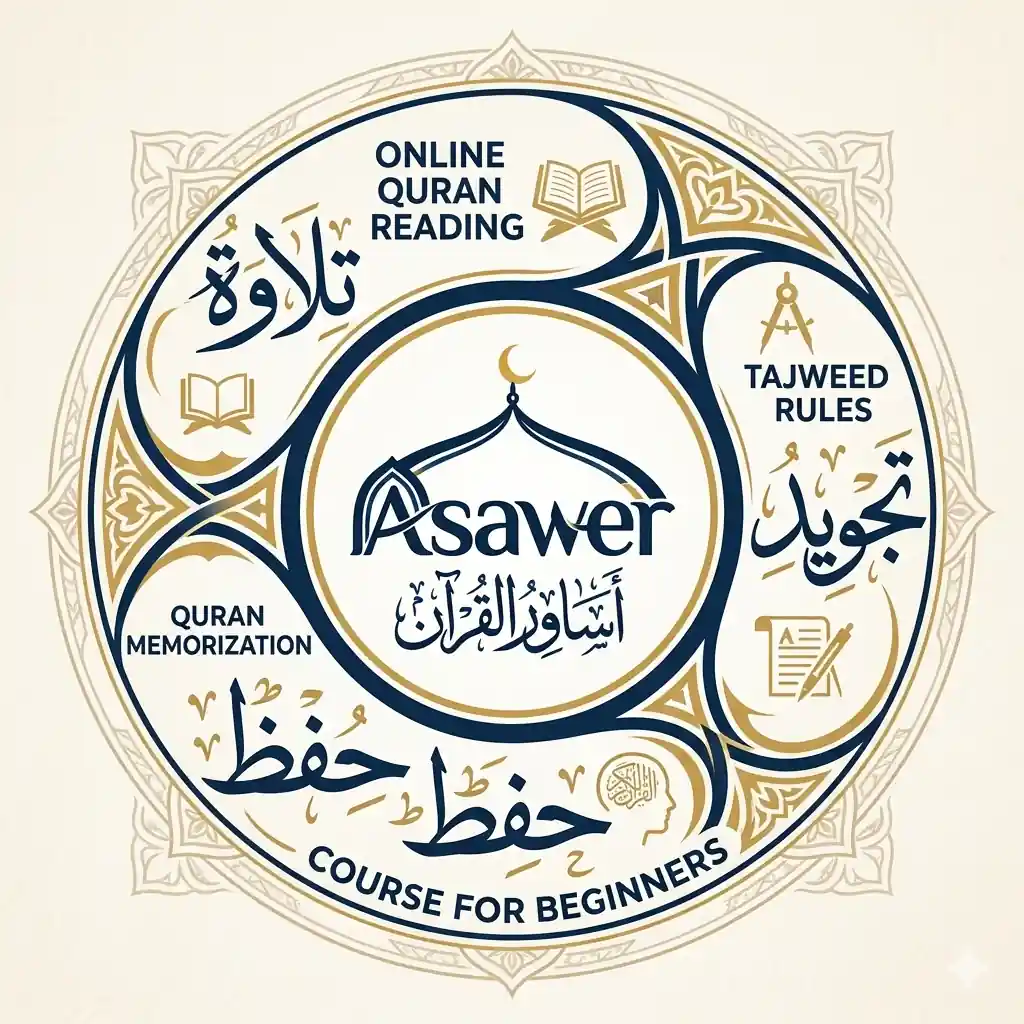
ONE PERSONALIZED PATH FOR READING, TAJWEED AND HIFZ

Online Quran Reading, Tajweed and Memorization Course

A beginner does not need three disconnected classes competing for attention. This course builds Quran reading first, introduces Tajweed at the point where it improves real recitation, and adds memorization through a revision plan the learner can maintain.
Children, adults, reverts and returning learners begin with a live level assessment. The teacher identifies whether the next priority is Arabic decoding, reading fluency, pronunciation, a Tajweed rule, new memorization or revision of previously learned Surahs. The course then combines only the strands that serve that learner’s current goal.
Asawer Academy video overlay.webp

Watch How the Integrated Course Works

Private Live Teaching

The teacher hears every mistake and adjusts the lesson to one learner.

One Integrated Plan

Reading, Tajweed and Hifz are combined only when the learner is ready.

Revision Before Expansion

New memorization is balanced with recent and older review.

Flexible Global Schedule

Recurring times can be discussed for families and adults across international time zones.
Online Quran Reading, Tajweed
WHY COMBINED COURSES OFTEN FAIL

Reading, Tajweed and memorization should support each other—not compete for the same lesson

A learner may memorize by listening while remaining unable to read the same verses from the Mushaf. Another may study Tajweed terminology but still pause at every word. A child may keep receiving new Surahs while older memorization becomes unstable. These are not motivation problems; they are pathway problems.
The integrated course uses one priority at a time. Reading establishes access to the text. Practical Tajweed corrects the sounds that affect the current passage. Memorization begins with portions small enough to recite accurately, and every new target is linked to a defined revision cycle.
THE INTEGRATED PATHWAY

Four stages, with movement based on evidence rather than a calendar

The learner can work across stages, but the teacher keeps one clear primary objective so the course never becomes overloaded.
01

Decode the Arabic Text

Recognize letters, vowels, joining patterns, Sukoon, Shaddah and common Mushaf signs until words can be read without transliteration.
02

Stabilize Reading Fluency

Reduce guessing and repeated pauses through guided reading, word-pattern practice and correction of high-impact mistakes.
03

Apply Tajweed in Context

Learn Makharij and selected rules inside the verses being read, then repeat until the sound becomes more consistent.
04

Memorize and Protect

Add a realistic new portion, review recent work and return to older Surahs through a planned retention cycle.
FULL COURSE CURRICULUM

Detailed Reading, Tajweed and Memorization Curriculum

Open each section to review the reading, Tajweed, memorization and personalization framework.
Starting points: complete beginner, partial alphabet knowledge, dependence on transliteration, slow decoding or repeated confusion between similar letters.

Core reading curriculum:
• Arabic letter recognition in isolated and connected forms.
• Fathah, Kasrah, Dammah, Tanween, Sukoon and Shaddah.
• Joining letters and reading common Quranic word patterns.
• Madd foundations and recognizing lengthening in the text.
• Heavy and light letter awareness at the appropriate level.
• Common Mushaf symbols and basic stopping awareness.
• Transition from Qaida material to short Surahs and selected Mushaf pages.

Milestone examples: reading a selected passage with fewer prompts, recognizing previously confusing forms and reducing reliance on transliteration.
Teaching principle: Tajweed is introduced as a recitation skill, not only a set of definitions.

Core Tajweed curriculum:
• Makharij of the letters most relevant to the learner’s errors.
• Selected Sifaat that help distinguish difficult sounds.
• Noon Sakinah and Tanween: Izhar, Idgham, Iqlab and Ikhfa.
• Meem Sakinah: Ikhfa Shafawi, Idgham Shafawi and Izhar Shafawi.
• Ghunnah, Qalqalah and practical nasalization control.
• Madd types introduced progressively.
• Tafkheem and Tarqeeq in selected letters and the word Allah.
• Waqf and Ibtida foundations during actual recitation.

Milestone examples: identifying the current rule, producing the corrected sound and applying it repeatedly in selected verses.
Memorization options: short Surahs, Juz Amma, selected Surahs, revision of previously memorized portions or a longer Hifz pathway.

Core memorization system:
• A portion size matched to age, reading ability and available review time.
• Teacher recitation and immediate correction before repetition fixes mistakes.
• New lesson: the portion being memorized now.
• Recent revision: material learned in the latest period.
• Older revision: Surahs or pages that need long-term protection.
• Connection points between verses to reduce hesitation.
• Meaning and key vocabulary where this supports retention.
• A realistic home-review plan for children and adults.

Milestone examples: reciting the assigned portion accurately, maintaining earlier work and following a review routine without constant prompting.
The course is not divided equally by default. A beginner may spend most of the lesson on reading, with a short memorization portion by listening. A fluent reader may focus on Tajweed correction and Hifz. A revision student may pause new memorization until earlier work becomes stable.

The teacher considers:
• Current reading and pronunciation.
• Age and attention span.
• Previous memorization and forgetting pattern.
• Whether the learner studies independently between classes.
• The time available each week.
• Family goals for a child, or personal goals for an adult.
• Preferred teacher and suitable recurring schedule.

Result: the student receives a clear first target instead of a long list of promises.
A LESSON WITH A CLEAR INTERNAL RHYTHM

Correction, new learning and revision each have a purpose

The teacher does not need to force every component into every lesson. The balance changes according to the learner’s stage, but the learner should always know the main target and the review responsibility.
For younger children, the lesson can use shorter activities, repetition and visible progress. For adults and reverts, explanations can be more direct and connected to prayer recitation and independent study.
Online Quran Reading, Tajweed & Memorization Course for Beginners
WHO CAN FOLLOW THIS COURSE

When an Integrated Quran Programme Is the Right Choice

This course is most useful when two or three Quran skills need to support each other inside one plan. A learner may read slowly and also want to memorise, may know Tajweed rules but fail to apply them during Hifz, or may have memorised Surahs that cannot be read confidently from the Mushaf. Choose the integrated route when the assessment finds a genuine connection between reading access, applied Tajweed and memorisation. Choose a specialist Qaida, Tajweed, Tafseer or Ijazah course instead when one discipline clearly needs full attention. Age changes the teaching style and lesson length, but the reason for joining this page is the need for a coordinated multi-skill Quran plan.

Children and Parents

Suitable for children who need a connected path from Qaida or reading into Tajweed and short-Surah memorization. Parents should discuss lesson length, teacher match, supervision, progress communication and the amount of home review expected.

Adults and Returning Learners

Suitable for adults beginning from zero, correcting long-standing reading habits, rebuilding fluency or combining selected memorization with Tajweed. Private lessons provide room to ask questions without comparison or embarrassment.

Reverts and Non-Arabic Speakers

Suitable for learners who need Quranic Arabic sounds explained clearly in English, a practical start with Al-Fatihah and prayer Surahs, and a plan that avoids permanent dependence on transliteration.
PROGRESS PARENTS AND LEARNERS CAN UNDERSTAND

Measure skills and retention, not only pages completed

Progress is reviewed through reading accuracy, Tajweed application, new memorization and retention across recent and older revision. The format of any notes or reports is explained before enrolment.
A

Reading Accuracy

Track the letters, vowels, word patterns and passages that still require correction.
B

Tajweed Application

Record the current rule, the learner’s common error and the passage used for practice.
C

New Memorization

Keep the assigned portion realistic and confirm accuracy before increasing it.
D

Retention and Revision

Check recent and older work so visible progress does not hide growing gaps.
Learn Arabic With Asawer
QUESTIONS PARENTS SHOULD ASK IN THE FREE TRIAL

A good course decision is based on the learning plan, not a dramatic promise

Parents in the United States, Canada and Australia often need clarity about safety, teacher suitability, scheduling and whether memorization will remain stable. The trial should help the family understand the actual plan before regular lessons begin.

What Happens in the Free Assessment

The teacher listens to reading or recitation, reviews previous memorization, discusses age and goals, and identifies the single most useful first target. The academy then confirms the suitable teacher and recurring time.

What the Free Assessment Clarifies

The free assessment clarifies lesson duration, class frequency, teacher match, materials, parent updates, attendance terms, package price and whether any certificate or Ijazah applies to the selected route.
FREQUENTLY ASKED QUESTIONS

Questions learners and parents ask before joining

Clear answers about combining the three skills, revision, scheduling, siblings, teachers and realistic progress.
A beginner may memorize a small number of short Surahs through listening and repetition while building reading skills. The teacher should keep the memorization target small enough that it does not replace the reading foundation.
Essential pronunciation correction should begin early, especially for letters and mistakes that affect the word. Detailed rule study should be introduced progressively so it supports reading rather than overwhelming it.
The plan separates new memorization, recent review and older revision. When retention becomes weak, the teacher may reduce or pause the new portion so revision can recover.
Parents can discuss goals during the assessment. The teacher should consider reading level, previous memorization, age and available revision time before confirming the sequence.
Yes. Adults and reverts can follow a private pathway beginning with letters, Al-Fatihah, prayer Surahs, reading fluency, Tajweed correction or selected memorization according to level.
A male or female teacher can be requested. The academy confirms the final match according to level, language, subject and schedule availability.
The course does not have one responsible completion time because it combines skills with different timelines. The assessment should establish shorter milestones for reading, Tajweed and memorization.
The suitable frequency depends on age, goals, class duration and home practice. Memorization usually requires consistent contact and review, while a busy adult may begin with a lighter plan.
Parents can help protect a quiet practice time, play the assigned recitation when advised, listen without introducing conflicting corrections, and inform the teacher when the home target is unrealistic.
It may be possible when their age, level and learning pace are close, but one-to-one teaching usually allows more precise correction. Ask the academy to compare both learners before choosing the format.
A stable internet connection and a phone, tablet or computer are generally sufficient. A headset can improve sound clarity, and the meeting platform is confirmed before the first lesson.
Attendance and pause arrangements are explained before enrolment. After a long break, the teacher reassesses retention before adding new memorization.

Asawer Academy

Asawer Academy specializes in teaching the Quran, Arabic, and Islamic Studies to non-Arabic speakers through live one-to-one online lessons.

📞

Phone / WhatsApp

+20 102 830 2494
✉️

Email Address

[email protected]
🌐

No credit card required. We'll confirm your lesson via email and phone.