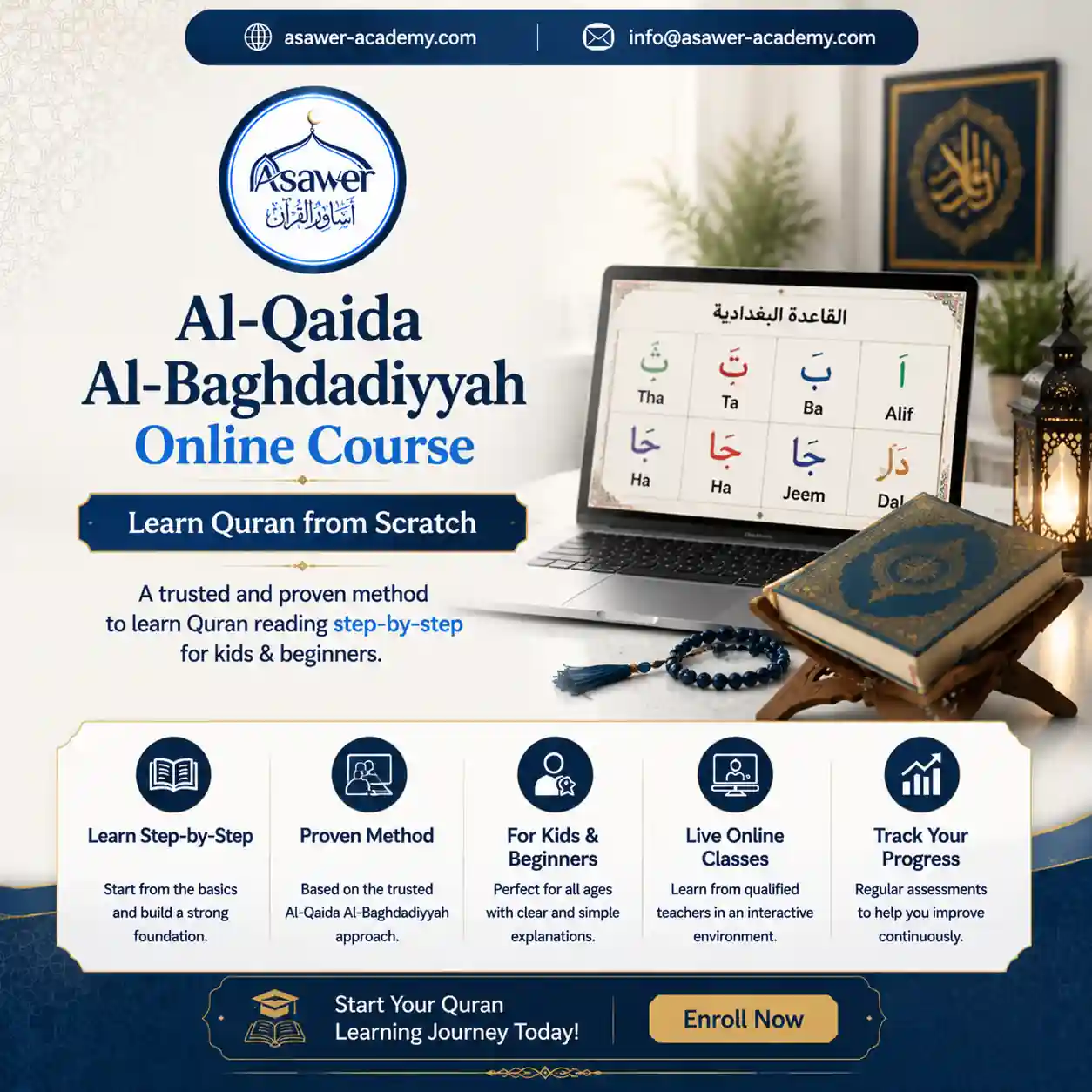
A TRADITIONAL LETTER-TO-WORD METHOD, REBUILT FOR LIVE ONLINE LEARNING

Al-Qaida Al-Baghdadiyyah Online Course: Learn Quran Reading Through Structured Word Building

Al-Qaida Al-Baghdadiyyah Online Course: Learn Through Tahajji and Word Construction
This online course is designed for children, adult beginners, new Muslims and learners who remember a traditional Qaida method but still need help reading independently. The free assessment identifies whether the student should begin with the alphabet, connected forms, Harakat, word assembly or the transition between standard Arabic and Uthmani Mushaf script.
Asawer Academy video overlay.webp

Watch the Baghdadi Word-Building Method

The workshop question
Can the learner explain the parts, produce the sound and rebuild the word without waiting for the teacher to supply it?

Teacher-Guided Tahajji

Al-Qaida Al-Baghdadiyyah teaches the learner to reconstruct a word from its visible parts. The student names or analyses the letter and sign, produces the reading unit, assembles the units in order and then removes the Tahajji scaffold to read the word naturally. This analytical sequence—not general phonics or rapid page completion—is the defining method of the course. The online delivery keeps the traditional progression while using mixed examples, digital word-building tools and transfer checks so the learner does not merely memorise a familiar page.

Cumulative Word Construction

Every new pattern is added to earlier skills so words and sentences are built step by step.

Arabic and Mushaf Script Bridge

The course prepares learners to notice differences between ordinary Arabic print and Uthmani Quranic script.

Mastery Before the Next Pattern

Repetition is used deliberately until the learner can recognise and rebuild an unfamiliar example.
Al-Qaida Al-Baghdadiyyah Online Course Learn Quran from Scratch
WHAT MAKES THE BAGHDADIYYAH METHOD DISTINCT

The learner does not jump from a picture of a word to its pronunciation

Traditional Baghdadi-style teaching is known for ordered repetition and progressive spelling or Tahajji. In many editions, the learner names the letter and reading sign, produces the resulting sound, and then combines the parts. That verbal analysis can make the structure of the word visible instead of turning the page into a memory test.
Modern delivery should preserve the method’s discipline without preserving its weaknesses. The teacher can randomize examples, compare similar letters, test transfer to a new word, use a digital pointer and shorten repetitive drills when the learner has already demonstrated mastery.
THE BAGHDADI WORD-BUILDING WORKSHOP

Six actions turn repetition into independent reading

01

See the Components

Identify the letter shape, dots, position and the written sign attached to it.
02

Name or Analyse

State the letter and sign according to the selected Baghdadi edition and teacher method.
03

Produce the Unit

Convert the analysis into the correct short, long, still or doubled sound.
04

Assemble the Word

Join the reading units in order without adding, dropping or stretching sounds.
05

Read Without the Scaffold

Repeat the word normally after the analytical spelling has done its job.
06

Transfer to a New Example

Use the same pattern in an unfamiliar word, sentence or short Quranic passage.
EIGHT MASTERY GATES

A complete path from the first letter to Quranic text

G0

Entry Diagnosis

Letter knowledge, pronunciation, visual tracking, reading habits and previous Qaida experience.
G1

Letter Inventory

Names, sounds, Makharij priorities and visual differences between similar letters.
G2

Forms and Connections

Beginning, middle and end forms; letters that connect and letters that break connection.
G3

Harakat Assembly

Fathah, Kasrah and Dammah through analysed syllables and mixed word construction.
G4

Madd and Tanween

Long-vowel structure, short/long contrast and the three forms of Tanween.
G5

Sukoon and Shaddah

Still letters, doubled structures and increasingly complex word assembly.
G6

Word and Sentence Reading

Definite article, sun/moon letters and graded Arabic sentence practice where included.
G7

Mushaf Transfer

Quranic words, Uthmani script, basic reading signs and a controlled transition to recitation.
COMPLETE BAGHDADIYYAH CURRICULUM

Seven detailed gates inside one visually controlled syllabus

Skills:
• Recognize letters in random order rather than only reciting the alphabet sequence.
• Learn the names used by the selected primer.
• Match the name, printed form and basic sound.
• Distinguish visually related letters through shape and dots.
• Correct the Makharij that most affect the learner’s current reading.
• Compare heavy and light articulation only at an age-appropriate level.

Mastery evidence: the learner identifies and produces the target letters without relying on page order.
Skills:
• Recognize isolated, initial, medial and final forms.
• Identify letters that do not connect to what follows.
• Break a connected word into visible components.
• Rebuild short combinations from their parts.
• Avoid treating every connected form as a new letter.

Mastery evidence: the learner can locate a familiar letter inside an unfamiliar word and explain its position.
Skills:
• Read Fathah, Kasrah and Dammah as distinct short sounds.
• Use the teacher’s selected Tahajji or analytical formula.
• Assemble two- and three-part reading units.
• Remove the analytical scaffold and read the complete word normally.
• Avoid stretching the short vowel or carrying a previous vowel into the next example.

Mastery evidence: the learner analyses and reads a mixed-vowel word without a complete teacher model.
Skills:
• Understand the relationship between a short vowel and its Madd letter.
• Preserve the contrast between short and long sounds.
• Recognize suitable Leen patterns where included.
• Read Fathatayn, Kasratayn and Dammatayn in words and short phrases.
• Combine new signs with previously learned letter forms.

Mastery evidence: the learner reads mixed examples without making every vowel the same length.
Skills:
• Join a moving letter to a still letter without inserting another vowel.
• Analyse Shaddah as a doubled consonant structure.
• Combine Shaddah with short vowels, Tanween and Madd.
• Read increasingly long words without losing the earlier components.
• Use repetition to stabilize the structure, not simply memorize the page.

Mastery evidence: the learner can rebuild and then read a new word containing Sukoon or Shaddah.
Where included in the selected edition:
• Alif-Lam of the definite article.
• Lam Qamariyyah and Lam Shamsiyyah.
• Definite and indefinite word patterns.
• Tarqeeq and Tafkheem in selected contexts.
• Graded vocabulary, phrases and complete Arabic sentences.
• Reading for accuracy before reading for speed.

Mastery evidence: the learner applies the studied pattern in a new sentence rather than only a memorized drill.
Skills:
• Compare familiar Arabic typography with Uthmani Mushaf signs.
• Recognize that Quranic orthography may differ from school spelling conventions.
• Read selected Quranic words containing mastered patterns.
• Introduce foundational Tajweed and stopping guidance gradually.
• Practise short Surahs or passages without permanent transliteration.

Mastery evidence: the learner reads selected Mushaf text with a manageable level of prompting and a specific next correction target.
THE BAGHDADI DIAGNOSTIC WORKSHOP

Traditional repetition works only when the teacher tests independence

A

Sequence Dependence

The learner recites letters or examples in order but cannot identify one when the order changes.
B

Spelling Without Reading

The learner can repeat the analytical formula but cannot remove it and read the word naturally.
C

Added or Missing Vowels

The learner inserts a sound after Sukoon, loses a Harakah or changes short vowels during assembly.
D

Page Memorization

The learner remembers a familiar exercise but cannot transfer the pattern into a new word.
THE LIVE APPRENTICESHIP LESSON

Traditional sequence, modern feedback and one clear reading target

A Baghdadi lesson can keep the discipline of the traditional Kuttab while avoiding passive repetition. The teacher models only as much as needed, then changes the example and checks whether the learner can reconstruct the reading independently.
Al Qaida Al Baghdadiyyah Online Course
THREE FOUNDATIONS—THREE TEACHING EMPHASES

Baghdadiyyah, Noorani Qaida and Noor Al Bayan should not share the same sales page

Al-Qaida Al-Baghdadiyyah

Common emphasis: letter names, written signs, analytical spelling or Tahajji, repeated graded examples, then movement from letters to words and sentences. It can also make the Arabic/Uthmani script distinction explicit.

Noorani Qaida

Common emphasis: a compact Quran-reading sound sequence, connected forms, Harakat, Madd, Sukoon, Shaddah and early Tajweed through Quranic examples. Many editions use a more direct phonics-style presentation.

Noor Al Bayan

Common emphasis: wider Arabic phonics and literacy, with graded words and sentences and, in some programmes, handwriting, spelling, dictation and comprehension alongside Quran preparation.
FOUR LEARNER PATHWAYS

The traditional method changes pace and presentation without losing its sequence

4–6

Early Child Route

Short drill sets, visual pointing, letter-name security and parent-supported repetition before longer words.
7–11

School-Age Route

Full word-building sequence, sentence reading, controlled writing and independent transfer checks.
Teen

Correction and Restart Route

A faster diagnostic entry for learners who know letters but remain slow, hesitant or dependent on memorized pages.
Adult

Adult and Revert Route

Private explanation, prayer priorities, correction without embarrassment and gradual removal of transliteration.
Al Qaida Al Baghdadiyyah
THE ARABIC-TO-MUSHAF BRIDGE

A strong Baghdadi course prepares the learner for a change in script—not only harder words

A learner may read a clear educational font and then feel that the Mushaf is a different language. The transition should therefore introduce Uthmani signs and script forms deliberately, while using words that contain patterns the student has already mastered.
PROGRESS BEYOND PAGE COMPLETION

Four evidence points show whether the method is becoming independent reading

01

Identifies

Recognizes the letter, sign and position without relying on page order.
02

Analyses

Names or breaks down the components using the selected Baghdadi formula.
03

Assembles

Combines the parts into the correct word or phrase without inserted sounds.
04

Transfers

Reads a new Arabic or Quranic example using the same structure.
TRADITIONAL REPETITION NEEDS A MODERN FEEDBACK LOOP

Practise the construction—not only the familiar page

Home Repetition That Preserves the Method

Course Details Explained Before Enrolment

A TRADITIONAL METHOD AVAILABLE ACROSS MODERN TIME ZONES

Scheduling for learners in the USA, Canada and Australia

US

United States

Discuss after-school, evening or weekend options and an English-supported teacher where required.
CA

Canada

Confirm local-time lessons, teacher continuity, family travel and parent progress communication.
AU

Australia

Check AEST, ACST or AWST compatibility around school, homework and bedtime.
FREQUENTLY ASKED QUESTIONS

Questions families and adult beginners ask about Baghdadi Qaida

It is a traditional graded method for beginner Arabic and Quran reading. Common versions begin with letters, then reading signs and analysed or spelled combinations, before progressing to words, sentences and Quranic text.
Baghdadi teaching commonly gives greater emphasis to letter names, analytical spelling or Tahajji, cumulative repetition and movement into words and sentences. Noorani Qaida commonly uses a more compact Quran-specific sound sequence. Editions and teachers vary.
No. Children, adult beginners and new Muslims can study it. The teacher should adapt the pace, explanation language, repetition length and prayer priorities.
No. Analytical spelling is a scaffold. The learner should eventually remove the scaffold and read the complete word naturally. The teacher checks when analysis is still useful and when it has become unnecessary.
Yes, it can begin with the alphabet. The trial may place a learner later if they already recognize letters or read simple words.
Some primers include letter-position examples and writing practice, while others focus mainly on reading. The selected book and the role of writing are explained before enrolment.
It can include foundational pronunciation and selected reading rules. A complete Tajweed curriculum normally continues after the learner can read connected Quranic text.
Standard Arabic print follows normal spelling conventions, while the Mushaf contains Uthmani orthographic forms and recitation signs. A good transition helps the learner recognize both without treating them as unrelated scripts.
There is no responsible fixed duration before assessment. Age, starting point, class frequency, repetition, pronunciation and the selected primer all affect the timeline.
Yes, with a teacher who can explain the spelling formula and pronunciation clearly in the learner’s language. English-guided Baghdadi primers also exist.
Readiness varies at early ages. The free assessment checks attention, speech, visual tracking and participation before recommending a lesson length and starting route.
The learner should identify, analyse, assemble and transfer the pattern. A familiar page read from memory is not enough evidence.
Yes, when the assessment shows gaps in connected forms, vowels, Sukoon, Shaddah or word assembly. A fluent reader with mainly Tajweed errors may need a different course.
A small listening-based memorization target may run alongside the reading foundation. It should not replace development of independent decoding.
The exact Baghdadi primer and its digital or physical format are explained before enrolment, together with any worksheets, audio practice or writing resources required for the selected route.
The learner may move into direct Mushaf reading, practical Tajweed, Quran memorization or a broader Arabic reading course, depending on the assessment result.

Asawer Academy

Asawer Academy specializes in teaching the Quran, Arabic, and Islamic Studies to non-Arabic speakers through live one-to-one online lessons.

📞

Phone / WhatsApp

+20 102 830 2494
✉️

Email Address

[email protected]
🌐

No credit card required. We'll confirm your lesson via email and phone.