Tafkheem and Tarqeeq are two important rules in Tajweed because they shape the sound of Arabic letters during Quran recitation. Tafkheem means giving a letter a heavier, fuller sound, while Tarqeeq means keeping the letter light and thin. For many beginners, especially children and non-Arabic speakers, the rule is easy to memorize but harder to hear. This guide explains the meaning, letters, examples, common mistakes, and simple practice steps so students can understand the rule before applying it in recitation.
Quick answer: Tafkheem means heavy pronunciation in Tajweed, while Tarqeeq means light pronunciation. The main Tafkheem letters are collected in the phrase خُصَّ ضَغْطٍ قِظْ. Most other Arabic letters are light by default, except special cases such as the letter Raa and the Laam in the word Allah.
What Do Tafkheem and Tarqeeq Mean in Tajweed?
In Tajweed, Tafkheem means pronouncing a letter with heaviness. The sound becomes fuller and deeper, but it should still be controlled and natural. Tafkheem does not mean shouting, forcing the throat, or making the voice rough. It is a sound quality that belongs to specific Arabic letters and specific cases.
Tarqeeq means pronouncing a letter lightly. The sound stays thin, clear, and free from heaviness. Most Arabic letters are pronounced with Tarqeeq unless a Tajweed rule changes that sound.
A teacher may explain it to a child like this: “Some letters need a strong sound, and some letters need a gentle sound. Your job is not to make everything heavy. Your job is to give every letter the sound it deserves.”
Teacher observation: Many students memorize the seven heavy letters quickly, but they still pronounce them incorrectly. Why? Because Tafkheem and Tarqeeq are heard before they are mastered. A child may know that ق is heavy, but still pronounce it close to ك until a teacher corrects the sound.
The Difference Between Tafkheem and Tarqeeq
The difference between Tafkheem and Tarqeeq is not just a definition in a Tajweed book. It changes how the letter sounds in actual Quran recitation. If a heavy letter becomes too light, the recitation may lose clarity. If a light letter becomes too heavy, the reading can sound unnatural and difficult to follow.
For example, the difference between ص and س is not only the place of articulation. The sound quality also changes. The letter ص carries heaviness, while س remains light.
| Point | Tafkheem | Tarqeeq |
|---|---|---|
| Meaning | Heavy or thick pronunciation | Light or thin pronunciation |
| Sound | Fuller, deeper, and stronger | Clearer, lighter, and thinner |
| Main letters | خ، ص، ض، غ، ط، ق، ظ | Most other Arabic letters by default |
| Common beginner issue | Making heavy letters weak or flat | Accidentally making light letters heavy |
This comparison is useful for young learners because it turns a difficult rule into something they can hear. Once the child hears the difference between قَ and كَ, the written rule becomes much easier to understand.
Tafkheem Letters in Arabic
The main Tafkheem letters are seven. They are collected in the famous phrase:
خُصَّ ضَغْطٍ قِظْ
خ – ص – ض – غ – ط – ق – ظ
These are the letters of Isti‘laa. In simple words, the back of the tongue rises during their pronunciation, and this rising quality contributes to their heavy sound.
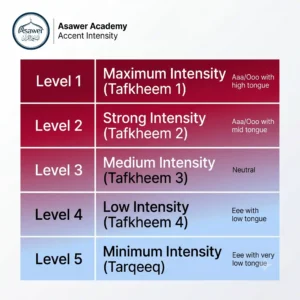
However, students should be careful. Memorizing the letters is only the first step. These letters do not always have the exact same strength of heaviness. A heavy letter with a Fathah followed by Alif is usually stronger than the same letter with a Kasrah.
That is why the next article in this cluster focuses on the levels of Tafkheem in Tajweed, because students need to understand that Tafkheem has degrees, not one fixed sound.
Examples of Tafkheem Letters
| Letter | Example Sounds | What the Student Should Notice |
|---|---|---|
| ق | قَ – قُ – قِ | The letter remains heavy, but the strength changes with the vowel. |
| ط | طَ – طُ – طِ | The sound is strong and should not become close to ت. |
| ص | صَ – صُ – صِ | Students often make it too close to س if the heaviness is weak. |
| ض | ضَ – ضُ – ضِ | This letter needs teacher correction because many beginners mispronounce it. |
Tarqeeq Letters in Arabic
Tarqeeq is the light pronunciation of letters. In general, most Arabic letters are light unless a rule makes them heavy. This is an important point because some students learn Tafkheem, then start adding heaviness to too many letters.
Letters such as ت، س، ك، ف، م، ن are usually pronounced lightly. If a student makes them heavy, the recitation may sound unnatural. For example, if س starts sounding like ص, the student has moved from a light sound to a heavy sound by mistake.
A helpful teaching sentence is: “Do not make every letter heavy to sound better. Tajweed is not about making the voice strong. It is about making each letter accurate.”
Does Alif Have Tafkheem or Tarqeeq?
The letter Alif follows the letter before it. If the letter before Alif is heavy, the Alif follows that heaviness. If the letter before it is light, the Alif stays light.
- قَالَ – the Alif follows the heavy ق.
- كَانَ – the Alif follows the light ك.
This is a small rule, but it helps students avoid making every long “aa” sound the same.
Letters That Can Change Between Tafkheem and Tarqeeq
Some letters need extra attention because they are not always heavy or always light in the same simple way. Their pronunciation changes depending on the vowel or the surrounding letters.
The Letter Raa
The letter Raa can be pronounced with Tafkheem in some cases and Tarqeeq in other cases. For example, Raa is generally heavy when it has a Fathah or Dammah, and light when it has a Kasrah. There are also special cases when Raa is silent and affected by the vowel before it.
Because Raa has detailed rules, this main article should not carry every detail. For the full lesson, read Raa Tafkheem and Tarqeeq rules with examples.
The Laam in the Word Allah
The Laam in the word Allah is also special. It is heavy when it comes after a Fathah or Dammah, and light when it comes after a Kasrah.
- قَالَ اللهُ – the Laam is heavy because it follows a Fathah.
- بِسْمِ اللهِ – the Laam is light because it follows a Kasrah.
Many children understand this rule quickly when they hear both examples side by side. The challenge is remembering it while reading naturally.
How Tafkheem Connects to Sifaatul Huroof
Tafkheem and Tarqeeq are closely connected to the qualities of Arabic letters. In Tajweed, these qualities are known as Sifaatul Huroof.
When a student studies Sifaatul Huroof, they begin to understand why some letters sound heavy and why others remain light. For example, the letters of Isti‘laa naturally carry heaviness because of their sound quality. Some of these letters also have stronger qualities that make the heaviness clearer.
This connection helps the learner stop memorizing rules as separate pieces. Instead, the student begins to see Tajweed as one connected system: letter qualities, articulation points, and recitation rules all work together.
How Tafkheem Connects to Makhaarij al-Huroof
Tafkheem also connects strongly to Makhaarij al-Huroof, which means the articulation points of Arabic letters. If the student produces the letter from the wrong place, the heaviness or lightness will often be affected.
For example, if a child pronounces ق too close to ك, the sound may lose its heaviness. If the student pronounces ص too close to س, the difference between the two letters becomes weak.
This is why a teacher does not only say, “Make it heavy.” A good teacher listens to where the sound is coming from, then corrects the letter step by step.
Practical tip: Do not practice Tafkheem by making your voice louder. Practice it by placing the letter correctly, listening carefully, and repeating slowly until the heavy sound becomes natural.
Common Mistakes in Tafkheem and Tarqeeq
Most mistakes happen because students try to apply the rule before they can hear the sound clearly. This is normal. Tajweed is not only reading information; it is sound training.
Making Heavy Letters Too Light
This happens when a student reads a Tafkheem letter as if it were a normal light letter. For example, ص may sound too close to س, or ق may sound too close to ك.
The solution is not to exaggerate the sound. The solution is to return the letter to its correct articulation point and give it its natural heaviness.
Making Light Letters Too Heavy
Some students become so focused on heavy letters that they accidentally make light letters heavy too. This often happens when a light letter comes next to a heavy letter.
A teacher may stop the student and say, “The heavy letter is finished. Now return to a light sound.” This small correction makes a big difference in recitation quality.
Giving Every Heavy Letter the Same Strength
Not every heavy letter is pronounced with the same strength in every case. The vowel affects the level of Tafkheem. A heavy letter with Fathah followed by Alif is not the same as a heavy letter with Kasrah.
This is why students should study the levels after understanding the basic difference between heavy and light letters.
Ignoring Raa and Laam Rules
Some students memorize the seven heavy letters and think the lesson is finished. But Raa and the Laam in Allah have special rules. Because they appear often in recitation, mistakes with them can happen frequently if the student does not practice carefully.
Examples of Tafkheem and Tarqeeq for Practice
The table below gives simple examples. The goal is not only to read the words, but to notice why the sound is heavy or light.
| Example | Type | Reason | Practice Note |
|---|---|---|---|
| قَالَ | Tafkheem | ق is a heavy letter, and the Alif follows its heaviness. | Do not make ق sound like ك. |
| سَمِعَ | Tarqeeq | س is a light letter. | Keep the sound thin and clear. |
| صَبَرَ | Tafkheem | ص is heavy, and Raa with Fathah is also heavy. | Avoid turning ص into س. |
| رِزْق | Raa Tarqeeq + heavy ق | Raa with Kasrah is light, while ق remains heavy. | Do not let the heavy ق affect the light Raa. |
| بِسْمِ اللهِ | Light Laam | The Laam in Allah follows a Kasrah. | Keep the Laam light and natural. |
How Kids Can Practice Tafkheem and Tarqeeq at Home
Parents do not need to be Tajweed teachers to support their children. They can still help by making practice short, calm, and regular.
A common parent-child moment sounds like this: the child knows that ص is heavy, but while reading, it comes out like س. The parent may feel unsure how to correct it. The best correction is not a long lecture. It is a simple reminder: “Try that letter again, but make it heavier.”
Here is a practical home routine:
- Practice only 3 to 5 examples at a time.
- Choose one sound for the day, such as ق or ص.
- Let the child repeat after the teacher or a correct recording.
- Compare one heavy letter with one light letter.
- Do not correct every mistake at once.
- Praise small improvement in sound.
For children, confidence matters. If the child feels embarrassed every time they make a pronunciation mistake, they may start avoiding recitation practice. Gentle correction works better than pressure.
Parent tip: If your child keeps mixing ق and ك, practice them as a pair: قَ، كَ، قُ، كُ، قِ، كِ. Short sound pairs are often more useful than reading a long page too early.
How Asawer Academy Helps Children Learn Quran Pronunciation
Reading about Tafkheem and Tarqeeq is helpful, but children usually need a teacher to hear and correct the actual sound. Some mistakes are too small for the child to notice alone, especially when they are still learning Arabic letters and Quran reading.
At Asawer Academy, children can learn Quran recitation online with teacher guidance, step-by-step correction, and a pace that matches their level. This is especially helpful for Muslim families living in English-speaking countries, where children may not hear Arabic sounds every day.
If your child is learning Tajweed or struggling with heavy and light letters, you can explore online Quran classes for kids at Asawer Academy. A teacher can check your child’s level, correct pronunciation, and build a simple learning plan.
Book Your Free Trial Class Now at Asawer Academy
Where to Go Next
This article gives you the foundation of Tafkheem and Tarqeeq in Tajweed. After understanding the main difference between heavy and light letters, the next step is to study the detailed branches one by one.
- To understand why heavy letters have different strengths, read: Levels of Tafkheem in Tajweed.
- To master one of the most common special cases, read: Raa Tafkheem and Tarqeeq Rules.
- To understand the qualities behind Arabic sounds, read: Sifaatul Huroof.
- To learn where Arabic letters come from, read: Makhaarij al-Huroof.
FAQ About Tafkheem and Tarqeeq in Tajweed
What is Tafkheem in Tajweed?
Tafkheem in Tajweed means pronouncing a letter with a heavy, thick, or full sound. It mainly applies to the seven heavy letters collected in the phrase خُصَّ ضَغْطٍ قِظْ.
What is Tarqeeq in Tajweed?
Tarqeeq means pronouncing a letter with a light or thin sound. Most Arabic letters are light by default unless a specific Tajweed rule gives them heaviness.
What are the letters of Tafkheem?
The main letters of Tafkheem are خ، ص، ض، غ، ط، ق، ظ. Students often memorize them through the phrase خُصَّ ضَغْطٍ قِظْ.
Are all Tafkheem letters pronounced with the same heaviness?
No. Tafkheem has levels. A heavy letter with Fathah followed by Alif is usually stronger than the same heavy letter with Kasrah.
Are most Arabic letters Tafkheem or Tarqeeq?
Most Arabic letters are pronounced with Tarqeeq by default. Only specific letters and special cases require Tafkheem.
Can the letter Raa be both heavy and light?
Yes. The letter Raa can be pronounced with Tafkheem or Tarqeeq depending on its vowel and the letters before it. This is why Raa has its own detailed rules in Tajweed.
When is the Laam in Allah heavy?
The Laam in the word Allah is heavy when it comes after a Fathah or Dammah. It is light when it comes after a Kasrah.
Why do children confuse Tafkheem and Tarqeeq?
Children often confuse Tafkheem and Tarqeeq because the difference is heard more than seen. They may understand the rule but still need listening practice and teacher correction.
How can parents help children practice Tafkheem?
Parents can help by using short practice sessions, comparing heavy and light letter pairs, and encouraging the child without pressure. A few accurate examples are better than a long page read incorrectly.
Can children learn Tafkheem and Tarqeeq online?
Yes. Children can learn Tafkheem and Tarqeeq online when the class includes live teacher correction, repetition, and simple examples.
Does Asawer Academy teach Tafkheem and Tarqeeq?
Yes. Asawer Academy teaches Quran recitation and Tajweed online, including pronunciation correction, Makhaarij, Sifaat, and rules such as Tafkheem and Tarqeeq.
Can I book a trial class for my child?
Yes. You can book a free trial class at Asawer Academy so a teacher can check your child’s level and recommend the best learning path.