Some Arabic letter qualities are not learned through direct opposites. They have their own sound behavior, and each one needs careful listening. These are known as Sifaatul Huroof without Opposites. In Tajweed, they help students understand special qualities such as echo, whistle, softness, spreading, repetition, and extension. This topic can feel technical at first, but it becomes much clearer when each quality is connected to real recitation instead of memorized as a dry list.
What Are Sifaatul Huroof without Opposites?
Sifaatul Huroof without opposites are letter qualities that do not have a direct opposite quality. They are usually attached to specific Arabic letters or small groups of letters.
For example, Qalqalah is not usually taught as “the opposite” of another quality. It is a unique sound feature that appears in certain letters under certain conditions. The same applies to qualities like Safeer, Tafashee, and Istitalah.
Example: Qalqalah
If you are new to the topic, it is better to begin with the main overview of Sifaatul Huroof and the qualities of Arabic letters before studying this section in detail.
How They Differ from Sifaatul Huroof with Opposites
The easiest way to understand this group is to compare it with the qualities that have opposites.
| Type of Sifah | How It Is Studied | Example |
|---|---|---|
| With Opposite | The quality is understood by comparing it with its opposite. | Hams and Jahr |
| Without Opposite | The quality is studied as a unique sound feature. | Qalqalah, Safeer, Tafashee |
So, when you study Sifaatul Huroof without Opposites, you are not asking, “What is the opposite of this quality?” Instead, you are asking, “What special sound feature does this letter have, and how should I apply it correctly?”
To understand the paired group, you can also read Sifaatul Huroof with Opposites.
The Main Sifaatul Huroof without Opposites
The qualities in this group are important because they are very easy to exaggerate or ignore. Some students remove the quality completely. Others make it too strong. Good Tajweed correction is usually somewhere in the middle.
| Quality | Simple Meaning | Common Student Issue |
|---|---|---|
| Qalqalah | A controlled echo or bounce in specific letters. | The student removes it or makes it too strong. |
| Safeer | A whistle-like sound in certain letters. | The sound becomes too sharp or unclear. |
| Leen | Softness and ease in specific letters. | The student makes it too stiff or too stretched. |
| Tafashee | Spreading of the sound. | The sound spreads too much or becomes weak. |
Qalqalah
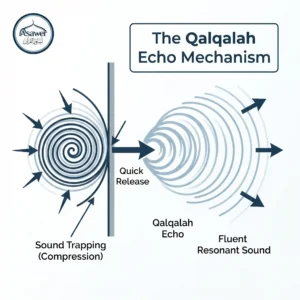
Qalqalah is one of the most recognizable qualities without an opposite. It is usually described as a light echo or bounce that appears with specific letters, especially when they carry sukoon or when stopping on them.
قُطْبُ جَدٍّ
Many learners know the famous phrase for the qalqalah letters, but the real challenge is not memorizing the letters. The challenge is applying the echo correctly. It should be heard, but not exaggerated.
A common teacher correction sounds like this: “I can hear the qalqalah, but make it lighter.” Or the opposite: “The letter disappeared; give it a small bounce.”
Safeer
Safeer refers to a whistle-like sound connected with certain letters. This quality is usually associated with:
Students often struggle with Safeer when they speak English most of the time and do not naturally produce these Arabic sounds with clarity. The goal is not to make an artificial whistle. The goal is to allow the natural sharpness of the letter to appear without forcing it.
Leen
Leen means softness or ease. It is connected with waw and yaa in specific conditions.
This quality should feel smooth. Some students make the sound too dry or stiff, especially when reading slowly. Others stretch it more than needed. A teacher helps the student keep it soft without turning it into an incorrect extension.
Inhiraf
Inhiraf is often explained as a slight leaning or deviation of the sound. It is connected with specific letters, commonly:
This quality is subtle. It is not always the first thing a beginner hears. With time, however, the student starts to notice how certain letters do not come out in a completely straight sound path.
Takreer
Takreer is connected with the letter ر. It refers to the natural tendency of the tongue to repeat or vibrate slightly when pronouncing the letter.
This is a good place to be careful. Tajweed teachers usually warn students not to exaggerate the repetition of ر. The quality is recognized, but it should be controlled.
A student may think, “If Takreer exists, I should roll the r strongly.” That is not the aim. The aim is to pronounce the letter correctly while preventing extra repeated beats.
Tafashee
Tafashee is the spreading of the sound. It is commonly connected with the letter:
This quality is often easier to hear than to describe. When the letter ش is pronounced, the sound spreads in the mouth. The student should allow that spread naturally without making the letter weak or noisy.
Istitalah
Istitalah is connected with the letter:
It is usually described as an extension of the sound along the side of the tongue. This quality is one reason why ض needs careful teacher correction. Many non-native Arabic speakers confuse it with other heavy letters or pronounce it too quickly.
If a student is not sure whether the ض is correct, reading a definition will not be enough. The sound needs to be heard, corrected, and repeated.
Why These Qualities Are Easy to Misapply
Sifaatul Huroof without opposites are easy to misapply because many of them are noticeable. Once a student learns that Qalqalah has a bounce, or Safeer has a whistle-like sound, the student may try too hard to show it.
The opposite can also happen. Some learners focus only on fluency and speed, so the unique quality becomes weak or disappears inside recitation.
A balanced approach asks:
- Is the quality present?
- Is it natural?
- Is it controlled?
- Is it applied correctly inside Quran words?
This balance is why Sifaatul Huroof should be studied with listening and correction, not just memorization.
Common Mistakes Students Make with Sifaat without Opposites
Mistake 1: Exaggerating Qalqalah
Some students make qalqalah sound like an extra vowel. This can affect the accuracy of recitation. Qalqalah should be clear, but it should not create a new movement that does not belong to the word.
Mistake 2: Forcing Safeer
Safeer should not become a harsh whistle. If the student forces it, the letter may sound unnatural. The teacher’s job is to help the student hear the natural sharpness without pushing too hard.
Mistake 3: Rolling the Letter ر Too Much
Because Takreer is linked to ر, some students over-roll the letter. In Tajweed, the teacher helps control this tendency rather than exaggerate it.
Mistake 4: Reading ض Like Another Heavy Letter
The letter ض has its own sound and needs careful correction. Many students confuse it with ظ, د, or a general heavy sound. Studying Istitalah helps the student respect the unique behavior of this letter.
How to Practice These Qualities in Quran Recitation
The best way to practice these qualities is to move slowly from isolated sounds to real Quran words. Do not start by trying to fix everything at once.
Use this simple method:
- Choose one quality: For example, start with Qalqalah.
- Learn its letters: Keep the letter group clear and small.
- Listen to a teacher model it: Sound comes before long explanation.
- Repeat short examples: Do not rush into long recitation.
- Apply it in Quran words: Practice where the quality naturally appears.
- Ask for correction: Make sure it is neither missing nor exaggerated.
| Practice Stage | What to Do | Teacher Checks |
|---|---|---|
| Letter Level | Practice the individual letter slowly. | Is the sound clear? |
| Word Level | Apply the quality inside short words. | Is the quality still present? |
| Recitation Level | Read short Quran passages. | Is the application balanced? |
A useful reminder: if you cannot hear the quality yet, do not panic. Many students need repeated examples before the ear starts noticing the difference.
How Asawer Academy Helps Adults Refine Letter Qualities
At Asawer Academy, adult Quran learners can work on Tajweed in a practical and steady way. A teacher can listen to the student’s recitation and identify whether a sound issue is related to the makhraj, the sifat, or the way the student is applying the rule inside words.
If you are an adult learner who wants guided correction instead of studying Tajweed charts alone, you can explore Quran Classes for Adults at Asawer Academy and practice recitation with teacher feedback at a level that suits you.
Book Your Free Trial Class Now at Asawer Academy
Continue the Sifaatul Huroof Series
This guide focused on the qualities that do not have direct opposites. To complete the topic, continue with the related articles:
- Start with the main Sifaatul Huroof guide for the full overview.
- Study Sifaatul Huroof with Opposites to understand paired qualities like Hams and Jahr.
- Follow a practical plan to learn Sifaatul Huroof if you want a step-by-step study method.
You may also find it helpful to review Makhaarij al-Huroof, because the correct articulation point gives each quality a stronger foundation.
Quick Review Checklist
Use this checklist after studying Sifaatul Huroof without opposites:
- Can you explain what a Sifah without an opposite means?
- Can you name examples such as Qalqalah, Safeer, and Tafashee?
- Do you know the qalqalah letters?
- Can you avoid turning qalqalah into an extra vowel?
- Can you pronounce Safeer without forcing the sound?
- Do you understand why the letter ر should not be over-rolled?
- Do you know that ض needs careful teacher correction?
- Are you applying the qualities inside Quran words?
These qualities become easier with patient listening. Do not judge your progress from one practice session. Small corrections, repeated consistently, can make recitation much cleaner over time.
FAQ About Sifaatul Huroof without Opposites
What are Sifaatul Huroof without opposites?
Sifaatul Huroof without opposites are Arabic letter qualities that do not have a direct opposite. They are studied as unique sound features, such as Qalqalah, Safeer, Tafashee, and Istitalah.
What is an example of a Sifah without an opposite?
Qalqalah is a common example of a Sifah without an opposite. It is a controlled echo or bounce connected with specific letters under certain conditions.
What are the qalqalah letters?
The qalqalah letters are commonly gathered in the phrase قُطْبُ جَدٍّ, which includes ق, ط, ب, ج, and د.
Is Safeer a Sifah without an opposite?
Yes. Safeer is usually taught as a Sifah without an opposite. It is connected with the letters ص, س, and ز and has a whistle-like sound quality.
Why is Takreer connected to the letter ر?
Takreer is connected to the natural tendency of the tongue to repeat or vibrate when pronouncing ر. In Tajweed, this tendency should be controlled and not exaggerated.
Why is the letter ض difficult for many students?
The letter ض has a unique articulation and quality, including Istitalah. Many students confuse it with other heavy letters, so it often needs teacher correction.
Should I memorize these qualities first or practice them?
You can memorize the names, but practice is more important. The qualities should be heard, repeated, corrected, and applied inside Quran recitation.
Does Asawer Academy teach Sifaatul Huroof without opposites?
Yes. Asawer Academy teaches Tajweed topics such as Sifaatul Huroof, including qualities without opposites, as part of Quran recitation improvement.
Are Quran Classes for Adults useful for correcting these qualities?
Yes. Quran Classes for Adults can help learners correct qualities such as Qalqalah, Safeer, Takreer, and the pronunciation of ض with teacher feedback.
Can I start with a free trial class?
Yes. You can book a free trial class at Asawer Academy to assess your recitation level and understand which Tajweed areas need improvement.