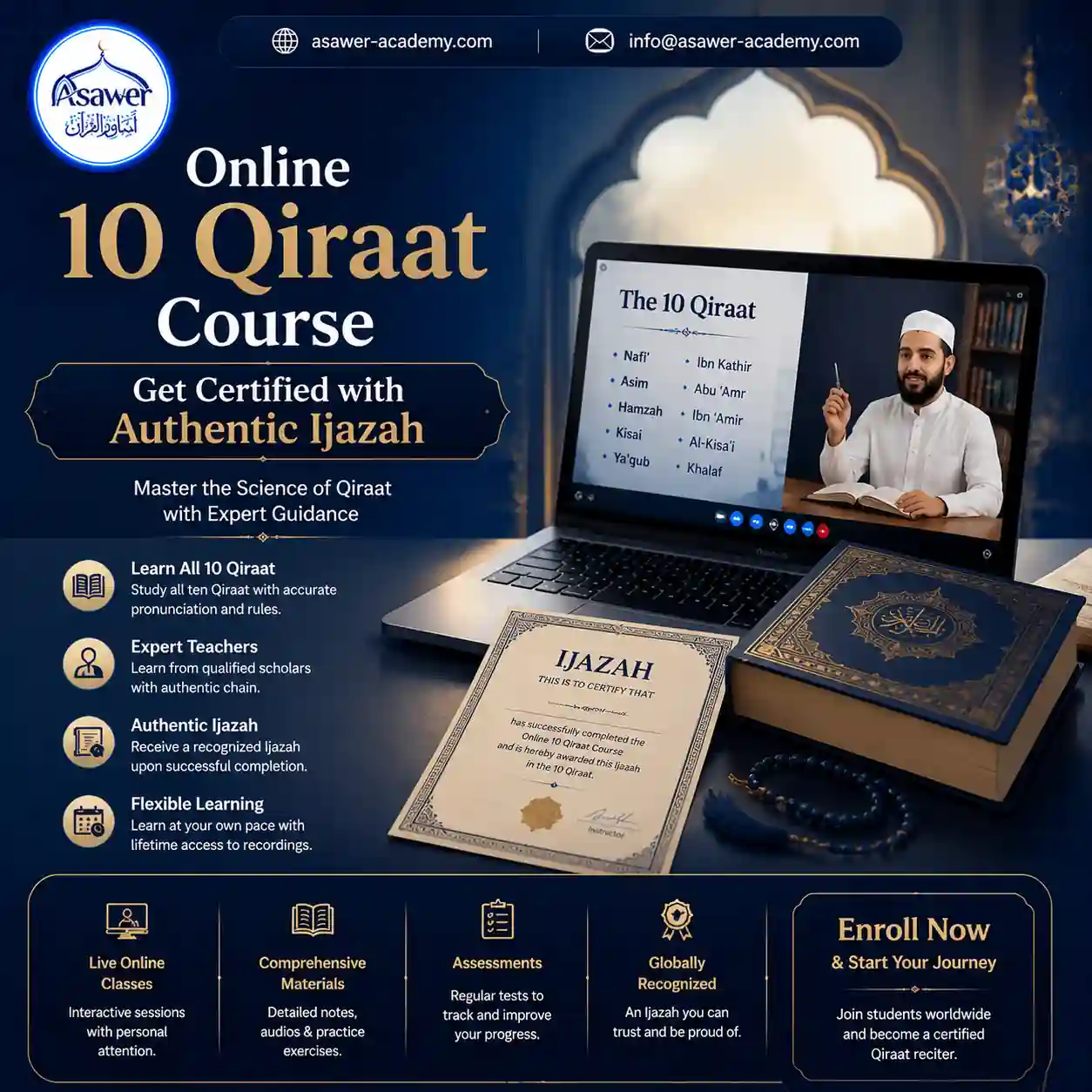
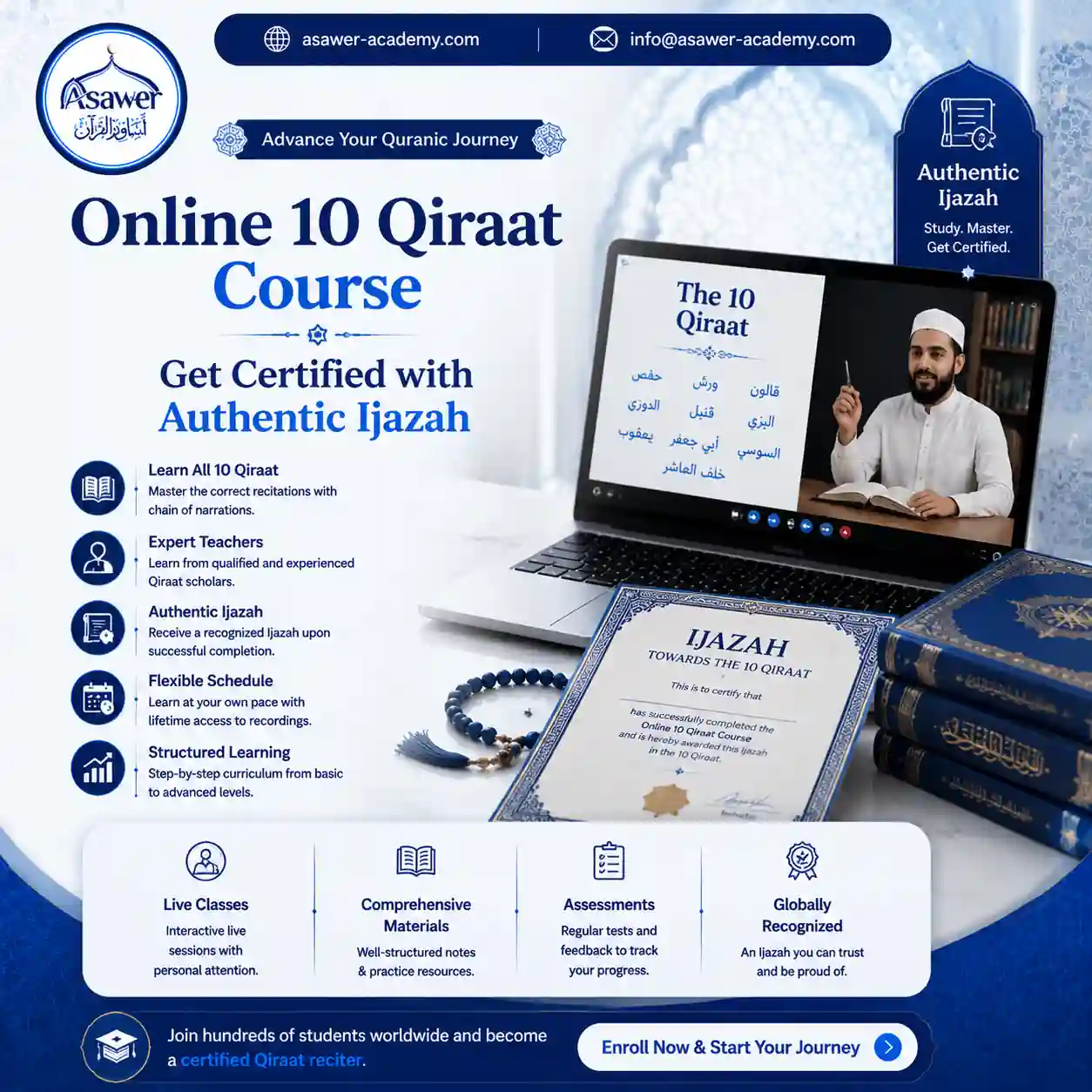
ADVANCED QIRAAT STUDY FOR QUALIFIED RECITERS, HUFFAZ AND QURAN EDUCATORS

Online 10 Qiraat Course: Study Usul, Farsh, Rawis and Transmission Routes

This specialist programme studies how the recognised Qiraat are organised and transmitted. Students learn to attribute a variation to its Imam, Rawi and route, apply recurring Usul, locate word-specific Farsh and use texts such as Al-Shatibiyyah, Al-Durrah or Tayyibat al-Nashr according to readiness. Direct oral correction remains essential, but the main learning goal is comparative Qiraat knowledge and disciplined route control. A complete Khatmah or Ijazah may be available only within a separately defined teacher-led route; it is not the default purpose of every Qiraat enrolment.
This online 10 Qiraat course begins with an advanced readiness assessment. The assigned teacher identifies the student’s current riwayah, Tajweed control, memorization, Arabic ability and previous matn study before recommending an individual-riwayah route, Al-‘Ashr Al-Sughra, a Jam‘ pathway or further preparation.
Asawer Academy video overlay.webp

Transmission Before Comparison

Every variation is learned through its Imam, Rawi and authorized route—not as an isolated pronunciation choice.

Usul and Farsh Together

General recurring principles are studied alongside word-specific Quranic variations.

Oral Precision with a Mujaz Teacher

Books and charts support the course, but direct audition and correction remain essential.

A Route Matched to Readiness

Individual riwayah, Minor Ten, Jam‘ or preparation is recommended after assessment.
Online 10 Qiraat Course Get Certified
READ THE MAP BEFORE ENTERING THE ROUTE

Qira’ah, Riwayah, Tariq and Wajh are different levels of transmission

A serious Qiraat programme should make the transmission hierarchy visible. The name of an Imam identifies a Qira’ah. A recognized narrator transmits a Riwayah from that Imam. A Tariq is a defined pathway through later transmitters and source works. A permitted Wajh is a valid performance option within the conditions of that route.
Confusing these levels produces a common beginner mistake: taking a pronunciation heard in one route and applying it everywhere. The course therefore teaches each variation with its attribution, rule, location and permitted combinations.
THE TRANSMISSION ATLAS

Ten Imams and their two famous narrators

The roster is a map, not the full curriculum. Every riwayah contains its own recurring principles, word variations and authorized routes.
01

Nafi‘ al-Madani

Qalun and Warsh
02

Ibn Kathir al-Makki

Al-Bazzi and Qunbul
03

Abu ‘Amr al-Basri

Al-Duri and Al-Susi
04

Ibn ‘Amir al-Shami

Hisham and Ibn Dhakwan
05

‘Asim al-Kufi

Shu‘bah and Hafs
06

Hamzah al-Kufi

Khalaf and Khallad
07

Al-Kisa’i

Abu al-Harith and Al-Duri
08

Abu Ja‘far al-Madani

Ibn Wardan and Ibn Jammaz
09

Ya‘qub al-Hadrami

Ruways and Rawh
10

Khalaf al-‘Ashir

Ishaq and Idris
TWO SCHOLARLY SYSTEMS

Minor Ten and Major Ten describe pathway scope—not authenticity levels

The assessment should identify which system Asawer actually offers and whether the candidate is ready for it.
SYSTEM 1

Al-‘Ashr Al-Sughra — The Minor Ten

The commonly taught Minor Ten route combines the seven recitations encoded in Hirz al-Amani, known as Al-Shatibiyyah, with the three additional recitations encoded in Al-Durrah. It is called “minor” because of the source pathways used, not because the final three Imams are “minor” or less authentic.
SYSTEM 2

Al-‘Ashr Al-Kubra — The Major Ten

The Major Ten is associated with the broader pathways gathered in Tayyibat al-Nashr. It introduces a much wider network of transmission routes and requires careful study of Tahrirat so valid options are not combined in an unauthorized way.
TWO RECITAL METHODS

Al-Infrad and Al-Jam‘ require different cognitive and recitation control

The teacher decides the suitable method after reviewing the student’s level, memory and previous study.

Al-Infrad — Individual Recitation

The learner studies and presents a recitation or riwayah separately, preserving its Usul and Farsh before moving to another. This route can make attribution clearer and may suit students building their first structured Qiraat map.

Al-Jam‘ — Combined Recitation

The learner combines readings within a passage according to an authorized order and method. Jam‘ requires stronger recall, attribution and control because the student must avoid invalid mixing or repeating the passage without a disciplined system.
ADVANCED ADMISSION

The Qiraat readiness audit

The honest result may be admission, admission with preparation, or a recommendation to strengthen Tajweed, Hifz or Arabic first.
The candidate should read extended Quran passages fluently and maintain practical Tajweed without constant decoding or correction. The assessment identifies recurring apparent and subtle errors before adding Qiraat variation.
The memorization requirement depends on the route and issuing teacher. Full Hifz is commonly expected for advanced combined or Ijazah pathways, while some study routes may begin with strong reading and selected memorized texts. The advanced readiness assessment states the exact entry standard for the selected route.
The candidate should be able to follow Arabic technical terms, recognize grammatical or morphological references when used, and study the selected matn at the required level. English explanation may support learning but does not remove the need to understand the Arabic recitation material.
A prior Ijaza in Hafs ‘an ‘Asim or another recognized riwayah is often recommended and may be required by the assigned teacher. The assessment should distinguish course study from a formal authorization route.
The learner may need to memorize or study sections from Al-Shatibiyyah, Al-Durrah or Tayyibat al-Nashr depending on the selected system. The selected programme’s memorisation and examination requirements are explained during the advanced readiness assessment before enrolment.
ACADEMIC CURRICULUM

From transmission architecture to supervised recitation

Study:
• Qira’ah, Riwayah, Tariq and Wajh.
• Imam, Rawi and later transmission routes.
• Attribution of every variation.
• Difference between a valid variation and an invalid mixture.
• Relationship between the oral tradition and written reference tools.

Outcome: build a transmission map that can identify where a recited form belongs.
Study may include:
• Madd and Qasr systems.
• Treatment of individual and paired Hamzahs.
• Idgham, Izhar and assimilation patterns.
• Imalah and Taqlil where applicable.
• Naql, Sakt, Ishmam, Rawm and related performance details.
• Ya’at al-Idafah, Ya’at al-Zawa’id and recurring pronoun rules.

Outcome: apply a recurring rule across its relevant Quran locations without losing attribution.
Study:
• Word-level differences arranged by Surah or passage.
• Vowel, consonant, morphological and grammatical variation.
• Memorization cues from the selected matn.
• Comparison without treating one reading as correction of another.
• Linking every form to the relevant Imam or narrator.

Outcome: recall and recite the correct word form in context.
Study:
• Symbols, conventions and structure of Hirz al-Amani.
• Reciters and narrators covered by the text.
• Relevant Usul and Farsh lines.
• Guided parsing of verses from the matn.
• Oral application under teacher supervision.

Outcome: use Al-Shatibiyyah as a controlled study and recall tool rather than a memorized poem without application.
Study:
• Abu Ja‘far, Ya‘qub and Khalaf al-‘Ashir.
• The relationship of Al-Durrah to the symbols and framework of Al-Shatibiyyah.
• Additional Usul and Farsh.
• Comparison with the first seven without confusing route structure.

Outcome: complete the map of Al-‘Ashr Al-Sughra according to the assigned teacher’s syllabus.
For suitable advanced students:
• The wider pathway network of Al-‘Ashr Al-Kubra.
• Source attribution and route constraints.
• Tahrirat that regulate valid combinations.
• Advanced matn reading and teacher-directed application.

Outcome: understand that more options require more route discipline, not free combination.
The candidate presents the assigned Quran portion or complete Khatmah according to the chosen route. The teacher records repeated errors, attribution failures, invalid combinations and matn gaps. Completion and Ijaza depend on the issuing teacher’s verified requirements, not attendance alone.
THE VARIATION LAB

The student must identify, attribute, recite and compare—without collapsing the readings into one list

A chart can tell the student that a word has multiple transmitted forms. Advanced learning begins when the student can hear the difference, name its attribution, recite it inside the passage and preserve the rule when a similar case appears elsewhere.
Online 10 Qiraat Course Get Certified with Authentic Ijazah
THE QIRAAT SCHOLAR’S NOTEBOOK

Four records turn a large science into a controlled personal map

01

Attribution Record

Imam, Rawi, Tariq and the source text used for the assigned form.
02

Usul Register

Recurring rules, conditions, exceptions and Quran locations used for practice.
03

Farsh Index

Word-specific variations arranged by Surah, matn evidence or teacher syllabus.
04

Correction and Tahrir Notes

Recurring oral mistakes and route combinations that require further control.
A SPECIALIST COURSE FOR ADVANCED READINESS

Who this programme can support

The admission standard should remain clear even when the course is accessible online.

Huffaz Ready for Advanced Transmission

A Hafiz may use the course to connect strong memorization with systematic Qiraat study. The assessment should test older retention, Tajweed stability and whether the candidate can manage multiple readings without corrupting the familiar riwayah.

Quran Teachers and Imams

Educators may seek deeper recitation literacy, stronger comparison skills or an authorization route. Before enrolment, the pathway is identified clearly as advanced study, a course-completion track or an Ijaza route.

Serious Students of Arabic and Quranic Sciences

Students with strong Tajweed and Arabic may study the linguistic, grammatical and phonetic dimensions of Qiraat while remaining under oral supervision. Academic interest does not replace recitation readiness.
Online 10 Qiraat Course
COURSE STUDY, CERTIFICATE AND IJAZA ARE NOT THE SAME RESULT

The final authorization belongs to the qualified issuing teacher

The programme distinguishes between academic participation, course completion and an Ijaza with Sanad, which is granted only after the issuing teacher accepts the required recital.

GLOBAL ACCESS TO SPECIALIST TEACHERS

Scheduling for students in the USA, Canada and Australia

Online access removes distance, but advanced Qiraat study still requires preparation, continuity and a stable teacher relationship.
US

United States

Confirm stable times across US time zones and whether the assigned Qiraat teacher can sustain the selected route and Khatmah.
CA

Canada

Discuss Arabic or English explanation, teacher continuity, travel pauses and a recurring schedule that protects independent preparation.
AU

Australia

Check AEST, ACST or AWST compatibility and whether an advanced teacher is available at a sustainable weekly time.
FREQUENTLY ASKED QUESTIONS

Questions advanced students ask before a Ten Qiraat programme

They are ten recognized traditions of Quran recitation transmitted through established Imams, narrators and routes. They include systematic differences in pronunciation and word forms while belonging to the transmitted Quranic recitation tradition.
No. Voice and melody concern performance style. Qiraat concern authenticated transmitted readings with defined principles, narrators and source pathways.
A Qira’ah is associated with a recognized Imam. A Riwayah is a transmission through a recognized narrator from that Imam. A Tariq is a more specific pathway within that transmission.
Usul are recurring principles applied across multiple locations, while Farsh refers to word-specific variations found in particular Quran passages.
Al-Shatibiyyah encodes the seven Qiraat, and Al-Durrah adds the three completing the Minor Ten. The readiness assessment explains how much memorisation and explanation of each text the selected route requires.
The Minor Ten commonly refers to the paths of Al-Shatibiyyah and Al-Durrah. The Major Ten uses the broader pathway network associated with Tayyibat al-Nashr. The terms describe route scope, not greater or lesser authenticity.
A prior Ijaza is commonly recommended and may be required by the assigned teacher. The readiness assessment states the condition that applies to the selected track.
Full Hifz is often required for advanced combined or Ijaza routes, but prerequisites vary. The readiness assessment states the exact requirement for the selected programme.
Al-Infrad presents a recitation separately. Al-Jam‘ combines readings within a passage according to an authorized method. Jam‘ requires stronger attribution and route control.
Books and recordings are important study tools, but they do not replace direct oral learning and correction from a qualified teacher.
There is no responsible fixed duration before assessment. The timeline depends on the selected system, memorization, matn study, class frequency, preparation and recital method.
No. An Ijaza is granted only if the qualified teacher accepts the required recital and confirms that the route conditions have been met.
A female teacher can be requested. Availability depends on the exact Qiraat authorization, language and time zone required.
Ask which teacher will teach and authorize, which route is offered, whether full Hifz is required, which matn is studied, how Jam‘ is taught, how Tahrirat are handled and what the final document represents.

Asawer Academy

Asawer Academy specializes in teaching the Quran, Arabic, and Islamic Studies to non-Arabic speakers through live one-to-one online lessons.

📞

Phone / WhatsApp

+20 102 830 2494
✉️

Email Address

[email protected]
🌐

No credit card required. We'll confirm your lesson via email and phone.
