Some Arabic letters are hard for beginners because the tongue has to move to a very specific place. A child may know the letter ق, but pronounce it too close to ك. Another student may read ض like د or ظ. This is why Makhaarij al-Huroof Al-Lisaan needs patient practice. Al-Lisaan means the tongue, and in Tajweed it covers many letters that require careful listening, small corrections, and regular review.
Al-Lisaan Quick Answer: What Are the Tongue Makharij?
Al-Lisaan is the largest Makhaarij area. In the common 17-point model, the tongue contains 10 detailed makharij that produce 18 Arabic letters. The tongue works with different parts of the palate, teeth, and gums, so learners should study the letters in small articulation groups instead of treating “the tongue” as one point.
Where This Area Fits in the Full Makhaarij Map
| Main Area | Detailed Makharij | Main Output |
|---|---|---|
| Al-Jawf — oral cavity | 1 | Madd letters |
| Al-Halq — throat | 3 | 6 throat letters |
| Al-Lisaan — tongue | 10 | 18 letters across tongue zones |
| Al-Shafataan — lips | 2 | 4 lip-related letters |
| Al-Khayshoom — nasal passage | 1 | Ghunnah resonance |
| Total | 17 | Five general areas |
Return to the complete Makhaarij al-Huroof guide for the full 5-area, 17-point structure, or compare articulation points with Makharij vs Sifaat.
For practical feedback on tongue articulation while reading Quran, Asawer’s Quran course directory can help you choose the most suitable guided learning route.
What Is Al-Lisaan in Makhaarij al-Huroof?
Al-Lisaan means the tongue. In Makhaarij al-Huroof, it refers to the letters that are produced when different parts of the tongue meet or come close to parts of the mouth, such as the upper palate, gums, or teeth.
Many Tajweed teachers commonly explain that the tongue area contains several detailed articulation points and covers a large group of Arabic letters. This is one reason students usually need more time with Al-Lisaan than with some other makhaarij.
Before studying the tongue letters in detail, it helps to understand the full map of articulation points. You can review the main guide here: Makhaarij al-Huroof and the five main articulation areas.
These are commonly taught as the main tongue letters. The list looks long, but a student does not need to master it in one sitting. The better approach is to study the letters in small groups.

Why the Tongue Letters Need Careful Practice
The tongue moves quickly. That is helpful in fluent recitation, but it also means mistakes can happen very easily. A tiny change in tongue position may turn one letter into another.
For children who speak English most of the day, some Arabic tongue positions may feel unfamiliar. This does not mean the child is weak. It simply means the mouth has not built the habit yet.
A teacher may hear a student read the letter correctly alone, then lose it inside a Quran word. That is normal. Isolated letters are the first step, not the final goal.
Teacher’s note:With tongue letters, correction should be small and specific. “Move your tongue back a little” is more useful than simply saying “wrong, repeat again.”
The Main Groups of Tongue Letters in Tajweed
The tongue letters are easier to study when they are grouped by the part of the tongue used in pronunciation. The following table gives a practical overview, not a replacement for live correction from a teacher.
| Tongue Area | Letters | What the Teacher Usually Checks |
|---|---|---|
| Back of the tongue | ق، ك | Is the sound too far forward or too close to English “k”? |
| Middle of the tongue | ج، ش، ي | Is the middle of the tongue rising correctly? |
| Side of the tongue | ض، ل | Is the side or edge of the tongue involved properly? |
| Tip of the tongue | ن، ر، ط، د، ت، ص، ز، س، ظ، ذ، ث | Is the tip touching or approaching the correct area? |
Back of the Tongue: ق and ك
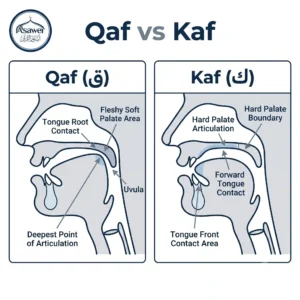
The letters ق and ك are both connected to the back area of the tongue, but they are not the same. Many children pronounce ق too close to ك, especially if they are used to English sounds.
A useful practice is to compare the two letters slowly. The teacher should model the sound first, then ask the student to repeat without rushing.
قِ — كِ
قُ — كُ
The goal is not to make the child exaggerate the sound. The goal is to help the child hear that ق is not simply an English “k.”
Middle of the Tongue: ج، ش، ي
The letters ج، ش، ي are commonly taught from the middle area of the tongue with the upper palate. Students usually find ش familiar, but ج and ي still need careful practice depending on the word and vowel.
جِ — شِ — يِ
جُ — شُ — يُ
If the student is confused, it is better to practice one pair first instead of all three letters together.
Side of the Tongue: ض and ل

The letter ض is one of the letters that often needs the most individual correction. Many students turn it into a simpler sound, such as د, ظ, or something close to an English “d.”
The letter ل is usually easier, but it still needs a correct tongue position. A child might say it clearly in normal Arabic practice but lose control when reading quickly in Quran recitation.
ضِ — لِ
ضُ — لُ
Do not expect a young student to perfect ض immediately. It often improves gradually through teacher feedback, repeated listening, and Quran word practice.
Tip of the Tongue: ن، ر، ط، د، ت، ص، ز، س، ظ، ذ، ث
The tip of the tongue is involved in many Arabic letters. This is where students often mix letters that look or sound close to each other.
Some common groups include:
ص — س — ز
ظ — ذ — ث
ن — ر
These groups should not be rushed. A teacher may spend a whole lesson on one pair if needed. That is not slow progress. That is proper foundation building.
| Group | Common Issue | Better Practice |
|---|---|---|
| ط / ت | The heavy letter becomes too light. | Compare slowly with the teacher’s model. |
| ص / س | The student makes both letters sound the same. | Practice one short pair, then a Quran word. |
| ذ / ز | The tongue placement is unclear. | Ask the child to slow down and listen first. |
| ر / ن | The student loses control when reading fast. | Practice inside short words, not only alone. |
Common Mistakes Children Make With Al-Lisaan Letters
Mistake 1: Memorizing the List Without Correct Sound
A student may memorize that ق and ك come from the back of the tongue, but still pronounce both incorrectly. Makhaarij is not only information. It is a skill that needs sound correction.
Mistake 2: Using English Pronunciation as a Shortcut
This happens often with children living in the USA, Canada, the UK, Australia, or the UAE. They may use the closest English sound because it feels easier. The teacher’s job is not to shame the accent, but to train the Arabic sound clearly.
Mistake 3: Moving Too Fast Between Letter Groups
Because Al-Lisaan includes many letters, some students try to finish the whole list quickly. That usually does not work. It is better to study fewer letters with better correction.
Mistake 4: Practicing Only When There Is a Mistake
Parents sometimes review Makhaarij only after the teacher points out a problem. A short regular routine works better than emergency practice before the next class.
Simple Practice Activities for Tongue Letters
Parents do not need to become Tajweed teachers at home. Their role is to support the habit and keep the practice calm.
- Choose one pair: Do not practice all tongue letters at once.
- Listen before repeating: Play the teacher’s sound or class recording.
- Repeat two or three times only: Avoid repeating the wrong sound too much.
- Move into a word: The letter should work inside recitation, not only alone.
- End calmly: Stop before the child becomes frustrated.
Here is a simple weekly plan:
| Day | Practice Focus | Time |
|---|---|---|
| Monday | ق and ك | 5 minutes |
| Tuesday | ج، ش، ي | 5 minutes |
| Wednesday | ض and ل | 5 minutes |
| Thursday | ص، س، ز | 5 minutes |
| Weekend | One Quran word from class | 5 minutes |
How Al-Lisaan Differs From Other Makhaarij
Al-Lisaan should not be corrected the same way as every other makhraj. If the child is struggling with ع or ح, the issue is usually not the tongue. That belongs to Makhaarij al-Huroof Al-Halq and the throat letters.
If the problem is with ب، م، ف، و, the teacher may focus more on lip movement. That is explained in Makhaarij al-Huroof Al-Shafataan and the lip letters.
And if the correction involves nasal sound with noon or meem, the student needs to understand Al-Khayshoom and the sound of ghunnah.
This is why a teacher first identifies where the sound comes from. Without that, the child may keep repeating, but not actually improving.
How Asawer Academy Teaches Tongue Letters
At Asawer Academy, tongue letters are taught through listening, modeling, and small corrections. The teacher does not only ask the student to repeat. The teacher checks whether the tongue is too far forward, too far back, too tense, or moving too quickly inside words.
For beginners, the Online Noorani Qaida Course at Asawer Academy can help students build a cleaner foundation before moving deeper into Tajweed. It supports letter recognition, vowels, joining sounds, and early pronunciation practice in a structured way.
Book Your Free Trial Class Now at Asawer Academy
Quick Review Checklist
Use this checklist after your child has practiced Al-Lisaan for a while:
- Can the child recognize the main tongue-letter groups?
- Can the child hear a difference between ق and ك?
- Can the child practice ص and س without making them identical?
- Is the child improving with ض, even slowly?
- Can the child read the letter inside a short Quran word?
- Does the teacher give specific correction?
- Is home practice short and consistent?
If the answer is “not yet,” that is fine. Tongue letters take time because they depend on small movements. Progress is usually gradual.
FAQ About Makhaarij al-Huroof Al-Lisaan
What is Makhaarij al-Huroof Al-Lisaan?
Makhaarij al-Huroof Al-Lisaan refers to the articulation points of Arabic letters that are produced using the tongue. These letters are important in Tajweed because small tongue movements can change one letter into another.
What are the tongue letters in Tajweed?
The tongue letters commonly include ق، ك، ج، ش، ي، ض، ل، ن، ر، ط، د، ت، ص، ز، س، ظ، ذ، ث. Tajweed teachers usually teach them in smaller groups based on the part of the tongue used.
Why are Al-Lisaan letters difficult for beginners?
Al-Lisaan letters can be difficult because the tongue has to move to precise places in the mouth. Children who speak English most of the day may need extra time to build these Arabic pronunciation habits.
What is the hardest tongue letter in Arabic?
Many students find ض difficult because it needs careful tongue placement and cannot be replaced with a simple English sound. However, the hardest letter may differ from one student to another.
How can my child practice tongue letters at home?
Your child can practice one pair of letters at a time, listen to the teacher’s model, repeat slowly, and then use the letter inside a short Quran word. Short daily practice is better than long practice without correction.
What is the difference between Al-Lisaan and Al-Halq?
Al-Lisaan refers to letters produced with the tongue, while Al-Halq refers to letters produced from the throat. The correction method is different because the sound comes from a different place.
Can online Quran classes correct tongue-letter mistakes?
Yes. Online Quran classes can help when the teacher listens carefully, models the sound clearly, and gives specific feedback. The student also needs short practice between lessons.
Does Asawer Academy teach Al-Lisaan letters for children?
Yes. Asawer Academy teaches tongue letters as part of Quran pronunciation and Tajweed basics, especially for children who need step-by-step correction.
Is Noorani Qaida helpful before studying Al-Lisaan in detail?
Yes. Noorani Qaida helps beginners learn Arabic letters, vowels, joining sounds, and early pronunciation. This foundation makes it easier to study Al-Lisaan and other Makhaarij later.
Can we book a free trial class for tongue-letter practice?
Yes. Families can book a free trial class at Asawer Academy to check the student’s level and see how the teacher corrects Arabic pronunciation and Quran recitation.