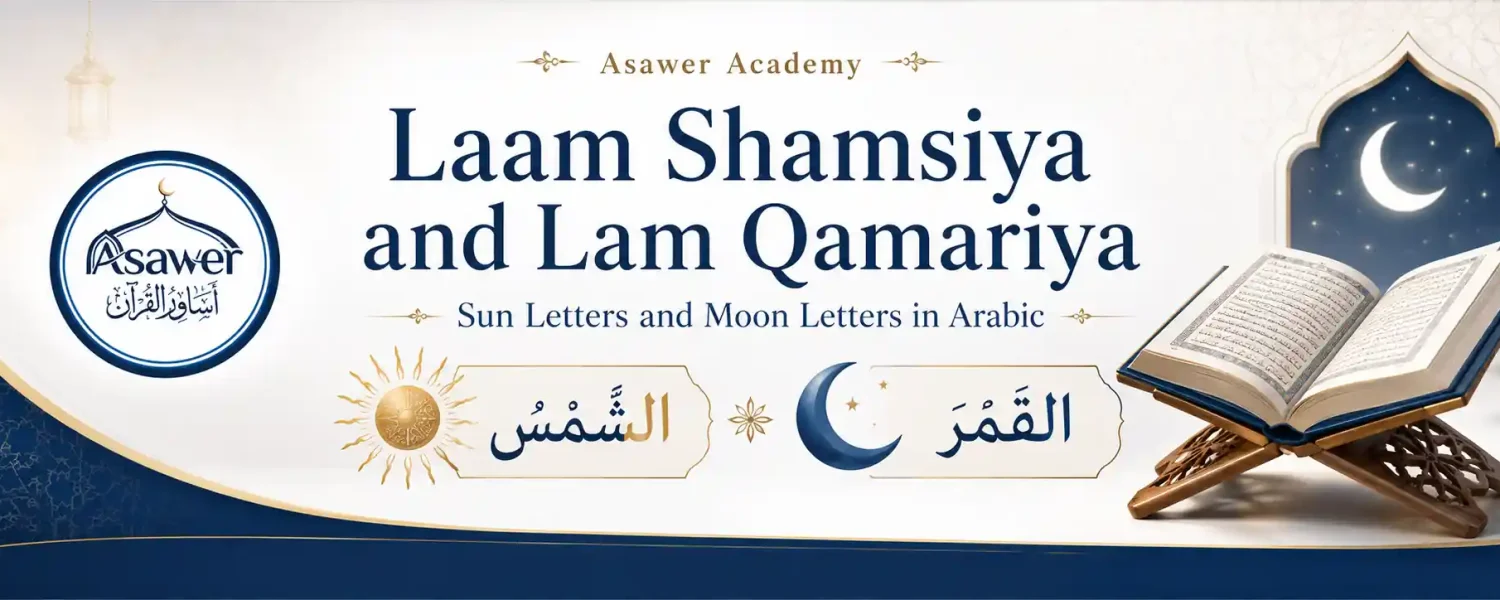
Lam Shamsiya and Lam Qamariya are two foundational Arabic reading rules that explain what happens to the Lam in the definite article ال when it comes before different Arabic letters. In some words, the Lam is written but not pronounced. In others, it is written and heard clearly.
These rules matter in both Arabic and Quran reading because they affect how common words such as الشَّمْس, النَّاس, القَمَر, and الكِتَاب are pronounced. Beginners do not need to guess: the letter that comes immediately after ال tells you which rule to use.
Quick answer: In Lam Shamsiya, the Lam in ال is written but not pronounced because the next letter is one of the 14 sun letters. In Lam Qamariya, the Lam is written and pronounced clearly because the next letter is one of the 14 moon letters.
What Do Shamsiya and Qamariya Mean?
Shamsiya (شمسية) means “solar” or “related to the sun.” In this reading rule, it refers to the group commonly called the sun letters. Qamariya (قمرية) means “lunar” or “related to the moon,” and it refers to the moon letters.
If you are learning this rule as part of a wider recitation path, you can compare the structured options in Asawer’s online Quran courses, including reading foundations, Tajweed, memorization, Tafseer, and advanced recitation routes.
The names come from the two classic examples:
- الشَّمْس — “the sun” — is read with Lam Shamsiya.
- القَمَر — “the moon” — is read with Lam Qamariya.
What Are Lam Shamsiya and Lam Qamariya?
Both rules are connected to the Arabic definite article ال, which often corresponds to “the” in English. The written form stays the same, but its pronunciation changes according to the next letter.
ال + sun letter = Lam is not pronounced.
ال + moon letter = Lam is pronounced clearly.
The rule does not depend on the meaning of the word. It depends on the letter immediately after ال. A useful beginner question is: “What letter comes after Alif-Lam?”
Why This Rule Matters in Arabic and Quran Reading
A learner may recognize every letter in a word and still misread it if the definite article is pronounced incorrectly. In الشَّمْس, saying “al-shams” gives the Lam a sound that should be assimilated. In القَمَر, hiding the Lam removes a sound that should be heard.
The rule therefore connects several early reading skills: letter recognition, the definite article, Shaddah in Arabic, Sukoon in Arabic, and smooth word decoding. Learners who are still building the earlier vowel foundation can also review Fathah, Kasrah, and Dammah.
The 14 Sun Letters and 14 Moon Letters in Arabic
Arabic letters are divided into two equal groups for this rule: 14 sun letters and 14 moon letters. You do not need to memorize both lists in one sitting. First learn to hear the difference, then use the lists as a reference while reading.
The 14 Sun Letters — Lam Shamsiya Letters
The sun letters are:
ت – ث – د – ذ – ر – ز – س – ش – ص – ض – ط – ظ – ل – ن
| Sun Letter | Example | Reading Note |
|---|---|---|
| ش | الشَّمْس | Do not pronounce the Lam; read the doubled ش. |
| ن | النَّاس | The Lam is assimilated and ن is read with Shaddah. |
| ر | الرَّحْمٰن | The Lam is not heard before ر. |
| ص | الصَّلَاة | The Lam is not pronounced before ص. |
The 14 Moon Letters — Lam Qamariya Letters
The moon letters are:
ا – ب – ج – ح – خ – ع – غ – ف – ق – ك – م – ه – و – ي
| Moon Letter | Example | Reading Note |
|---|---|---|
| ق | القَمَر | Pronounce the Lam clearly before ق. |
| ك | الكِتَاب | The Lam is heard before ك. |
| ب | البَيْت | The Lam remains clear. |
| م | المَسْجِد | Pronounce the Lam before م. |
What Is Lam Shamsiya?
Lam Shamsiya is the rule in which the Lam of ال is written but not pronounced because the next letter is a sun letter. The sound of the Lam is assimilated into the following consonant, which is pronounced as a doubled consonant.
ال + sun letter = Lam written, Lam not pronounced, next consonant doubled.
Lam Shamsiya Example: الشَّمْس
In الشَّمْس, the letter after ال is ش, a sun letter. The Lam is not heard, and the ش carries Shaddah in fully vowelled writing. The word is read approximately as ash-shams, not al-shams.
Another Example: النُّور
In النُّور, the next letter is ن, another sun letter. The Lam is not pronounced, and the Noon is read as a doubled consonant.
Teacher cue: If a learner reads الشَّمْس as “al-shams,” ask them to look at the letter after ال and then notice the Shaddah on the sun letter.
What Is Lam Qamariya?
Lam Qamariya is the rule in which the Lam of ال is written and pronounced clearly because the next letter is a moon letter. In fully vowelled Arabic, the Lam is commonly shown with Sukoon.
ال + moon letter = Lam written and pronounced clearly.
Lam Qamariya Example: القَمَر
In القَمَر, the letter after ال is ق, a moon letter. The Lam is pronounced clearly: al-qamar.
Another Example: الكِتَاب
In الكِتَاب, the next letter is ك, a moon letter. The Lam is heard before the Kaf.
Teacher cue: “If it is Lam Qamariya, let me hear the Lam.” Learners who add an extra vowel after a consonant with Sukoon can review the focused guide to Sukoon in Arabic.
Lam Shamsiya vs Lam Qamariya: Quick Comparison
| Point | Lam Shamsiya | Lam Qamariya |
|---|---|---|
| Lam pronunciation | Not pronounced | Pronounced clearly |
| Letter after ال | Sun letter | Moon letter |
| Main visual clue in vowelled text | Shaddah on the next letter | Sukoon on the Lam |
| Classic example | الشَّمْس | القَمَر |
| Approximate reading | ash-shams | al-qamar |
Lam Shamsiya and Lam Qamariya Examples from the Quran
The rule appears constantly in Quran reading. These examples help learners move beyond memorizing lists and begin recognizing the pattern inside real words.
| Quranic Word | Type | Key Letter | Reading Note |
|---|---|---|---|
| الشَّمْس | Lam Shamsiya | ش | The Lam is not pronounced. |
| النَّاس | Lam Shamsiya | ن | Read the doubled ن. |
| الرَّحْمٰن | Lam Shamsiya | ر | The Lam is assimilated before ر. |
| الصَّلَاة | Lam Shamsiya | ص | The Lam is not heard. |
| القَمَر | Lam Qamariya | ق | The Lam is clear. |
| الكِتَاب | Lam Qamariya | ك | Pronounce the Lam before ك. |
| الْحَمْد | Lam Qamariya | ح | The Lam is pronounced clearly. |
| الْمُؤْمِن | Lam Qamariya | م | The Lam is heard before م. |
How to Identify Lam Shamsiya or Lam Qamariya in Any Word
- Find the definite article ال. Make sure the word actually begins with the Arabic definite article.
- Look at the next letter. Ignore the meaning of the word for the moment.
- Decide whether that letter is a sun or moon letter. Use the lists above until the groups become familiar.
- Read the Lam correctly. Hide its sound before a sun letter; pronounce it clearly before a moon letter.
For a beginner, this four-step method is more useful than trying to recite all 28 letters every time. The goal is to turn the rule into a reading habit.
Common Mistakes Beginners and Children Make
1. Pronouncing the Lam in Lam Shamsiya
A learner may see the written Lam and pronounce it automatically. For example, they may read الشَّمْس as “al-shams.” Correction: look at the sun letter and read the doubled following consonant instead.
2. Hiding the Lam in Lam Qamariya
Some learners overgeneralize the sun-letter rule and begin hiding the Lam everywhere. In القَمَر, the Lam must be heard clearly.
3. Memorizing the Lists Without Reading Words
A student may know every sun letter but still make mistakes in real reading. Lists are reference tools. Reading practice is what makes the rule automatic.
4. Ignoring Shaddah and Sukoon
In fully vowelled material, these marks give useful clues. The following sun letter is typically written with Shaddah, while the Lam before a moon letter is commonly shown with Sukoon.
5. Adding an Extra Vowel
A beginner may pronounce a hidden or sakin consonant with an unnecessary vowel. The correction is to read the written sound pattern without inserting an extra a, i, or u.
How Kids and Beginners Can Practice Sun and Moon Letters
Short, repeated practice is usually more effective than one long list. The learner should see the pattern, hear it, classify it, and then read it inside complete words.
Practice 1: Compare the Two Famous Words
الشَّمْس — القَمَر
- Which word has a Lam that is not pronounced?
- Which word has a clear Lam?
- Which word shows Shaddah on the following letter?
Practice 2: Sort Words into Two Groups
Use: الشَّمْس – القَمَر – النُّور – الكِتَاب – الرَّحْمٰن – البَيْت.
Create two groups: “Lam heard” and “Lam not heard.” Ask the learner to explain why each word belongs in its group.
Practice 3: Blend the Whole Word
Do not stop after identifying the rule. Read the complete word smoothly. Learners who can identify letters but still pause between sounds can practise Arabic letter blending before increasing speed.
Practice 4: Find the Rule on a Quran Page
Choose a short passage and ask the learner to circle two examples of Lam Shamsiya and two examples of Lam Qamariya before reading. The aim is visual recognition followed by correct pronunciation.
Which Learning Path Can Help Next?
This article can explain the rule, but learners who repeatedly miss the pattern may need guided reading practice. Choose the path according to the actual skill gap rather than enrolling in the most advanced course available.
- Noor Al Bayan Online Course: a strong fit for children and beginners who still need systematic work on letters, vowels, Sukoon, Shaddah, blending, and early Arabic/Quran reading patterns.
- Learn Arabic Reading Online: suitable for learners whose main goal is decoding Arabic script, connected words, reading signs, and increasingly independent reading.
- Online Quran Classes for Kids: suitable when a child can benefit from live recitation correction, reading practice, practical Tajweed, memorization support, or a teacher-led Quran plan.
For a learner who is starting from the alphabet and early Quran-reading foundations, the academy can assess whether Noor Al Bayan, Noorani Qaida, a reading-only route, or a broader Quran class is the better starting point.
Related Reading for the Same Skill Cluster
- Shaddah in Arabic: Meaning, Pronunciation, and Practice
- Sukoon in Arabic: Meaning, Rules, and Reading Examples
- Fathah, Kasrah, and Dammah: Beginner Reading Guide
- Arabic Letter Blending: A Step-by-Step Reading Guide
- Arabic Alphabet for Quran Reading
FAQ About Lam Shamsiya and Lam Qamariya
What is Lam Shamsiya?
Lam Shamsiya is the rule where the Lam in ال is written but not pronounced because the next letter is one of the 14 sun letters. The following consonant is pronounced as a doubled consonant.
What is Lam Qamariya?
Lam Qamariya is the rule where the Lam in ال is written and pronounced clearly because the next letter is one of the 14 moon letters.
What does Shamsiya mean?
Shamsiya (شمسية) means solar or related to the sun. In this rule, it refers to the sun-letter group, named after the example الشَّمْس.
What does Qamariya mean?
Qamariya (قمرية) means lunar or related to the moon. In this rule, it refers to the moon-letter group, named after the example القَمَر.
How many sun letters are there in Arabic?
There are 14 sun letters: ت، ث، د، ذ، ر، ز، س، ش، ص، ض، ط، ظ، ل، ن.
How many moon letters are there in Arabic?
There are 14 moon letters: ا، ب، ج، ح، خ، ع، غ، ف، ق، ك، م، ه، و، ي.
What are the Lam Qamariya letters?
The Lam Qamariya letters are the 14 moon letters: ا، ب، ج، ح، خ، ع، غ، ف، ق، ك، م، ه، و، ي. When one follows the definite article ال, the Lam is pronounced clearly.
Why are they called sun and moon letters?
The names come from the classic examples الشَّمْس (the sun) and القَمَر (the moon). The first demonstrates Lam Shamsiya; the second demonstrates Lam Qamariya.
Does Lam Shamsiya always show Shaddah?
In fully vowelled Arabic and common teaching or Mushaf-style notation, the sun letter following the definite article is typically marked with Shaddah to show the doubled consonant. In unvowelled everyday Arabic, diacritics may be omitted, so the reader must know the rule from the word pattern.
Is Lam Shamsiya and Lam Qamariya a Tajweed rule or an Arabic rule?
It is fundamentally an Arabic pronunciation rule connected to the definite article, and it is also very important in Quran reading. For that reason, it is often taught inside beginner Arabic-reading and Tajweed programmes.
What are easy Quran examples of Lam Shamsiya and Lam Qamariya?
Easy Lam Shamsiya examples include الشَّمْس, النَّاس, and الرَّحْمٰن. Easy Lam Qamariya examples include القَمَر, الْحَمْد, and الكِتَاب.
How should children practice this rule?
Start with short pairs, sort words into “Lam heard” and “Lam not heard,” notice Shaddah and Sukoon, and then practise the same pattern inside complete Quranic or Arabic words. A teacher can help when the child understands the rule but still applies it inconsistently while reading.