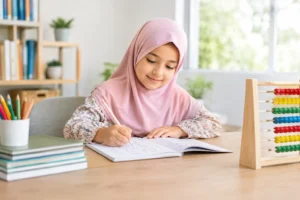
arabic books for children can turn Arabic from a weekly lesson into a language connected with bedtime, humor, family conversations, imagination, and everyday life. The most helpful book is not always the one with the most beautiful cover or the longest vocabulary list. It is the one your child can understand with support, enjoy enough to revisit, and use as a bridge to speaking, listening, and reading.
For families raising children in the USA, Canada, Australia, the UK, or the UAE, the challenge is often choosing books that match both age and actual Arabic level. A ten-year-old heritage learner may need an early-reader text without wanting a book that feels designed for preschoolers. A younger beginner may understand stories when heard aloud but still struggle to decode the script. This guide helps parents choose wisely without turning reading into a test.
Children who need systematic help connecting letters, sounds, and words may benefit from Learn Arabic Reading Online. Guided correction can be useful when a child guesses from pictures, confuses similar letter shapes, or reads each word slowly without understanding the sentence.
Children who can read some words but need stronger Modern Standard Arabic vocabulary and sentence patterns may benefit from Learn Arabic Fusha Online. A structured lesson can help them notice how story language works and then reuse it in speech and writing.
How to Choose arabic books for children
Start with the child in front of you, not only the age printed on a product page. Consider four things: decoding ability, listening comprehension, attention span, and emotional maturity. A suitable book should stretch one area without overwhelming all four at once.
| What to check | Good sign | Warning sign |
|---|---|---|
| Text amount | The child can finish a page with limited help. | Every line requires translation or correction. |
| Vocabulary | Most words are familiar, with a few useful new ones. | Unknown words block the meaning of nearly every sentence. |
| Sentence length | The child can retell the main idea after reading or listening. | The child reaches the end but cannot explain what happened. |
| Interest | The topic connects with the child’s humor, questions, or experiences. | The book feels childish, frightening, preachy, or irrelevant. |
A useful rule is the “supported success” test. Let your child read or listen to one page. If the story remains understandable after two or three brief explanations, the level may be appropriate. If you must translate every sentence, save the book for read-aloud time or return to it later.
Parents also need to distinguish between Arabic language level and content level. For a fuller view of the different needs of beginners and heritage speakers, read Arabic for Kids and Heritage Learners.
Best Book Types by Age and Reading Stage
Ages 0–3: Board Books, Naming Books, and Rhymes
At this stage, choose sturdy books with one clear image or action per page, repeated phrases, and words connected with daily routines. Useful themes include family members, body parts, food, animals, bedtime, clothing, and simple emotions. The goal is not independent reading. It is repeated listening, pointing, naming, and enjoying the sound of Arabic.
Read the same small set many times. Pause before a familiar word and let the child complete it. Ask simple questions such as “Where is the cat?” or “What is the baby doing?” Do not turn every page into a vocabulary quiz. A toddler learns through warm repetition and shared attention.
Ages 3–5: Predictable Picture Books
Preschoolers usually benefit from short stories with a clear sequence, repeated sentence frames, expressive illustrations, and a satisfying ending. Look for books that allow the child to predict what comes next. Repetition supports memory without requiring worksheets.
For children beginning Arabic before school or alongside an English-speaking preschool, the guide to preschool Arabic can help parents balance letters, speaking, songs, stories, and play.
Ages 5–7: Early Readers with Controlled Text
Once children begin decoding, select books with larger print, short lines, familiar sentence structures, and helpful vowel marks where needed. Pictures should support meaning without making it possible to guess every word. A child who relies only on illustrations may appear fluent while avoiding the Arabic text.
At this stage, alternate two kinds of reading. In “accuracy reading,” the child reads a small amount carefully. In “meaning reading,” the parent reads most of the story while the child follows, repeats a favorite line, and discusses the plot. This protects comprehension while decoding develops.
Ages 7–9: Illustrated Stories and Short Chapter Books
Children ready for longer stories need stronger plots, recognizable characters, and chapters short enough to finish in one sitting. Choose themes such as school, friendship, family changes, travel, nature, problem-solving, and gentle humor. A glossary can help, but the story should still make sense without constant dictionary use.
Examples worth previewing include picture books listed by IBBY Europe, such as لو كنت طائراً by Fatima Sharafeddine and كيف صرت حكواتياً by Nabiha Mehaydli. Another title in the same collection is كائنات سقف الغرفة, also by Nabiha Mehaydli. These examples show the range of imaginative Arabic storytelling available, but parents should still review the actual edition, language difficulty, and themes before choosing.
Ages 9–12: Novels, Nonfiction, and Series
Older children often need books that respect their maturity while keeping the language accessible. Short novels, biographies written for young readers, science and nature books, travel writing, mysteries, and serial adventures can all work. Series are especially useful because the child becomes familiar with the world, characters, and writing style.
If the Arabic is difficult, use a “bridge reading” approach: preview the chapter in English only when necessary, listen to part of it in Arabic if audio is available, and then read a manageable section in Arabic. The aim is to preserve curiosity while increasing direct contact with the Arabic text.
Teenagers: Identity, Ideas, and Authentic Voice
Teenagers usually reject books that feel younger than their social and emotional world. They may prefer realistic fiction, historical stories, essays, biographies, graphic narratives, or novels involving choices and consequences. Let them participate in selection and permit them to stop a book that is unsuitable or unengaging.
Families supporting adolescents can use the practical guidance in Arabic for Teens to match reading with conversation, identity, school demands, and realistic goals.
Should You Choose Arabic-Only or Bilingual Books?
Arabic-only books give children more direct exposure to Arabic and reduce the temptation to read only the English side. They work well when the learner can follow most of the story through the text, pictures, or a parent’s reading.
Bilingual books can be useful for beginners, mixed-language families, and parents who are still learning Arabic. However, the translation should support meaning rather than replace the Arabic experience. Try reading the Arabic page first, discussing the picture, and using the English text only when needed. For stronger readers, cover the translation during the first reading.
Also check whether the Arabic is Modern Standard Arabic, a dialect, or a mixture. Modern Standard Arabic supports formal reading and school-related language. Dialect books can support family connection and natural conversation. Neither format is automatically better; the choice should match the child’s purpose.
What Makes an Arabic Children’s Book High Quality?
- Natural language: Sentences should sound meaningful, not like a vocabulary list placed inside a weak story.
- Readable design: The font should be clear, the lines should not be crowded, and the text should be easy to follow from right to left.
- Age-respectful content: The emotional level should suit the child even when the Arabic level is simple.
- Strong illustrations: Pictures should add information, mood, or humor instead of merely decorating the page.
- Cultural care: Families should review how the book presents religion, family life, identity, history, and social behavior.
- Rereading value: A good home-library book offers details, language, or enjoyment that remain useful after the first reading.
International book lists can help parents discover titles, but no award or catalog replaces a family review. IBBY describes its Honour List as a recurring selection of notable children’s books chosen through national sections, and its Arabic collections include picture books, comics, and novels from different publishers and countries.
How to Read Arabic Books Without Creating Pressure
- Preview first. Scan the pages and choose three to five words that are important for understanding.
- Read for meaning. Use voice, expression, and pictures. Do not interrupt every sentence for correction.
- Choose one reading target. It may be a letter pattern, a repeated phrase, or one pronunciation point.
- Invite a response. Ask the child to predict, choose a favorite character, or explain one event.
- Reuse the language. Bring one phrase from the book into the next day’s conversation.
For example, after a story about a lost object, a parent can hide a toy and reuse the story’s question pattern. This transforms book language into active language. Families can also use Arabic vocabulary activities to practise new words through sorting, drawing, movement, and simple speaking tasks.
On another day, turn the story into play. Act out one scene, build a character with blocks, or make a simple matching challenge. These Arabic games for kids can keep repeated exposure enjoyable without requiring a new book every session.
A Simple Weekly Arabic Reading Routine
- Day 1: Parent read-aloud for enjoyment.
- Day 2: Reread and notice three useful words.
- Day 3: Child reads a short section or repeated line.
- Day 4: Retell the story using pictures.
- Day 5: Use one game, drawing task, or role-play activity.
- Weekend: Let the child choose whether to reread, switch books, or listen to an audio version.
Ten focused minutes can be more productive than a long session filled with correction. Keep a small basket of books visible and rotate only a few at a time. Familiarity builds confidence, while occasional new titles maintain curiosity.
Common Book-Buying Mistakes
Buying only by age label: Age does not reveal the child’s Arabic reading level. Preview a sample page whenever possible.
Choosing books that are too educational: Alphabet and vocabulary books have a place, but children also need stories that are funny, surprising, comforting, or emotionally meaningful.
Expecting independent reading too soon: A child may benefit from a book for months as a read-aloud before reading it alone.
Correcting every error: Excessive interruption can damage comprehension and confidence. Select one or two important errors and let minor slips wait.
Ignoring the child’s dignity: Older beginners need simple Arabic with age-appropriate topics and design. Avoid materials that make them feel treated like toddlers.
Conclusion
The best Arabic home library is not the largest one. It is a carefully chosen collection that includes enjoyable read-alouds, manageable books for independent practice, and topics the child genuinely cares about. Match the text to the learner’s real level, reread without pressure, and connect story language with speech and play. Over time, Arabic books can become more than study materials; they can become part of family memory and a lasting relationship with the language.
Frequently Asked Questions
What are the best Arabic books for a beginner child?
The best beginner books use clear print, short sentences, familiar vocabulary, supportive pictures, and an engaging idea. Choose by the child’s actual Arabic level rather than age alone.
Should Arabic children’s books include vowel marks?
Vowel marks can help early readers decode unfamiliar words, but a page does not need every letter fully marked forever. As fluency grows, children should gradually meet texts with fewer marks.
Are bilingual Arabic-English books helpful?
Yes. They can support beginners and mixed-language families when the Arabic side is read first. Use the English translation only as needed so it does not replace attention to Arabic.
How many Arabic books should I buy at first?
Start with a small varied set, such as one board or picture book, one story the child can partly read, and one higher-level read-aloud. Add books after observing what the child actually enjoys.
How often should children read Arabic books?
A short routine three to five times a week is usually easier to sustain than one long session. Even ten minutes can be useful when the reading is focused and enjoyable.
What should I do when my child does not understand the story?
Explain only the words needed for the main idea, use the pictures, act out actions, and summarize difficult parts. If every sentence needs translation, choose an easier book for independent reading.
Should I correct every reading mistake?
No. Correct errors that change the word or reflect a repeated decoding problem, but avoid interrupting every line. Preserve the meaning and flow of the story.
Can Arabic storybooks improve speaking?
Yes, especially when families reuse phrases from the story in conversation, ask the child to retell events, and act out scenes. Reading becomes more powerful when language moves beyond the page.
How can I choose Arabic books for an older beginner?
Look for simple language with mature themes, clean design, short chapters, graphic narratives, nonfiction, or adapted stories. Avoid books that appear babyish even if the language level is suitable.
Do online Arabic courses replace reading at home?
No. Courses can provide structure, feedback, and correction, while home reading provides repetition, choice, and family connection. The two can support each other.
How do I know whether my child needs a teacher?
Teacher support may help when the child repeatedly confuses letters, guesses instead of reading, cannot blend sounds, avoids Arabic texts, or needs a clear progression that home practice has not provided.
References and External Resources
- IBBY Honour List — background on an international selection of children’s literature.
- IBBY Europe: Books in Arabic — examples of Arabic picture books, comics, and novels.
- Al Salwa Books — a publisher catalog organized by formats and age groups, useful for comparing board books, picture books, early readers, chapter books, and young adult titles.