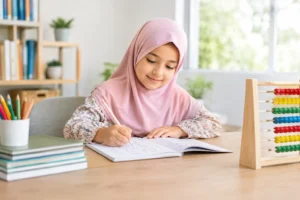
Arabic games for kids can turn a short language lesson into an active experience in which children listen, speak, move, remember, and make choices. Instead of asking a child to repeat a long vocabulary list, a parent or teacher can use familiar objects, picture cards, movement, stories, and simple challenges to give each Arabic word a clear purpose.
Games are most useful when they support a specific learning goal. One activity may practise recognizing Arabic letters, while another helps a child understand instructions, recall vocabulary, or build a short sentence. The objective is not to keep children entertained every minute. It is to create enjoyable opportunities for meaningful repetition and communication.
Children who recognize some letters but struggle to blend sounds may benefit from guided practice through Learn Arabic Reading Online. A teacher can observe where reading breaks down and help the learner connect letter recognition, sound blending, and word reading more systematically.
Children who need broader support with listening, everyday vocabulary, sentence patterns, and formal Arabic may explore Learn Arabic Fusha Online. This can be especially helpful when parents want structured instruction alongside playful practice at home.
How Arabic Games for Kids Support Real Language Use
A well-chosen game gives a child a reason to use Arabic. The learner may need to identify the correct object, follow an instruction, ask for a card, describe a picture, or remember a word in order to continue playing. This makes repetition feel purposeful rather than mechanical.
Language development also involves more than memorizing individual nouns. ACTFL describes proficiency through listening, speaking, reading, and writing in meaningful contexts. A balanced selection of games can therefore include spoken instructions, visual recognition, short conversations, letter work, and simple writing rather than focusing on only one skill.
Games can also require children to focus, remember rules, take turns, and control impulsive responses. Harvard’s Center on the Developing Child notes that playful activities can help children practise attention, working memory, and self-control. These abilities can support learning when games remain age-appropriate and are not made unnecessarily difficult.
Before Choosing an Arabic Game
The same activity will not suit every child. Consider the learner’s age, Arabic exposure, reading ability, attention span, and confidence before deciding how to play.
- Choose one language target. Practise colors, family words, animals, classroom objects, letters, or one sentence pattern at a time.
- Use familiar instructions. Explain the game briefly in the child’s stronger language when necessary, then repeat a small set of Arabic instructions during play.
- Keep the first round easy. Let the child understand the rules before adding new vocabulary or a time limit.
- Model the expected answer. Say the word or sentence first instead of waiting silently for a beginner to guess.
- Correct selectively. Focus on the target sound or phrase rather than interrupting every attempt.
- Stop while the child is still engaged. A focused ten-minute activity can be more useful than a long game that ends in frustration.
15 Arabic Games for Kids at Home or Online
1. Arabic Object Hunt
Select five familiar objects, such as a book, door, cup, chair, and pen. Say one Arabic word and ask the child to touch or bring the correct object.
كِتَاب — بَاب — كُوب — كُرْسِيّ — قَلَم
Beginners can listen and point. More advanced learners can say a sentence such as “This is a book” or describe the object’s color. Avoid introducing too many new nouns during one round.
2. Picture-Card Memory Game
Create pairs of cards using pictures and matching Arabic words. Place them face down and let players turn over two cards at a time. When a child finds a pair, ask for the Arabic word before the cards are kept.
This activity works well for vocabulary review because children repeatedly see and hear the same words. Parents looking for additional formats can combine it with the ideas in Arabic Vocabulary Activities.
3. Simon Says in Arabic
Use a small set of commands involving actions the learner already understands.
قِفْ — اِجْلِسْ — اِفْتَحْ — أَغْلِقْ — صَفِّقْ
Begin by demonstrating every command. Once the child is comfortable, remove the demonstration and check listening comprehension. Young beginners do not need to produce the verbs immediately; responding correctly with an action is already meaningful practice.
4. What Is Missing?
Place four or five objects or picture cards on a table. Name them together, ask the child to close their eyes, and remove one item. The child then identifies what is missing in Arabic.
For early learners, accept the single missing word. Older children can answer with a complete sentence. This game is easy to adapt because it requires no special equipment beyond household objects.
5. Arabic Letter Fishing
Write Arabic letters on paper fish and attach a paper clip to each one. Use a simple magnetic fishing rod or let the child select a card by hand. The learner names the letter, gives its sound, or says a word beginning with it.
Do not require a preschooler to complete all three tasks at once. Children who are beginning their first structured exposure may need activities designed specifically for their developmental stage, such as those discussed in Preschool Arabic.
6. Sound-to-Letter Race
Place three or four known Arabic letters in front of the child. Produce one sound without naming the letter, and ask the learner to point to the correct symbol. Later, reverse the activity by showing a letter and asking for its sound.
This distinction matters because recognizing a letter’s name is not always the same as recalling the sound needed for reading. Keep visually similar letters in separate rounds until the child understands the basic task.
7. Build the Word
Prepare movable letter cards for a few short words the learner has already encountered. Say a word or show its picture, then ask the child to arrange the letters.
Arabic letters change shape according to their position, so beginners may need printed models showing the connected word. The game should reinforce a reading lesson rather than require a child to discover joining rules without guidance.
8. Arabic Bingo
Create bingo boards with pictures, letters, numbers, or familiar written words. Call each item in Arabic while children cover the matching square.
Ask the winner to read or name the covered items before confirming the result. This keeps the activity connected to its learning goal instead of making success depend only on chance.
9. Roll and Speak
Assign a language task to each number on a die. A child who rolls one may name an animal, while another number may require a color, action, family word, question, or short sentence.
Use categories the learner has studied recently. For beginners, place a visual prompt beside each number so the challenge tests Arabic recall rather than memory of complicated rules.
10. Describe and Guess
Show one child a picture without allowing the other player to see it. The first child gives simple Arabic clues, and the second tries to identify the picture.
A beginner may use isolated words such as “big,” “red,” and “animal.” A more experienced learner can form connected sentences. Parents can model a clue first so the child understands the difference between describing an object and saying its name.
11. Arabic Story Sequencing
Choose three to six pictures that show a simple event, mix them, and ask the child to arrange them in order. The learner then describes what happens first, next, and last.
Children who enjoy stories can extend this activity by reading or discussing age-appropriate material from Arabic Books for Children. Use illustrations to support understanding instead of translating every sentence immediately.
12. Shopkeeper Role-Play
Arrange toy food, stationery, clothes, or household items as a small shop. One player becomes the seller and the other becomes the customer. Practise greetings, item names, numbers, and polite requests.
أُرِيدُ هَذَا، مِنْ فَضْلِكَ
Keep a small phrase card nearby until the child can speak without it. The objective is successful communication, so do not demand a long conversation from a beginner.
13. Pass the Question
Players pass a ball or soft object while counting or playing a short sound. When the passing stops, the child holding the object answers one familiar Arabic question.
Possible topics include name, age, favorite color, family, food, school, or hobbies. Repeat the same question across several sessions before expecting a fluent response.
14. Digital Whiteboard Challenge
During an online lesson, a teacher can place pictures, letters, or words on a shared screen. The child circles the correct answer, moves labels, completes a match, or sorts items into categories.
Digital interaction should still require meaningful Arabic. Clicking quickly is not enough; ask the learner to name, read, or explain the selection according to their level.
15. Arabic Challenge Cards for Older Children
Write short tasks on cards, such as describing a room, correcting a sentence, creating a dialogue, summarizing a picture, or using three target words in one story.
Older learners may dislike activities that feel designed for very young children. Use age-respectful topics and collaborative challenges. Families supporting adolescents can find additional guidance in Arabic for Teens.
How to Adjust Games by Age and Ability
| Learner Stage | Suitable Game Features | What to Avoid |
|---|---|---|
| Preschool beginners | Movement, pictures, songs, matching, short turns | Long explanations and heavy writing |
| Early readers | Letter recognition, sound matching, word building | Unfamiliar words that hide the reading skill |
| Developing speakers | Role-play, guessing, question cards, descriptions | Correcting every word during conversation |
| Older children and teens | Team challenges, stories, debates, problem-solving | Activities that feel childish or repetitive |
Families with children at different levels may need a broader learning plan rather than using the same material for everyone. The guide to Arabic for Kids and Heritage Learners explains how children’s backgrounds and previous exposure can affect what they need next.
Common Mistakes When Using Arabic Learning Games
Adding Too Many New Words
A game becomes confusing when the learner is trying to understand the rules, remember unfamiliar vocabulary, and produce full sentences at the same time. Introduce a small group of words before playing, then use the game for repetition.
Rewarding Speed Instead of Understanding
Fast competition can motivate some children but discourage careful beginners. Give enough thinking time and occasionally use cooperative rounds in which everyone works toward the same goal.
Using Transliteration for Too Long
Transliteration may help a complete beginner follow a spoken phrase temporarily, but it does not show Arabic sounds and letter connections accurately. Introduce Arabic script in manageable steps and use audio or teacher modeling for pronunciation.
Correcting Every Error Immediately
Constant interruption can make a child hesitant to speak. During a communication game, note recurring errors and correct the most relevant one after the turn. Immediate correction is more useful when the target is a specific letter, sound, or reading pattern.
Playing Without Reviewing
End with a one-minute review. Ask the child to name three words, repeat one useful sentence, or explain which task was easiest. Revisit the same language in another activity later in the week.
A Simple Weekly Game Routine
Families do not need a different activity every day. Repeating familiar games with slightly different vocabulary can make routines easier to maintain.
- Day one: Introduce four to six words with objects or pictures.
- Day two: Use an object hunt or listening game.
- Day three: Play memory matching or Arabic bingo.
- Day four: Use the words in a role-play or guessing activity.
- Day five: Review through a short challenge and note which words need more practice.
Keep a simple record of what the child can understand, say, read, and write. This helps parents and teachers select the next game based on an observed need rather than choosing activities randomly.
Conclusion
The most effective Arabic games for kids are simple, purposeful, and suited to the learner’s current ability. A child does not need expensive materials or complicated technology. Picture cards, household objects, paper letters, stories, and short role-plays can provide valuable practice when each activity has a clear language target.
Games should support structured learning rather than replace it. When a child repeatedly confuses sounds, cannot blend letters, avoids speaking, or has outgrown the available activities, teacher guidance can identify the underlying difficulty and provide appropriate correction. At home, parents can help by keeping practice consistent, encouraging attempts, and treating mistakes as part of learning.
Frequently Asked Questions
What are good Arabic games for complete beginners?
Good beginner games include object hunts, picture matching, Arabic bingo, action commands, and simple memory games. Use only a few familiar words and demonstrate each task before asking the child to respond independently.
How long should an Arabic game last?
Many children benefit from focused games lasting about five to fifteen minutes, depending on their age and attention. End the activity before the child becomes tired, and use another short session later instead of forcing a long lesson.
Can Arabic games help a child learn to read?
Yes, games can reinforce letter recognition, sound recall, blending, word building, and reading fluency. However, the activity should match the child’s reading stage and should not replace clear instruction in letter forms and connections.
Should parents use English during Arabic games?
Parents may use brief English explanations when a beginner does not understand the rules. During the game, keep a small set of Arabic words and instructions consistent so the child gradually understands them without translation.
How many new Arabic words should a game include?
For many beginners, four to six new words are enough for one short activity. The exact number depends on the child, but it is usually better to practise a small set successfully than to introduce a long list that is quickly forgotten.
Are digital Arabic games as useful as physical games?
Digital games can support learning when children must listen, read, speak, sort, or make meaningful choices. Physical games remain valuable because they add movement, real objects, face-to-face interaction, and opportunities for natural conversation.
How should pronunciation mistakes be corrected during a game?
Model the correct pronunciation calmly and ask the child to try again without turning every error into a long explanation. Focus on one target sound at a time, especially when repeated mistakes affect understanding or Quranic and Arabic reading.
What Arabic games work for siblings at different levels?
Use the same topic but give each child a different task. A beginner may point to a picture, an intermediate learner may name it, and an advanced learner may describe it or use it in a sentence.
Can Arabic games replace formal lessons?
Games are useful for practice, review, motivation, and communication, but they may not provide a complete sequence for reading, grammar, pronunciation, and skill development. Structured lessons can address gaps that playful practice does not reveal clearly.
How can an online Arabic teacher use games?
An online teacher can use shared whiteboards, picture prompts, movement commands, quizzes, role-play, storytelling, and sorting activities. The teacher should connect each game to a lesson objective and observe how the child responds.
Which Arabic course is suitable for a child who cannot read yet?
A reading-focused course may suit a child who needs help recognizing letters, connecting forms, blending sounds, and reading words. The child’s current level should be checked before selecting materials or deciding where instruction should begin.
Which Arabic course is suitable for a child who wants to speak Fusha?
A Fusha course may suit a child who needs structured practice with listening, vocabulary, sentence building, reading, and formal spoken Arabic. Parents should consider the learner’s age, previous exposure, goals, and ability to participate consistently.
References and External Resources
- UNICEF Parenting: The Playbox provides ideas for using playful everyday experiences to support children’s learning and development.
- Harvard Center on the Developing Child: Brain-Building Through Play discusses playful activities that practise attention, memory, and self-control.
- ACTFL Guiding Principles for Language Learning outlines communication-focused approaches to listening, speaking, reading, writing, and meaningful language use.