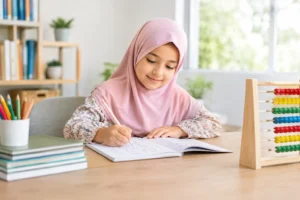
arabic ages 5-7 learning should help children connect sounds, letters, words, and meaning through short, active lessons. At this age, most children are ready for more structure than preschoolers, but they still learn best when practice includes movement, pictures, repetition, conversation, and simple success they can notice. The goal is not to rush through the alphabet or demand long writing tasks. It is to build a dependable foundation for listening, speaking, early reading, and confident participation.
Children who are beginning to identify Arabic letters and blend simple sounds may benefit from Learn Arabic Reading Online. Guided reading support can help a child distinguish similar letter shapes, connect letters to sounds, and practise blending without turning every session into a test.
Families who want their child to understand and use Modern Standard Arabic may also consider Learn Arabic Fusha Online. A structured Fusha pathway can support useful vocabulary, listening comprehension, and simple sentence building alongside reading work.
This stage also sits between two different learning phases. A child who is not yet comfortable with routines, pencil control, or sound matching may need ideas from preschool Arabic learning. A child who already reads short vowelled words independently may be approaching the next stage described in Arabic for ages 8-10.
What Should arabic ages 5-7 Include?
A balanced plan should develop several connected skills rather than treating Arabic as an alphabet-only subject. Children need to hear meaningful language, say words and short phrases, recognize letters in different positions, blend sounds, read simple words, and gradually write what they can already identify.
| Skill area | Suitable goals | Useful activities |
|---|---|---|
| Listening | Follow short classroom directions and identify familiar words | Picture choices, action commands, short stories, and sound hunts |
| Speaking | Use greetings, answer simple questions, and produce short patterned sentences | Role-play, question cards, show-and-tell, and sentence frames |
| Reading | Recognize letters, short vowels, and simple connected words | Letter sorting, blending practice, word-picture matching, and shared reading |
| Writing | Trace and copy letters accurately, then write familiar words with support | Air writing, sand trays, large-line worksheets, and labelled drawings |
Build Letter Knowledge Without Teaching Letters in Isolation
Arabic letters change shape depending on where they appear in a word, so children need to see letters in meaningful examples. Introduce a small group, compare their shapes and sounds, and revisit them in initial, medial, final, and isolated forms. Avoid presenting too many similar letters at once if the child regularly confuses them.
For example, a lesson on ب can include hearing the sound, finding the dot, tracing the shape, and reading it inside a familiar word.
بَيْتٌ
The teacher can then ask the child to point to ب, say the first sound, and match the word to a picture of a house. This sequence joins visual recognition, pronunciation, meaning, and reading. It is more useful than copying one letter across a page without understanding it.
Common letter mistakes at this age
- Remembering a letter name but not its sound.
- Recognizing the isolated form but missing the same letter inside a word.
- Confusing letters that share a basic shape, such as ب، ت، and ث.
- Reading from left to right because English habits take over.
- Guessing from the picture instead of looking carefully at the letters.
A teacher can correct these mistakes by slowing the task down, using contrast pairs, covering the picture temporarily, and asking the child to explain what they noticed. Correction should be specific: “This letter has one dot underneath,” rather than simply saying, “Try again.”
Teach Sounds, Short Vowels, and Blending Step by Step
Children need to hear how a written symbol connects to a spoken sound. Begin with clear letter sounds, then add the short vowels fatḥah, kasrah, and ḍammah. Practise small contrasts so the child hears and sees the difference.
بَ بِ بُ
Once the child can produce these reliably, blend two or three sound units into short words. Keep the print clear and add full vowel marks during early practice. Do not remove support too quickly. Fluency grows through accurate repetition, not through guessing faster.
A useful correction routine is: listen, watch, repeat, read, and use. The child first hears the model, watches the teacher’s mouth when helpful, repeats the sound, reads the written form, and then uses the word in a short phrase or picture task.
Develop Speaking Alongside Reading
Some children can decode Arabic words yet cannot answer a simple question. Others can understand family Arabic but struggle to read. A strong plan connects both sides. Use a limited set of sentence patterns and recycle them across topics such as family, school, food, colors, toys, and daily routines.
هَذَا كِتَابٌ
After modelling the sentence, replace the final word with objects the child knows. Then ask a simple question and accept a short answer before expanding it. A child might begin with “كِتَابٌ” and later say “هَذَا كِتَابٌ.” This gradual expansion supports confidence without accepting unclear pronunciation indefinitely.
For a wider overview of pathways for beginners and heritage learners, parents can read Arabic for kids and heritage learners. It helps families think about whether the child needs support mainly in speaking, reading, vocabulary, or a combination of skills.
Use Play With a Clear Learning Purpose
Games are effective when they practise a specific target. A fast matching game can reinforce letter recognition. A scavenger hunt can practise vocabulary. A “teacher says” activity can build listening comprehension. The game should not become so complicated that the Arabic disappears.
Useful options include:
- Sound detective: Ask the child to find pictures whose names begin with a target sound.
- Letter builder: Form letters with craft sticks, clay, or finger tracing, then say the sound.
- Word-picture race: Match a small set of fully vowelled words to pictures.
- Question ball: Roll or toss a soft ball and answer one familiar Arabic question.
- Missing card: Remove one vocabulary card and ask the child to name what is missing.
More activity ideas are available in Arabic games for kids. Choose games that match the child’s current skill instead of using entertainment as a substitute for teaching.
A Realistic Weekly Arabic Routine for Ages 5-7
Consistency matters more than occasional long sessions. A practical home routine can use 10 to 15 minutes on most days, adjusted for the child’s attention and school workload.
- Day 1: Review two known letters and introduce one new sound.
- Day 2: Practise short vowels and blend three to five syllables.
- Day 3: Use four to six vocabulary words in a game or picture talk.
- Day 4: Read a few short words and copy one or two accurately.
- Day 5: Reuse the week’s language in a mini-dialogue or simple story.
Stop before the child becomes exhausted. A short session that ends with success is easier to repeat. Keep one notebook or folder for recent letters, words, and sentence patterns so review is focused rather than random.
How Parents Can Help Without Speaking Arabic Fluently
Parents do not need to become the main Arabic instructor. Their most valuable role is to protect a regular time, show interest, and make practice easy to begin. Ask the child to teach you one word, point to the correct card, or read a short line from the week’s lesson. Use the teacher’s audio model when pronunciation is uncertain rather than inventing a sound.
A simple parent checklist is enough:
- Can my child identify this week’s letters in more than one form?
- Can my child say the target words clearly enough to be understood?
- Can my child read the words without relying only on pictures?
- Can my child answer one familiar question using a word or short sentence?
- Does the teacher explain mistakes in a way my child can act on?
How to Choose Lessons and Track Progress
Look for lessons that are active but organized. The teacher should know whether the child is working on sound recognition, blending, vocabulary, or sentence production. Activities should change, but the learning target should remain clear. Parents should be able to describe what the child can now do, not only how many pages were completed.
Useful progress statements include: “I can identify six letters in connected words,” “I can read five short vowelled words,” or “I can answer questions about my name and age.” This kind of evidence is more meaningful than expecting every child to finish the same textbook at the same speed.
Avoid comparing a six-year-old beginner with an older sibling or a fluent heritage speaker. Later, the learning emphasis will change. The needs of older children are discussed separately in Arabic for teens, where lessons usually require more independent study and age-appropriate themes.
Conclusion
Arabic learning between ages five and seven should combine careful sound work, meaningful speaking, early reading, supported writing, and purposeful play. Children need repetition, but they also need variety and clear reasons for each activity. A steady plan, specific teacher correction, and brief home review can help a child move from recognizing separate letters to reading and using simple Arabic with growing confidence.
Frequently Asked Questions
What should a 5-year-old learn first in Arabic?
A 5-year-old should usually begin with listening, familiar vocabulary, letter recognition, clear letter sounds, and simple oral routines. Writing can start with large tracing and shape-building activities rather than long copying tasks.
Should children ages 5-7 learn speaking or reading first?
They can develop both together. Speaking gives words meaning, while reading connects those known sounds and words to print. The balance should depend on whether the child is a complete beginner or already understands some Arabic at home.
How many Arabic letters should a child learn each week?
There is no single correct number. One to three new letters may be enough when lessons also include sound practice, different letter forms, review, and simple words. Move more slowly when similar letters are being confused.
When should short vowels be introduced?
Short vowels can be introduced once a child understands that letters represent sounds. Teach fatḥah, kasrah, and ḍammah through small contrasts and repeated blending rather than asking the child to memorize their names only.
How long should Arabic practice last at home?
For many children in this age group, 10 to 15 focused minutes is practical. A shorter successful routine repeated regularly is usually more useful than an occasional long session that causes frustration.
What if my child mixes up Arabic letter shapes?
Reduce the number of letters being compared, highlight dots and direction, and practise the same letter in isolated and connected forms. Ask the child to describe the visual difference before reading it.
Can games replace formal Arabic lessons?
Games can strengthen a clear target such as vocabulary, listening, or letter recognition, but they should not replace explanation, guided practice, and correction. The child still needs a structured sequence.
Can parents help if they do not speak Arabic?
Yes. Parents can schedule practice, use teacher-provided audio, review cards, listen to the child read, and ask the child to teach them a word. They should avoid modelling pronunciation they are unsure about.
Are online Arabic lessons suitable for ages 5-7?
Online lessons can be suitable when they are interactive, visually clear, paced for the child, and include frequent responses rather than long explanations. The teacher should be able to redirect attention and give specific correction.
How do I know whether my child needs an Arabic reading course?
A reading course may help when the child struggles to connect letters with sounds, recognize connected forms, blend syllables, or read simple vowelled words. An initial level check should identify the starting point.
How do I know whether my child needs a Fusha course?
A Fusha course may be useful when the goal includes understanding and producing Modern Standard Arabic for stories, study, or wider communication. The child should practise listening and speaking as well as vocabulary and sentence patterns.
References and External Resources
- NCSSFL-ACTFL Can-Do Statements — guidance for describing language growth through practical communication goals.
- Brain-Building Through Play — Harvard Center on the Developing Child resources on purposeful play and learning.
- Tips for Teaching Your Child About Phonemes — parent-friendly guidance on connecting letters and speech sounds.