TEXT, TRANSMISSION, MEANING AND PRACTICE — TAUGHT WITHOUT TURNING BEGINNERS INTO SELF-APPOINTED HADITH GRADERS

Online Hadith Classes: Learn Prophetic Teachings Through Evidence, Context and Practice

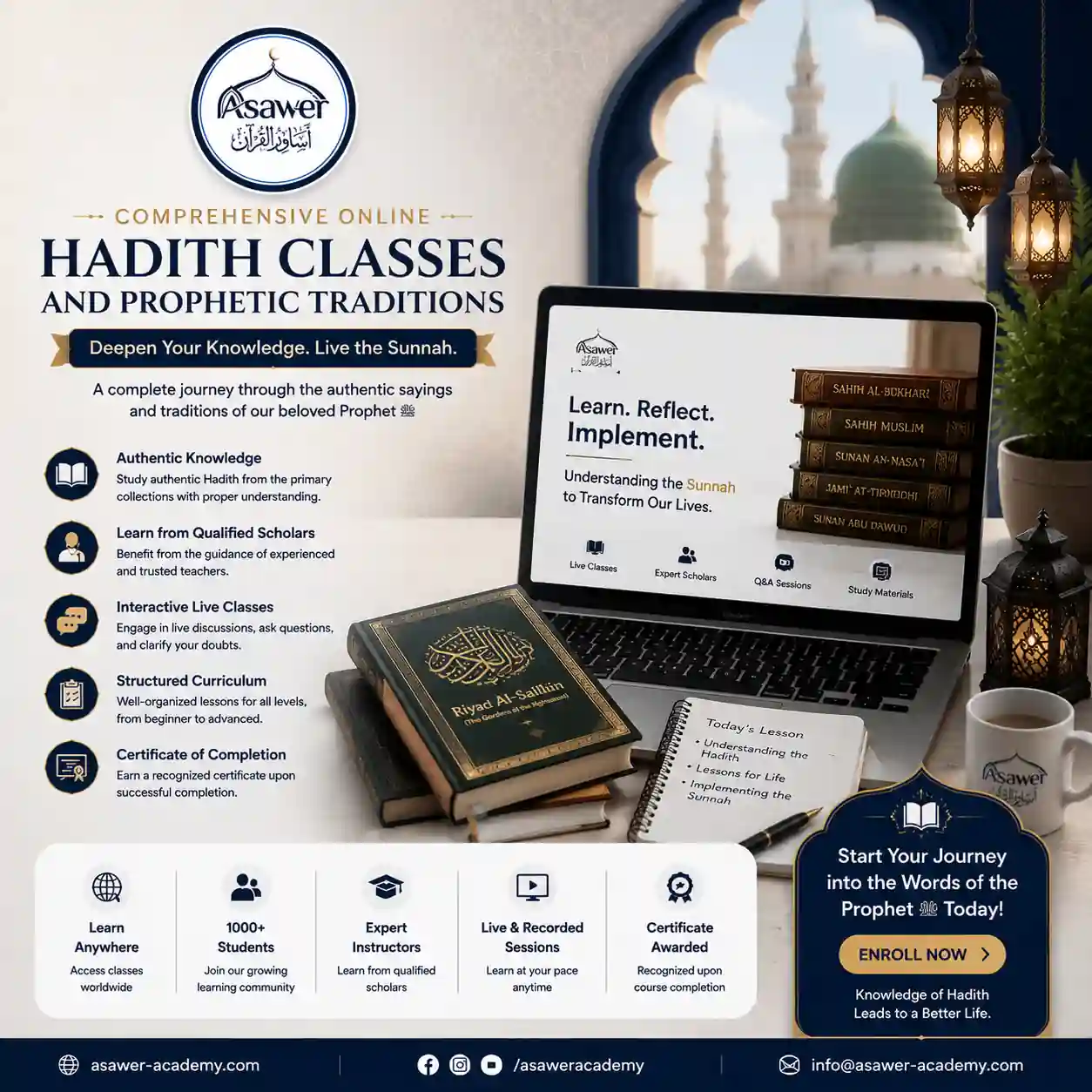
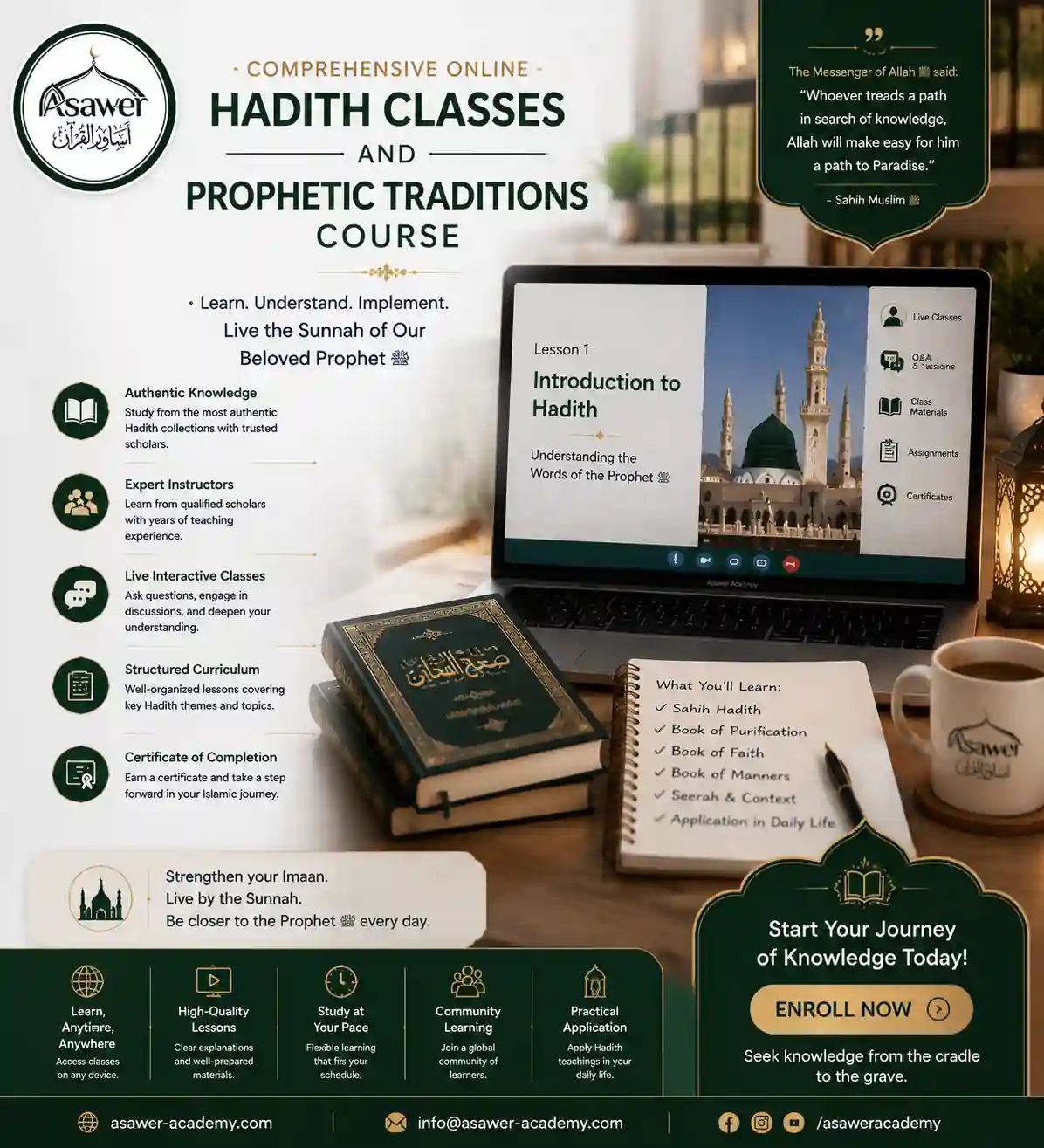
Study Hadith online through private live lessons that connect the words of Prophet Muhammad ﷺ with their source, transmission, meaning, context and daily application. The course offers separate routes for children, beginners, adults and students beginning Mustalah al-Hadith.
The free trial identifies Arabic reading, prior Islamic study, age, memorisation goals and whether the learner needs a text-based path such as Imam al-Nawawi’s Forty Hadith, a character course, a source-literacy path or an academic introduction to Hadith sciences.
Asawer Academy video overlay.webp
مَتْن • سَنَد • مَعْنًى • سِياق • عَمَل
Every narration is studied as a text with evidence and responsibility—not a quote card.
5
EVIDENCE LAYERS
4
LEARNER ROUTES
32
CURRICULUM UNITS
1
SOURCE AUDIT PROTOCOL

Text Accuracy

Learn the complete selected wording, translation and limits of paraphrase instead of relying on viral quote graphics.

Transmission Literacy

Understand what Isnad, narrator evaluation and classification mean without claiming independent authority too early.

Context and Commentary

Read related narrations, Quranic principles and recognised commentary before drawing a broad conclusion.

Sunnah in Practice

Turn one clear teaching into worship, character or family action without exaggerating what the text proves.
Online Hadith Classes and Prophetic Traditions Course
A HADITH IS NOT A SOCIAL-MEDIA CARD

The wording, source, grading and explanation can all change what a learner should conclude

A short translated sentence may omit the speaker, situation, condition, parallel wording or scholarly qualification. A source label alone also does not make every reader qualified to issue a ruling.
The Hadith Evidence Studio keeps the text, source, confidence level, explanation and application in separate visible fields.
THE FIVE EVIDENCE LAYERS

Every lesson shows what kind of claim is being made

The layers create academic honesty without overwhelming children or beginners.
01

Matn

The selected Arabic text, accurate translation, key words and the limits of a shortened quotation.
02

Source

Collection, chapter, narrator and edition or numbering notes where relevant.
03

Transmission Status

The published grading or scholarly treatment is reported accurately; students do not manufacture grades.
04

Meaning and Context

Related Quranic principles, parallel narrations, occasion and recognised commentary shape understanding.
05

Responsible Practice

One supported action, question or reflection is extracted without extending the Hadith beyond its evidence.
FOUR LEARNER ROUTES

The same collection should not be taught with the same depth to every student

Placement selects the text, language, memorisation load and level of Hadith science.
6–9

Short Hadith and Character

Selected short authentic narrations, meaning, one Arabic phrase, story context and a home action.
10–13

Forty Hadith Foundations

Age-responsive study of selected Nawawi Hadith, vocabulary, evidence labels and practical discussion.
14+ / Adult

Text, Commentary and Questions

Forty Hadith, Riyad al-Salihin selections, difficult questions and careful application.
Student of Knowledge

Mustalah Foundations

Classification, Isnad, Matn, preservation, collection maps and guided research under a qualified teacher.
THE 32-UNIT HADITH CURRICULUM

Eight studios from Prophetic teachings to source-aware research

The syllabus serves character learning and Hadith-science literacy without pretending one short course creates an independent Muhaddith.
1. Quran, Sunnah and Hadith
What each term means, how the Sunnah explains Islamic practice and why translation is not the original text.

2. Sayings, Actions, Approvals and Descriptions
Recognise common forms of Prophetic report and avoid reducing Hadith to quotations only.

3. Oral and Written Preservation
Companions, early writing, transmission, travel and the growth of scholarly verification—without simplistic myths in either direction.

4. The Hadith Research Boundary
What a beginner can locate, what a student can compare and what requires a qualified Muhaddith, Mufti or specialist.

Evidence: classify examples by type and state which questions remain beyond the learner’s level.
5. Intention and Sincerity
Study the Hadith of intentions, the difference between action and motive, and one realistic practice.

6. Islam, Iman and Ihsan
Use the Hadith of Jibril to organise belief, worship and excellence without presenting the lesson as a complete Aqeedah or Fiqh course.

7. Halal, Haram and the Doubtful
Understand the heart of the teaching while referring case-specific rulings to qualified scholarship.

8. Religion Is Sincere Counsel
Meaning, recipient categories, manners and the difference between Nasihah and public humiliation.

Evidence: explain one Hadith in context and choose an application that the text actually supports.
9. Mercy, Gentleness and Restraint
Selected authentic narrations with careful comparison rather than a single motivational slogan.

10. Truthfulness, Trust and the Tongue
Speech, promises, backbiting, verification and digital forwarding.

11. Parents, Neighbours and Community
Rights and character with age-appropriate boundaries and no forced family conclusions from isolated texts.

12. Anger, Envy and the Heart
Spiritual instruction and behaviour practice without presenting Hadith study as clinical treatment.

Evidence: build one Hadith-in-action plan and record what the narration does not claim.
13. Imam al-Nawawi’s Forty Hadith
Why the collection is called Forty although it contains forty-two narrations; purpose, themes and commentary use.

14. Riyad al-Salihin
Its thematic structure, Quran introductions and the need to check individual narration treatment rather than assuming one blanket grade.

15. Sahih al-Bukhari and Sahih Muslim
Purpose, chapter headings, repeated narrations and why advanced reading needs guidance.

16. Sunan, Adab, Shama’il and Ahkam Collections
Map major collection types and why a book’s purpose affects how its narrations are studied.

Evidence: locate the same topic across two collections and explain the difference in organisation.
17. Sahih, Hasan and Da‘if
Introductory definitions, limits and the danger of reducing grading to one label without scholarly detail.

18. Marfu‘, Mawquf and Maqtu‘
Who a report is attributed to and why attribution matters.

19. Mutawatir, Ahad, Mashhur and Gharib
Introductory transmission categories taught without oversimplified certainty claims.

20. Connected and Disconnected Chains
Musnad, Mursal, Mu‘allaq and related terms as a guided map, not an independent grading licence.

Evidence: read a scholar-provided example and identify the published term accurately.
21. Reading an Isnad
Recognise the chain structure, narrator sequence and basic transmission language.

22. Narrator Evaluation
Integrity, precision and biographical scholarship at an introductory level; no rating narrators from short biographies.

23. Multiple Routes and Corroboration
Why parallel chains can matter and why combining routes requires specialist method.

24. Hidden Defects and the Limits of Beginners
Introduce ‘Ilal so learners understand why apparent chain continuity is not the final word.

Evidence: annotate an instructor-selected chain and state what cannot be concluded independently.
25. Wording Variation and Translation
Compare variants, additions and paraphrases without treating every English rendering as identical.

26. Context and Related Evidence
Occasion, audience, Quranic principles, parallel narrations and commentary.

27. Difficult or Controversial Narrations
Check authenticity, wording, commentary, scope and scholarly disagreement before responding.

28. Hadith and Modern Claims
Medicine, science, psychology, politics and business require subject expertise; the course avoids forcing every text into a modern trend.

Evidence: produce a sourced question map rather than a confident answer beyond the evidence.
29. Viral Quote Audit
Search the exact wording, identify paraphrase, locate the source and record the published grading.

30. Numbering and Edition Differences
Why website numbers can differ and how to cite collection, book and chapter responsibly.

31. AI, Search Engines and Hadith
Use digital tools for retrieval only with verification; never treat generated confidence as scholarly authentication.

32. Hadith Evidence Portfolio
Present selected narrations with text, source, grading reference, commentary, application and referral notes.

Final evidence: audit an unfamiliar quote and explain what is known, uncertain and beyond the learner’s authority.
THE SOURCE AUDIT PROTOCOL

Before sharing a Hadith, the learner walks through seven checks

The protocol does not authorise a beginner to authenticate a narration or derive a Fatwa. It creates a transparent record for teacher review.
Comprehensive Online Hadith Classes and Prophetic Traditions Course
ACADEMIC AND PASTORAL BOUNDARIES

A serious Hadith course also teaches when to stop and ask a specialist

Text study, spiritual benefit, legal derivation, medical claims and historical analysis are related fields—not one automatic conclusion.

No Instant Authentication

Students learn terminology and published gradings but do not declare a Hadith Sahih or fabricated from a short chain exercise.

No Self-Fatwa

A narration may inform Fiqh, but legal application requires complete evidence, principles and qualified scholarship.

No Clinical or Scientific Guarantees

Hadith may guide worship and character without being marketed as therapy, diagnosis or a laboratory claim.

No Sectarian Weaponisation

Differences are taught with source, scholarly scope and respectful language instead of using one text to attack entire communities.
THE HADITH FAMILY PRACTICE CARD

One narration, one source and one honest action

Parents reinforce meaning and practice while source grading and difficult questions stay with the teacher.
1

One Hadith

Choose one short narration or one meaningful phrase rather than overloading the child.
3

Three Questions

Who said it? What does it mean? What can we practise this week?
1

One Source Label

Keep the collection or teacher-provided source with the Hadith instead of forwarding an image alone.
1

One Action Review

At the end of the week, discuss the action without shaming or claiming perfect transformation.
Comprehensive Online Hadith Classes and Prophetic Course
PROGRESS ON AN UNFAMILIAR NARRATION

The learner should show more than memorisation

Progress is reviewed through reading or recitation, source location, grading reference, meaning, context, responsible application and referral awareness. The format of any notes or reports is explained before enrolment.
PRIVATE HADITH LEARNING ACROSS TIME ZONES

Scheduling for the USA, Canada and Australia

A suitable schedule protects continuity, reading preparation and teacher-guided questions.
US

United States

Discuss school, university, work and family timing, plus the learner’s main source or character goals.
CA

Canada

Confirm local-time teacher availability, language support and a stable review rhythm.
AU

Australia

Check AEST, ACST or AWST compatibility and choose a time suitable for reading and discussion.
FREQUENTLY ASKED QUESTIONS

What learners and parents ask before online Hadith classes

Clear answers about collections, grading, Arabic, children, digital verification and responsible application.
They are live lessons that study selected Prophetic narrations, their wording, source, meaning, context and application. Advanced routes introduce Hadith terminology and research literacy.
Hadith is a transmitted report about the Prophet ﷺ. Sunnah refers more broadly to Prophetic guidance and practice. Introductory definitions can vary by scholarly field, so the course explains usage carefully.
No. Beginners can study through English explanation and selected Arabic text. Advanced collection and Mustalah work benefits from stronger Arabic.
Yes, selected or complete study can be used according to route. The famous collection contains forty-two narrations despite its conventional title.
Adult and intermediate routes may use selected chapters. Individual narrations are still studied with their source and scholarly treatment.
No. The exact wording, location, edition and translation still need checking. A viral paraphrase may not match the source text.
Yes, as technical introductory categories. The course does not promise that a beginner will independently authenticate narrations after a few lessons.
Isnad is the chain of transmission; Matn is the reported text. Both require scholarly method and wider evidence.
Yes, through an age-responsive route using shorter narrations, meaning, stories and practical character actions.
Yes. Beginners can start with foundational Hadith and Sunnah concepts without assumed Arabic or seminary study.
The teacher identifies the published grading and scholarly treatment. Weak narrations are not automatically treated as fabricated, and students are not asked to invent grades.
Digital tools can help locate texts, but numbering, translation, variants, grading and application still need verification and qualified commentary.
AI can assist retrieval or organisation, but it can hallucinate sources and cannot replace qualified Hadith scholarship.
Older learners can study difficult narrations through authenticity, wording, context, parallel evidence and recognised commentary rather than slogans.
Not necessarily. Fiqh may require multiple texts, Quranic evidence, principles, exceptions and scholarly analysis.
No. Prophetic teachings can support faith and character, but the course does not diagnose or replace professional mental-health care.
A preference may be requested. Matching depends on qualifications, age group, language, schedule and availability.
The exact text edition and supporting materials depend on the selected Hadith route. Any worksheets, audio, recordings, reports, platform access or completion document are explained before enrolment.
By reading or recitation, source location, grading reference, meaning, context, responsible application and referral awareness.
The 32-unit map is a curriculum framework. Duration depends on route, Arabic, memorisation, reading preparation and lesson frequency.

Asawer Academy

Asawer Academy specializes in teaching the Quran, Arabic, and Islamic Studies to non-Arabic speakers through live one-to-one online lessons.

📞

Phone / WhatsApp

+20 102 830 2494
✉️

Email Address

[email protected]
🌐

No credit card required. We'll confirm your lesson via email and phone.