AUTHENTIC QURANIC STORIES, AGE-RESPONSIVE TEACHING AND A HOME PLAN FOR PARENTS

Online Stories of the Prophets Course: Study Quranic Narratives Through Revelation, Trial and Response

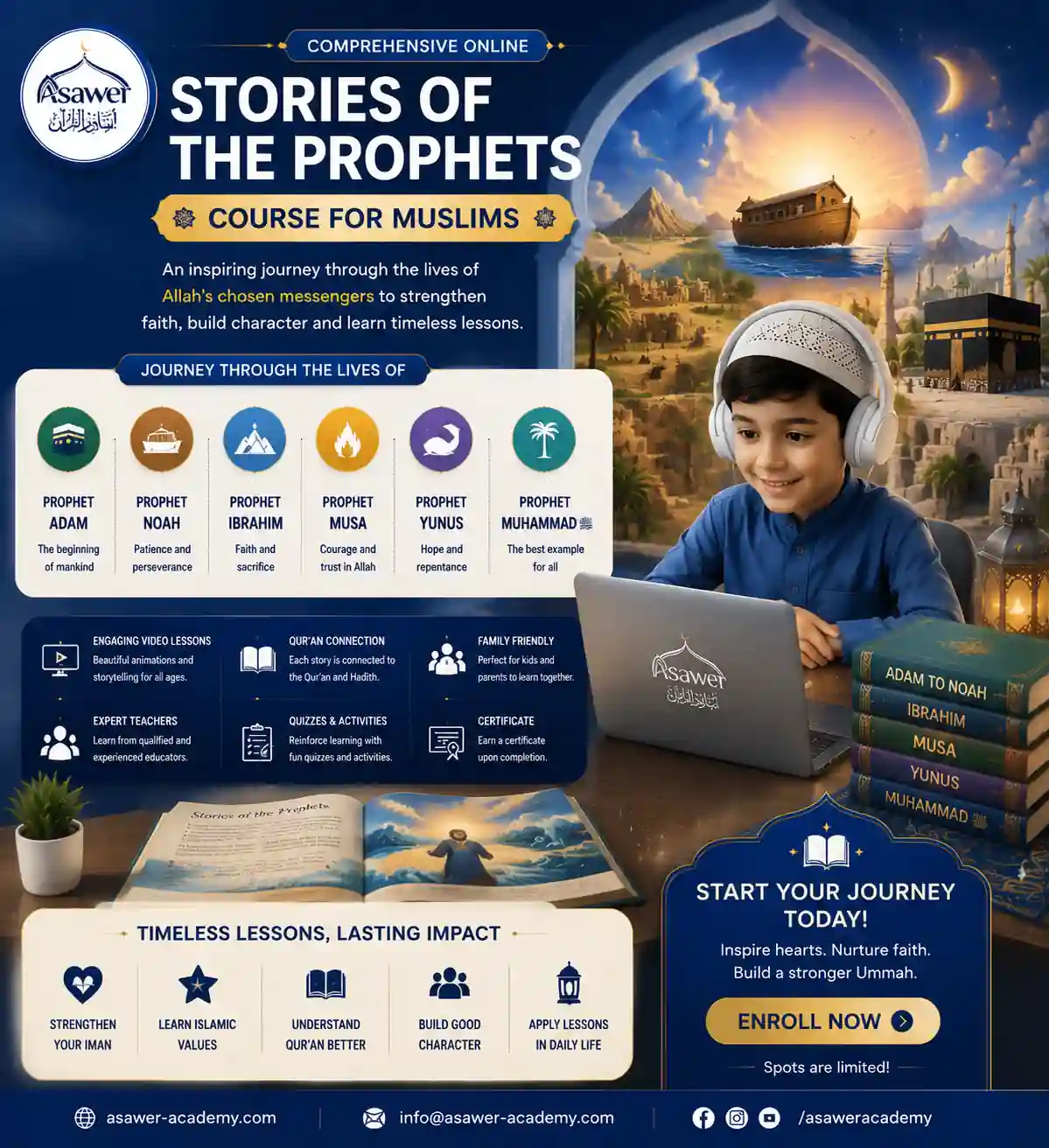
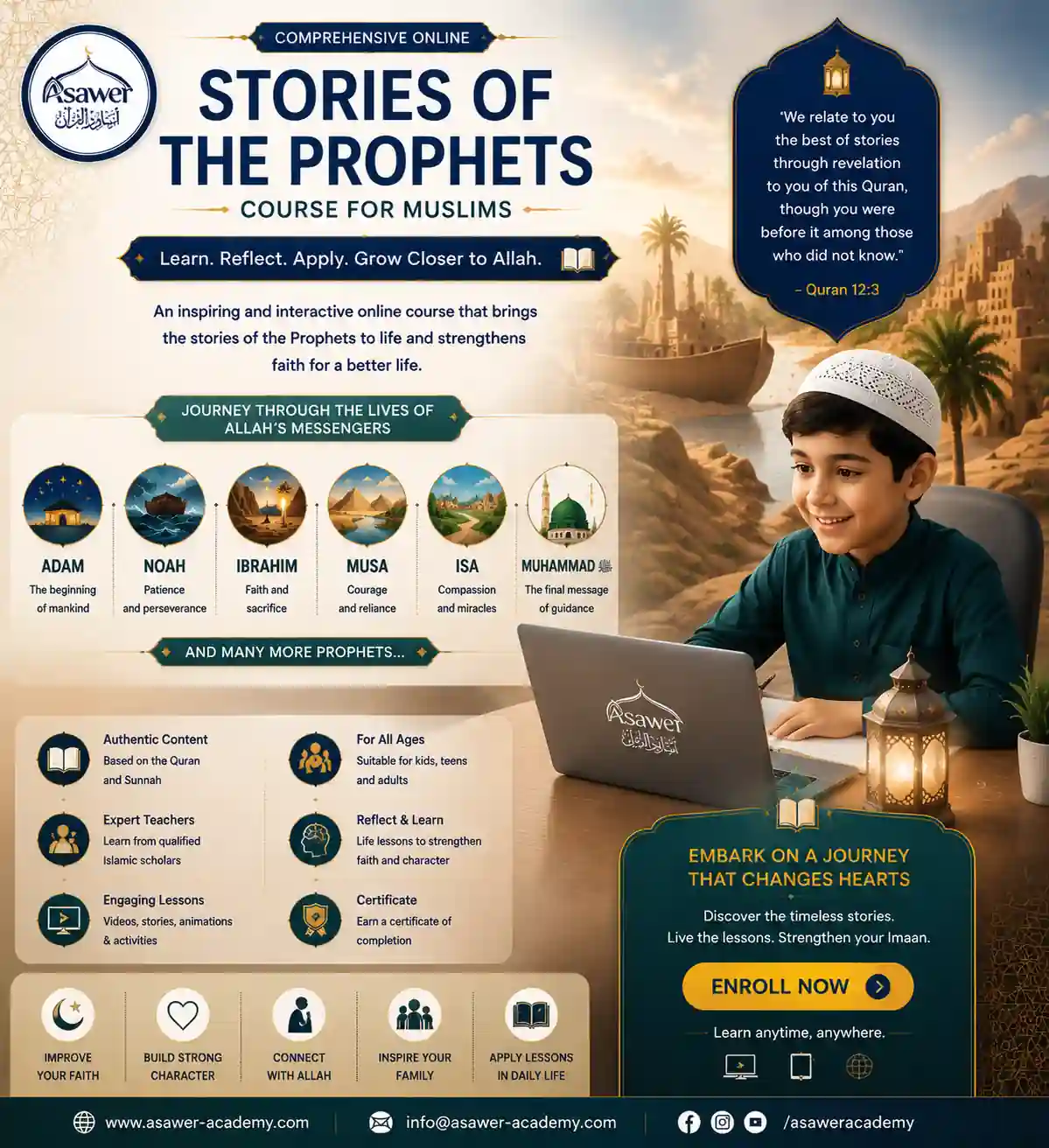
This course studies the major Prophetic narratives found in the Quran and authentic Sunnah, from Adam, Nuh and Ibrahim to Yusuf, Musa, Yunus, Isa and other Prophets whose stories are established in revelation. The learner follows what the source actually states, identifies the trial and the Prophet’s response and then considers one belief, character lesson or family practice supported by the narrative. The course is organised by Quranic journeys rather than by the Makkah–Madinah biography of Prophet Muhammad ﷺ. Learners seeking the connected chronology of the final Messenger’s life should continue in the dedicated Seerah course.
The course is designed for children, teens, families, new Muslims and adults who want an authentic and organised introduction to Qasas al-Anbiya. The free trial identifies the learner’s age, Islamic background, attention span, language level and the questions the family wants the course to answer.
Asawer Academy video overlay.webp
وَحْي • ابْتِلاء • اسْتِجابَة • عَمَل
Every story moves from revealed truth to one age-appropriate family action.

Quran-First Sources

The lesson begins with what the Quran states, then adds authentic Hadith and reliable explanation.

Age-Responsive Storytelling

The same story changes vocabulary, depth, questions and sensitive details according to age.

Lesson-to-Life Compass

Each class extracts Tawheed, character, decision-making and one practical family habit.

Parent Home Bridge

Parents receive a short follow-up plan that supports learning without repeating the whole class.
Online Seerah Course
THE PROPHETIC STORY COMPASS

Four questions keep every story accurate, meaningful and practical

Children often remember the ark, the whale or the sea but forget why the event matters. The Prophetic Story Compass prevents the lesson from becoming only a dramatic scene.
THE SOURCE INTEGRITY LADDER

Children should know what is certain and what is not

The Quran states that some messengers were described while others were not, so the course does not invent complete biographies where revelation gives only a brief mention.
01

Explicit Quranic Text

Names, events, dialogue and lessons directly stated in the Quran form the fixed centre of the lesson.
02

Authentic Hadith

Relevant sound narrations may add explanation, while the teacher distinguishes them from Quran wording.
03

Reliable Tafsir and Seerah

Scholarly explanation provides language, context and connections when the evidence is identified.
04

Uncertain Details Labelled or Left Out

Isra’iliyyat, disputed timelines and popular embellishments are not presented to children as certain revelation.
FOUR AGE-RESPONSIVE PATHWAYS

The story remains sacred; the teaching language changes

5–7

Story and Love

Short scenes, repeated key phrases, one belief, one character quality and a simple home action.
8–10

Story and Choice

Sequence events, explain motives, compare choices and connect the story to school and family situations.
11–14

Evidence and Reflection

Read selected verses, distinguish source levels, ask difficult questions and discuss social pressure.
15+ / Family

Context and Tafsir

Study recurring Quranic themes, reliable explanation, misconceptions and deeper personal reflection.
THE 24-UNIT PROPHETIC JOURNEY

Six journeys through the major Quranic narratives

The organisation supports learning; it does not claim certainty about every historical date or the exact chronological order of all Prophets.
1. Prophet Adam — Creation, responsibility and repentance
What Allah taught Adam, the first test, the danger of blame and the meaning of returning sincerely.

2. Prophet Nuh — Calling with patience
Long-term da‘wah, family pain, obedience and why results belong to Allah.

3. Prophet Hud — Strength without arrogance
The people of ‘Ad, false confidence and gratitude for ability.

4. Prophet Salih — A clear sign and a broken covenant
Respecting Allah’s signs, group pressure and accountability.

Family practice: one sincere apology, one act of obedience and one gratitude statement.
5. Prophet Ibrahim — Asking, reasoning and rejecting idols
Tawheed, respectful questioning and courage without mocking people.

6. Prophet Ibrahim — Fire, sacrifice and building the Ka‘bah
Trust, submission, family cooperation and dua for future generations.

7. Prophet Lut — Moral clarity and protection from corruption
Age-appropriate treatment of public wrongdoing, safety and refusing normalised sin.

8. Ismail, Ishaq and Yaqub — Promise, family and continuity
Obedience, parent-child trust, blessing and carrying faith across generations.

Family practice: create one household value and connect it to a Quranic dua.
9. Prophet Yusuf — Jealousy, the well and refusing revenge
Sibling conflict, harmful comparison, hope and the danger of hidden resentment.

10. Prophet Yusuf — Temptation, prison and responsibility
Private integrity, false accusation, competence and forgiveness without denying harm.

11. Prophet Ayyub — Patience without pretending pain is easy
Dua, endurance, gratitude and avoiding harmful claims that suffering is a guaranteed cure or therapy.

12. Prophet Shu‘ayb — Honesty in trade and public life
Fair measurement, corruption, truthful advice and economic ethics.

Family practice: identify one pressure and write the truthful response before it occurs.
13. Musa’s childhood, fear and return
Allah’s care, human fear, repentance and preparation for responsibility.

14. Musa and Harun before Pharaoh
Courage, teamwork, clear speech and speaking truth without arrogance.

15. The signs, the sea and liberation
Trust during danger, rejecting tyranny and remembering the source of rescue.

16. Bani Israel, the covenant and repeated learning
Gratitude after crisis, community responsibility and the danger of forgetting lessons quickly.

Family practice: practise one difficult truthful sentence with calm language.
17. Prophet Dawud — Worship, justice and accountability
Strength with humility, fair judgment and returning when corrected.

18. Prophet Sulaiman — Knowledge, power and gratitude
Leadership, listening, resources and refusing pride.

19. Prophet Yunus — Leaving too soon and calling Allah in darkness
Impatience, responsibility, repentance and hope.

20. Zakariyya and Yahya — Quiet dua and principled youth
Hope in old age, sincerity, purity and courage.

Family practice: choose one private act of worship and one fair decision.
21. Maryam and the birth of Prophet Isa
Purity, trust, miraculous birth and respectful Islamic belief about Maryam and Isa.

22. Prophet Isa — Message, miracles and disciples
Tawheed, miracles by Allah’s permission and correcting misconceptions without attacking people.

23. Prophet Muhammad ﷺ as the final Messenger
A bridge to the separate Seerah course: final revelation, continuity of the message and mercy.

24. The Prophetic Pattern Capstone
Compare Tawheed, da‘wah, patience, family trials, leadership, repentance and reliance across the course. Include brief Quranic mentions of Idris, Dhul-Kifl, Ilyas and Al-Yasa without invented biographies.

Family practice: build a Prophetic Character Charter with three habits for the next month.
THE LIVE STORY LESSON

A child should retell, question, explain and choose—not only watch

Online Stories of the Prophets Course for Muslims
THE PARENT HOME BRIDGE

Support the lesson in minutes—not with another lecture

Before

One Question

Ask the child what they already think, without correcting everything before the lesson.
After

Three-Part Retell

Who faced the test? What choice was made? What did we learn about Allah or worship?
Week

One Family Habit

Choose one small behaviour such as truthful speech, gratitude, dua, patience or apology.
Friday

Five-Minute Family Review

Read one verse translation, revisit the habit and let the child ask one unanswered question.
STORY SAFETY AND VISUAL ETHICS

Engaging does not mean sensational, frightening or invented

The strongest Islamic storytelling protects both authenticity and the child’s emotional readiness.

Age-Sensitive Storytelling

Violence, family conflict, punishment, temptation and sexuality-related themes are explained without graphic detail, shame or unnecessary fear. Parents can flag sensitivity before class.

Visual Respect

The page and lessons use landscapes, maps, architecture, objects, calligraphy and symbolic settings. They do not depict Prophets, messengers or angels as characters.
Stories of the Prophets Course for Muslims
PROGRESS THAT A PARENT CAN OBSERVE

Five forms of evidence are stronger than “finished another story”

PRIVATE ISLAMIC LEARNING ACROSS TIME ZONES

Scheduling for families in the USA, Canada and Australia

A useful schedule protects attention, teacher continuity and a short parent follow-up routine.
US

United States

Discuss after-school, evening or weekend times and the child’s Islamic-studies background.
CA

Canada

Confirm local-time teacher availability, parent feedback preference and a stable weekly routine.
AU

Australia

Check AEST, ACST or AWST compatibility and safeguarding expectations for private online lessons.
FREQUENTLY ASKED QUESTIONS

What parents and learners ask before a Prophets course online

Clear answers about sources, age groups, illustrations, chronology, sensitive topics, parent involvement and progress.
It is a live Islamic studies course that teaches major Quranic narratives, authentic lessons of faith and age-appropriate practical application.
Children are a primary audience, while separate pathways support teens, families, new Muslims and adults. Lesson depth, vocabulary and sensitive details are adapted to age and readiness.
The core journey covers the major Quranic narratives from Adam through Nuh, Ibrahim, Yusuf, Musa, Dawud, Sulaiman, Yunus, Isa and the final Messenger ﷺ, with other named Prophets included where revelation provides sufficient detail.
No. The Quran states that some messengers were related and others were not. The course avoids inventing complete stories for Prophets whose details are not established.
The source order is Quran, authentic Hadith and reliable tafsir or Seerah. Disputed or Israelite details are omitted or clearly labelled rather than presented as revelation.
Selected verses may be read, translated or paraphrased according to the learner’s Arabic and Quran-reading level.
No. Course visuals use maps, landscapes, architecture, objects, calligraphy and timelines without depicting Prophets or angels.
The teacher reduces graphic detail, uses age-appropriate vocabulary and focuses on belief, choice, safety and character. Parents can raise sensitivities before class.
The course uses a learning sequence and broad prophetic journey, but it does not claim certainty about every historical date or the exact order of all Prophets.
It includes a final-message bridge and recurring prophetic themes. The full life of Prophet Muhammad ﷺ belongs to the separate Seerah course.
A live teacher checks understanding, answers questions, separates reliable evidence from embellishment and adapts the lesson and home action to the learner.
Use the Parent Home Bridge: one question before class, a three-part retell after class, one weekly habit and a five-minute Friday review.
It may work when age, attention and knowledge are close. One-to-one teaching is better when sensitivities, pace or questions differ significantly.
Yes. The adult or family path can introduce the prophetic line, Tawheed, Quran connections and basic source awareness without assuming prior study.
A preference may be requested. The final match depends on teaching experience, language, age group, schedule and availability.
The exact learning resources depend on the selected route. Any worksheets, parent notes, recordings, progress reports, platform access or completion document are explained before enrolment.
The route depends on age, lesson length, selected stories and depth. The 24-unit map is a curriculum framework, not a guaranteed completion date.
The course teaches beliefs, choices and habits, but no course can guarantee behavioural transformation. Parents and teachers reinforce small consistent actions.

Asawer Academy

Asawer Academy specializes in teaching the Quran, Arabic, and Islamic Studies to non-Arabic speakers through live one-to-one online lessons.

📞

Phone / WhatsApp

+20 102 830 2494
✉️

Email Address

[email protected]
🌐

No credit card required. We'll confirm your lesson via email and phone.
