
A Reassuring First Lesson
During the trial class, my daughter learned the morning Adhkar and the Dua for entering the home along with its meaning. It felt immediately practical. What reassured us was that the trial felt like a genuine…

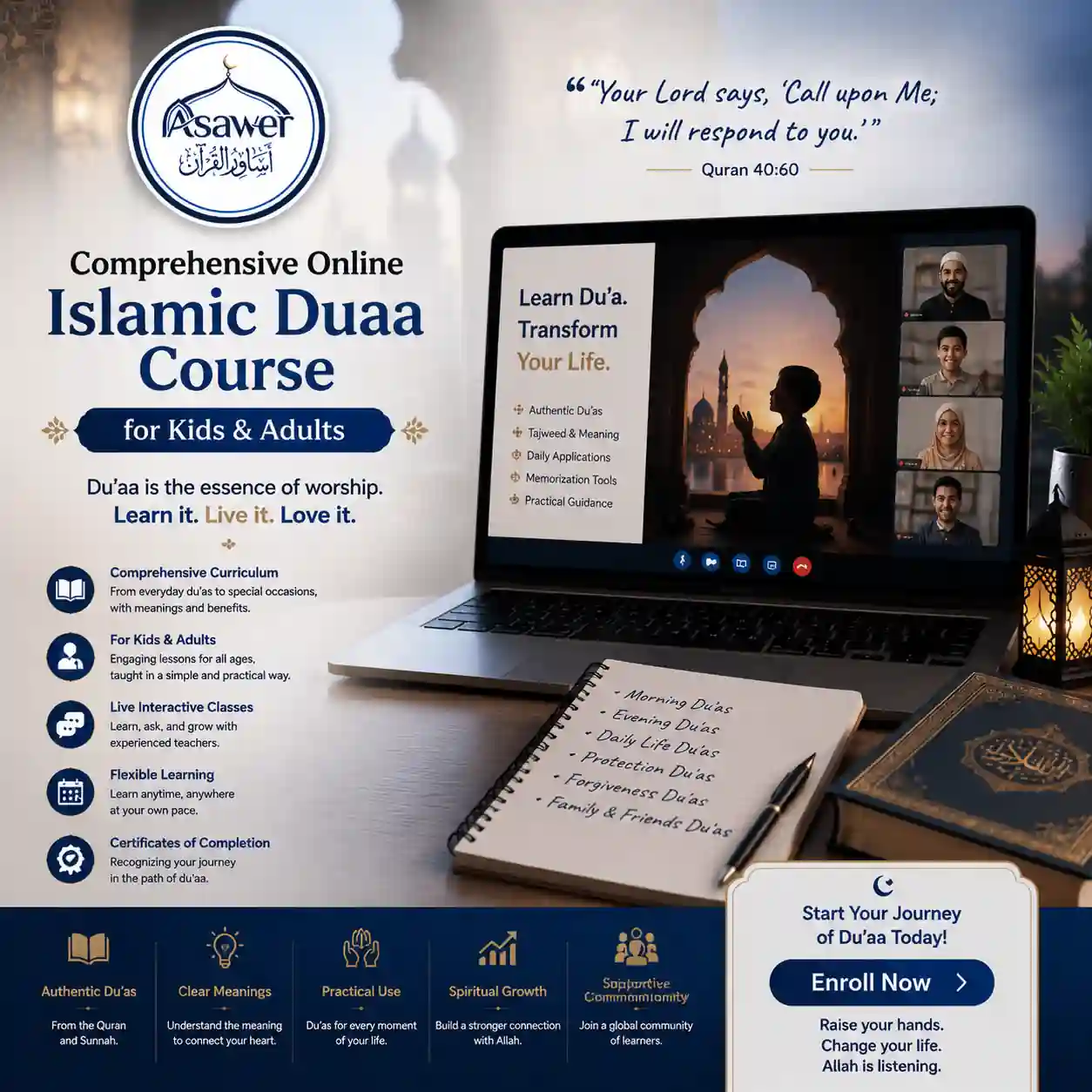
Build a daily rhythm of remembrance through an Online Islamic Dua Course that teaches authentic Quranic and Prophetic supplications with correct Arabic wording, understandable meaning, the right occasion and a revision system that turns memorization into a real habit.
The course serves children, adults, families and new Muslims. The free trial checks what you already know, pronunciation, Arabic reading, daily routines and whether the main need is essential duas, morning/evening Adhkar, Quranic supplications or a stronger long-term Dhikr habit.
A learner should know the Arabic wording, meaning, occasion and source confidence of a supplication—not only a phonetic sound remembered from childhood.
The course distinguishes transmitted Dua and Dhikr from personal supplication, and it avoids attaching unverified rewards, guaranteed outcomes or invented formulas to popular phrases.
Daily practice is built through real cues: waking, eating, leaving home, entering the masjid, travel, gratitude, fear, forgiveness and sleep.
Every new Dua begins with a verified text and teacher model. The learner repeats short chunks, understands the meaning and identifies the exact situation where the supplication belongs.
The teacher then removes the prompt. A child may use a picture or routine cue; an adult may use a daily checklist or audio recall. Older duas return through spaced review so new memorization does not erase earlier habits.
When relevant, the learner also studies how to make personal Dua sincerely and appropriately without confusing a private request with a fixed Prophetic formula.
The curriculum is organized around real-life cues instead of a random list. Learners can enter at the routine that matches what they already know and the habits they are ready to maintain.
What Dua is, what Dhikr is, authentic source awareness, manners of supplication, intention and how to learn Arabic wording responsibly.
Waking, morning/evening remembrance, bedtime, night waking and creating a repeatable start-and-end-of-day rhythm.
Eating, clothing, bathroom, entering/leaving the home, sneezing and daily cues that make remembrance automatic.
Entering/leaving the masjid, selected prayer-related adhkar, forgiveness, praise and understanding the difference between fixed and personal supplication.
Travel, fear, distress, illness-related general supplications, gratitude, seeking help and source-aware use of protective adhkar.
Selected Quranic supplications, meaning and context, then how to make sincere personal Dua without inventing guaranteed formulas.
Children benefit from short phrases, visual cues and parent reinforcement. Adults may need pronunciation repair, source checking and meaning. New Muslims can start with essential daily routines without needing full Arabic literacy.
Learners wanting a broader foundation can combine this course with Islamic Studies for Kids or Islamic Studies for Adults.
The teacher verifies the text, models the Arabic, corrects pronunciation, explains the meaning and connects the supplication to a real situation. The learner then retrieves it without reading the prompt.
Revision remains visible. Older duas return alongside new ones, and families can use routine cues without turning worship into pressure. Claims about special virtues or guaranteed results are only taught when reliable evidence supports them.
A useful Dua course needs authentic sources, understandable meanings, correct pronunciation, real-life cues and enough revision for the habit to survive after class.
Quranic and reliably sourced Prophetic supplications are prioritised before memorization.
Learners understand what they are asking or remembering instead of repeating unfamiliar sounds.
Teachers listen to Arabic wording and repair recurring sound errors in real time.
Every supplication is connected to a real routine such as food, sleep, home, masjid or travel.
Older Duas return through retrieval practice so new material does not replace previous habits.
Pacing, transliteration support, explanation and homework change with the learner’s starting point.
Learners distinguish transmitted supplications from personal Dua and avoid invented guaranteed formulas.
Male or female teacher requests and international recurring times can be discussed according to availability.
Answers about authentic Duas, Dhikr, pronunciation, meanings, children, transliteration, morning/evening Adhkar, personal Dua and revision.
It is a practical course for learning authentic Quranic and Prophetic supplications with correct wording, pronunciation, meaning, occasion, revision and daily habit-building.
The course prioritizes Quranic supplications and reliably sourced Prophetic duas and adhkar. Source confidence is checked before memorization.
Yes. The course can rebuild pronunciation, meanings and daily practice without assuming Arabic literacy.
Yes. Memorizing sounds without meaning is not the goal. Learners should know what they are asking or remembering.
Yes, at a route appropriate to age and readiness, with clear source and a realistic routine rather than an overwhelming checklist.
Yes. Selected supplications from the Quran can be studied with context and meaning so the learner does not treat every verse as a formula without understanding.
Only when reliable evidence supports the claim. Viral reward statements are not repeated simply because they are popular.
New duas are kept small enough that older material can still be recalled. Weak items return through spaced review and situational prompts.
Yes when pace and age are close. Family practice is especially useful because many daily duas are linked to shared routines.
The assessment can check source, pronunciation, meaning and actual recall, then skip stable items and build a more advanced routine.
A preferred male or female teacher can be requested. Final matching depends on age, subject depth, language, schedule and teacher availability.
Private one-to-one lessons are a core option, allowing the teacher to adjust pace, examples, questions and review to one learner.
Progress is checked through explanation, recall, evidence use, practical application and performance on a new example rather than attendance alone.
Homework can include a short reading, recall task, family discussion, worksheet, practical demonstration or review question matched to the course and learner.
They overlap but are not identical. Dua is supplication and asking Allah; Dhikr is broader remembrance that includes praise, glorification and prescribed remembrances.
Yes. Children can learn short daily supplications through meaning, repetition, visual or situational cues and family routines.
No. Arabic text remains central, but teacher modelling and a controlled transliteration bridge can support beginners while Arabic reading develops.
Yes. The teacher listens to Arabic wording and corrects errors that change or distort the recitation. This is not a full Tajweed course.
The course can include waking, sleep, food, home, bathroom, masjid, clothing, travel, entering/leaving, sneezing, gratitude, fear, distress and forgiveness.
Yes. Learners can understand the difference between transmitted supplications and permissible personal Dua, while avoiding invented claims about special guaranteed formulas.
Each supplication is tied to a real cue or routine such as eating, leaving home or sleeping, then reviewed through recall rather than reading the answer every time.
Transliteration can be used temporarily for non-readers, but it is treated as a bridge because it cannot represent every Arabic sound precisely.
The course can explain transmitted adhkar after prayer and the broader manners of Dua while distinguishing specific established forms from personal supplication.
Yes. Dua study can complement Quran reading and broader Islamic Studies without replacing either subject.
Yes. A change can be discussed when another teaching style, subject fit, language or schedule would better support the learner.
Yes. Recurring international times can be discussed according to teacher availability and the learner’s school, work or family routine.
There is no responsible fixed duration before assessment. Age, route, lesson frequency, prior knowledge, review and the depth selected all affect completion.
The learner receives a clearer next step: continue to a deeper level, move to a specialist subject, strengthen a weak foundation or maintain a review plan.
Read feedback from Asawer Academy students and families who joined Online Islamic Dua Course at different stages of their learning journey.
During the trial class, my daughter learned the morning Adhkar and the Dua for entering the home along with its meaning. It felt immediately practical. What reassured us was that the trial felt like a genuine…
A month in, my kids recite their eating, sleeping, and travel Duas habitually. Understanding the English meanings made memorisation so much faster. The first month gave us a clear sense of how the teacher was building…
Completed the essential Fortress of the Muslim Duaa course. Remembering Allah throughout daily routines has become a regular part of our family life. The course gave us a clear progression to look back on, rather than…
Thank you to the teacher for her patience in correcting Arabic pronunciation of long Supplications until my children recited them with confidence. What we appreciated most was the balance between patience, encouragement, and clear correction. Learning…
This course connects faith directly to everyday actions—waking up, eating, dressing, leaving the house—making Islam a lived experience for youth. The progress became more meaningful because it continued across several months rather than appearing only in…
The practice guides and audio recordings provided by the academy helped us review supplications regularly between live lessons. Seeing the progress in writing helped us understand both what had improved and what still needed attention. Learning…
Every learner begins at a different level. The free assessment helps the academy recommend a suitable starting point and learning plan.
Book Your Free Assessment →It is a structured course in supplication and remembrance that teaches source, Arabic pronunciation, meaning, daily use and personal Dua through live lessons.
They overlap but are not identical. Dua asks and calls upon Allah, while Dhikr broadly includes remembering and praising Allah. Some transmitted texts contain both.
The source path begins with Quranic supplications and authenticated Prophetic supplications, while personal Dua is clearly labelled. The teacher identifies the source used for each transmitted supplication.
No. A beginner can learn through teacher modelling, meaning and gradual Arabic support. Transliteration may be temporary rather than the permanent pronunciation source.
Personal Dua outside Salah can be made in a language the learner understands. Detailed questions about language inside Salah involve Fiqh differences and should follow the academy’s published policy.
Yes, through a manageable verified core selected for the learner’s level.
Yes. Selected supplications of Prophets and believers are taught with verse context rather than as isolated phrases.
Yes. The teacher models, chunks and corrects the Arabic while keeping meaning central.
Yes. Children follow an age-responsive route, and the free assessment confirms a suitable lesson length, teacher match and parent-feedback arrangement before regular classes begin.
Yes. Adults and new Muslims can follow an essential routine or a deeper evidence-and-personal-expression route.
Asawer Academy specializes in teaching the Quran, Arabic, and Islamic Studies to non-Arabic speakers through live one-to-one online lessons..

