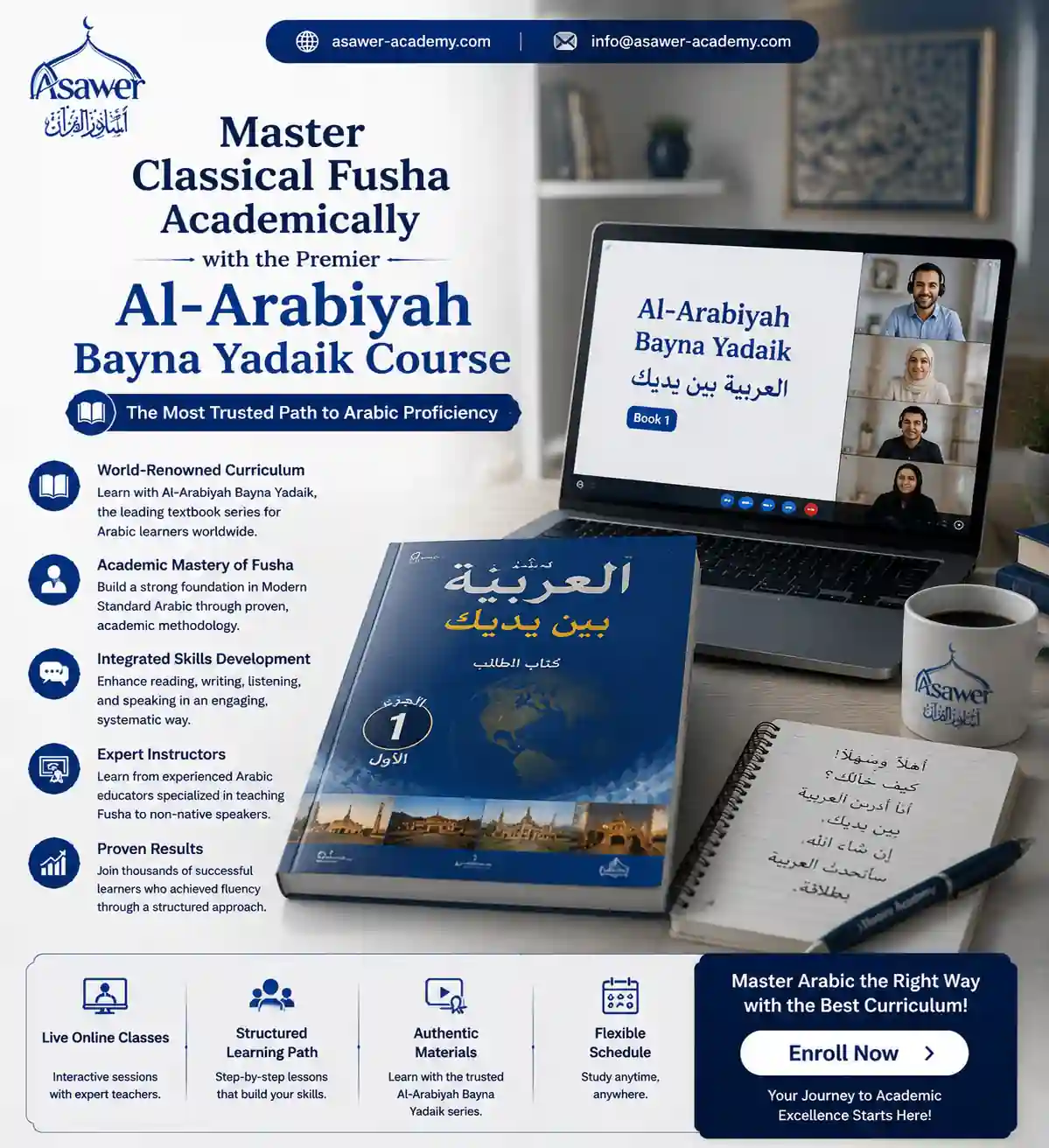
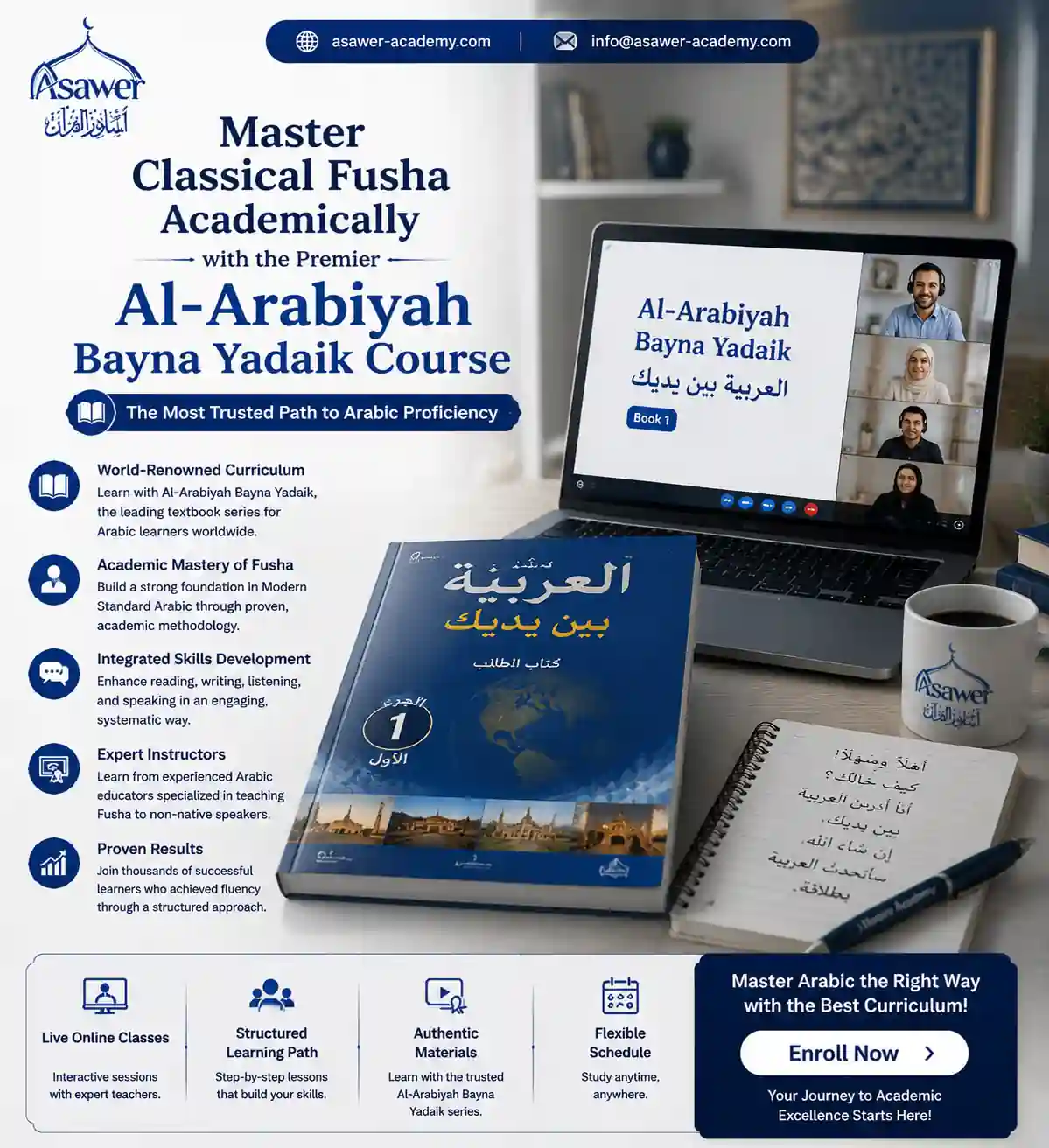
THE COMPLETE 2014 ARABIC BETWEEN YOUR HANDS SERIES — ADAPTED TO PRIVATE LIVE LEARNING

Al-Arabiyyah Bayna Yadayk Course Online: Study the Eight-Volume Series Unit by Unit

This course is built around the published Al-Arabiyyah Bayna Yadayk student series: four levels, two student volumes per level and a 64-unit communicative sequence. The placement assessment identifies the exact book, part and unit where the learner should enter, including learners who already read Quranic script but have limited general-language ability. Each live lesson keeps the series dialogue, vocabulary, comprehension and language-building objective visible. Asawer then extends the unit with custom slides, additional listening, sentence transformation, role-play, writing feedback and review tasks so the learner can use the language beyond the exercise page.
The updated series contains four student levels, each divided into two parts. That creates eight student volumes, supported by four teacher books and additional audio, placement and vocabulary resources. Asawer begins with a placement assessment so you enter the correct book, unit and skill target instead of automatically starting from page one.
Asawer Academy video overlay.webp

See How Asawer Teaches the Series

حِوار → فَهْم → تَرْكيب → اسْتِخْدام

We do not only explain the page; we make the learner perform the language beyond it.

4
STUDENT LEVELS
8
STUDENT VOLUMES
64
CURRICULUM UNITS
600
LESSONS INCLUDING TESTS

Linguistic Competence

Four skills plus sounds, vocabulary and grammar structures developed through progressive units.

Communicative Competence

Use Arabic in dialogues, descriptions, questions, roleplays, reports and real tasks.

Cultural Competence

Meet Arabic and Islamic cultural themes as context for language—not isolated facts.

Measured Progress

Placement, short reviews, oral tasks, written tasks and level checkpoints guide promotion.
Al-Arabiyah Bayna Yadaik Course
THE SERIES ANATOMY

Four levels, eight student volumes and four teacher books

The original series was first published as three books. The expanded 2014 edition reorganised the curriculum into four levels, and each level is divided into Part 1 and Part 2. That means eight student volumes. The official profile also lists one teacher book for each level, creating twelve core books in the teaching set.
THE FOUR-BOOK CURRICULUM SPINE

Every book changes the type of work—not only the difficulty of vocabulary

Across the complete series, the official profile records 3,325 target vocabulary items and 576 core lessons, plus 24 testing lessons.
01

Beginner Book

16 units, 144 basic lessons and 741 target words. Dialogues, vocabulary, grammar, sounds, listening, speaking, reading and writing.
02

Intermediate Book

16 units, 208 basic lessons and 946 target words. Denser dialogues, reading texts, grammar notes, expression, dictation and handwriting.
03

Advanced Book

16 units, 112 basic lessons and 853 target words. Intensive reading, expressions, language rules, listening, oral/written expression and dictation.
04

Proficient Book

16 units, 112 basic lessons and 785 target words. Summary, advanced expression, research writing, extended reading and higher-level language analysis.
THE BOOK GENOME

Exact unit architecture, topics and progression

Open each book to see what changes inside the curriculum and what performance Asawer expects.

Unit structure:
• Dialogue 1, vocabulary and practice
• Dialogue 2, vocabulary and practice
• Dialogue 3, vocabulary and practice
• Combined and additional vocabulary
• Grammar structures and practice
• Sounds and listening comprehension
• Speaking practice
• Reading practice
• Writing practice

Each unit: 9 core lessons and approximately 25 pages.
Assessment: short tests after every two units, a mid-level test after Part 1 and a comprehensive final test after Part 2.

Unit topics:
1. Introductions
2. The Family
3. The Home
4. Daily Life
5. Food and Drink
6. Prayer
7. Study
8. Work
9. Shopping
10. Weather
11. People and Places
12. Hobbies
13. Travel
14. Hajj and Umrah
15. Health
16. Holidays

Asawer milestone: manage controlled everyday exchanges, understand short audio, read beginner texts and write connected basic information.

Unit structure:
• Dialogue 1, comprehension and vocabulary
• Sounds and practice
• Grammar note 1
• Listening and speaking 1
• Reading text 1, comprehension and vocabulary
• Grammar note 2
• Dialogue 2, comprehension and vocabulary
• Grammar note 3
• Listening and speaking 2
• Reading text 2, comprehension and vocabulary
• Grammar note 4
• Guided expression, handwriting and dictation

Each unit: 13 core lessons and approximately 20 pages.
Unit topics:
1. Healthcare
2. Recreation
3. Married Life
4. City Life
5. Teaching and Learning
6. Professions
7. The Arabic Language
8. Gifts
9. The World Is a Small Village
10. Cleanliness
11. Islam
12. Youth
13. The Islamic World
14. Security
15. Pollution
16. Energy

Asawer milestone: discuss practical and social topics, understand longer input, produce guided expression and use grammar across unfamiliar examples.

Unit structure:
• Intensive reading text and comprehension
• Vocabulary and expressions
• Language rules 1
• Listening comprehension
• Oral and written expression
• Dictation
• Language rules 2

Each unit: 7 core lessons and approximately 18 pages.
Unit topics:
1. The Timeless Miracle
2. A Day in the Life of a Young Person
3. Minorities in the World
4. The Prophetic Sunnah
5. Children and Reading
6. Brain Drain
7. Good Sleep, Good Day
8. Anecdotes and a Party
9. True Equality
10. Kindness to Animals
11. Arabic Proverbs
12. Marital Disputes
13. Parents and Children
14. Water: The Origin of Life
15. A Father’s Advice
16. From Walid’s Diary

Asawer milestone: analyse longer texts, discuss ideas, apply more complex rules and produce connected oral and written responses.

Unit structure:
• Reading text, comprehension and summary writing
• Language rules 1
• Listening comprehension
• Advanced expression
• Language rules 2
• Writing and research
• Extended reading

Each unit: 7 core lessons and approximately 21 pages.
Unit topics:
1. The Dangers of Smoking
2. Recreation
3. Choosing a Wife
4. Holy Cities
5. Schools and Scientific Institutes
6. Choosing a Career
7. Arabic and the Quran
8. Scientists and the King Faisal Award
9. Globalisation
10. Cleanliness
11. The Seeker of Truth
12. Levels of Friendship
13. Effects of Islamic Culture
14. Knowledge and Security
15. Protection from Pollution
16. Types of Energy

Asawer milestone: summarise, research, argue, read extensively and communicate with stronger precision across academic and cultural themes.

HOW ASAWER EXPLAINS THE BOOK

The page is the starting point; independent language use is the destination

This four-stage conversion keeps the published sequence while preventing passive page-by-page teaching.
01

Context Before Explanation

Begin with the dialogue, image, audio or situation so vocabulary and grammar already have a communicative purpose.
02

Comprehension Before Performance

Check meaning, speaker purpose, key details and listening before asking the learner to reproduce the language.
03

Structure Through Transformation

Change person, number, tense, place or reason so the learner rebuilds the pattern rather than reciting one answer.
04

Transfer Beyond the Page

Use roleplay, a new text, voice note, summary or writing task that the textbook did not supply word-for-word.
THE ASAWER UNIT MICROCYCLE

Eight moves turn one unit into a complete learning loop

The balance changes by book. Book 1 gives more time to dialogue, sound and controlled production; Books 3 and 4 give more time to intensive reading, argument, summary, research and extended expression.
Master Classical Fusha Academically with the Premier Al Arabiyah Bayna Yadaik Course
THE FOUR-SKILL PERFORMANCE MATRIX

Every level must leave evidence in listening, speaking, reading and writing

Grammar and vocabulary support these performances; they do not replace them.

Listen and Extract

Understand the main message, target details, speaker relationship and recurring sound patterns without depending permanently on the written page.

Speak and Rebuild

Use the unit structures with changed information, ask follow-up questions and maintain a guided formal-Arabic exchange.

Read and Interpret

Move from dialogue comprehension to intensive and extended reading, vocabulary inference, summary and evidence.

Write and Revise

Progress from controlled sentences to guided expression, dictation, summaries, research and organised advanced writing.
THE ASSESSMENT ARCHITECTURE

The series contains tests; Asawer adds performance evidence

01

Placement

Script, listening, speaking, reading, grammar and writing samples identify the correct book and unit.
02

Unit Evidence

A new dialogue, roleplay, text or writing task checks transfer beyond familiar exercises.
03

Part Checkpoint

Part 1 ends with an integrated oral and written review before the learner enters Part 2.
04

Level Promotion

Promotion requires the four skills and core language elements—not attendance or page completion alone.
FOUR PLACEMENT ROUTES

The same series does not require the same starting page

01

Absolute Beginner Adult

Start with the alphabet booklet or Book 1 after a zero-level reading and listening check.
02

Quran Reader, New Language Learner

Use existing script skills while building listening, conversation, general vocabulary and writing.
03

Heritage Learner

Repair formal reading, grammar and writing gaps while using existing comprehension as an advantage.
04

Returning Intermediate Student

Use placement to enter Book 2, 3 or 4 without repeating securely mastered beginner units.
Master Classical Fusha Academically with the Premier Al Arabiyah Bayna Yadaik
BOOKS, AUDIO AND COPYRIGHT

A strong course explains exactly what the learner receives

The official publisher offers student books, teacher books, audio materials, an alphabet booklet, a picture dictionary, placement tests and a digital platform. That does not automatically mean every academy package includes every item.
A 600-HOUR CURRICULUM SHOULD NOT BE SOLD AS A QUICK-FLUENCY SHORTCUT

Private pacing can be efficient without becoming unrealistic

A learner may skip proven material, but no responsible page can guarantee completion of the full series or advanced fluency in a few months.

The Official Full-Series Scale

What Private Teaching Can Change

PRIVATE STUDY ACROSS GLOBAL TIME ZONES

Bayna Yadayk classes for the USA, Canada and Australia

Flexible scheduling should protect teacher continuity and consistent study between lessons.
US

United States

Discuss time zones, university or work schedules, book delivery and a recurring review routine.
CA

Canada

Confirm local-time teacher availability, materials access and continuity across a long multi-book curriculum.
AU

Australia

Check AEST, ACST or AWST compatibility and a time suitable for active listening, speaking and writing.
FREQUENTLY ASKED QUESTIONS

Everything learners ask about Arabic Between Your Hands

Clear answers about the books, levels, units, lessons, vocabulary, duration, dialect, materials and Asawer’s teaching method.

It is a comprehensive Standard Arabic series for non-native speakers. It develops linguistic, communicative and cultural competence through listening, speaking, reading, writing, vocabulary, sounds and grammar.

The expanded edition has four student levels, each divided into two parts, creating eight student volumes. It also has four teacher books, making twelve core books in the full teaching set.

No. The earlier edition was published as three books. The updated 2014 edition was expanded and reorganised into four levels and eight student volumes.

The four student levels contain 64 units and 576 core lessons. The official profile adds 24 testing lessons, for a total of 600 lessons.

The official profile records 3,325 target vocabulary items across the four levels.

The series uses Standard Arabic and does not teach a regional spoken dialect. Learners needing everyday Egyptian conversation should choose a separate dialect course.

Yes. The series begins from zero, and an alphabet booklet can support learners who do not yet read Arabic.

The official publisher describes adults as the main audience. Older teenagers may be accepted when the free assessment confirms that the textbook format and language level are suitable.

No. A placement assessment can identify whether you are ready for Book 2, 3 or 4, although gaps may need targeted repair.

The official curriculum scale is 600 teaching hours. The calendar depends on weekly hours, placement and independent study, so there is no honest universal completion date.
Yes. Dialogue, speaking exercises, oral expression and communicative tasks are present throughout the series, while later books require longer discussion and advanced expression.
Yes. Grammar structures are integrated progressively with dialogue, listening, reading and expression. Books 3 and 4 use more advanced language rules and analysis.
Yes. Book 1 develops controlled writing; Book 2 includes guided expression, handwriting and dictation; Books 3 and 4 expand written expression, summary, research and advanced writing.
The official series includes audio materials. Any licensed audio access included in the selected course package is explained before enrolment.
Students use legally obtained materials. Before enrolment, the course plan explains whether a printed book or licensed digital access is required; copyrighted PDFs are not distributed without permission.
The teacher uses four stages: context, comprehension, structure transformation and transfer beyond the page. The goal is to perform the language, not only finish exercises.
Progress is reviewed through placement, unit performance, oral tasks, written tasks, part checkpoints and level-promotion evidence.
Any available course-completion certificate and its attendance or assessment requirements are confirmed before enrolment.

Asawer Academy

Asawer Academy specializes in teaching the Quran, Arabic, and Islamic Studies to non-Arabic speakers through live one-to-one online lessons.

📞

Phone / WhatsApp

+20 102 830 2494
✉️

Email Address

[email protected]
🌐

No credit card required. We'll confirm your lesson via email and phone.
