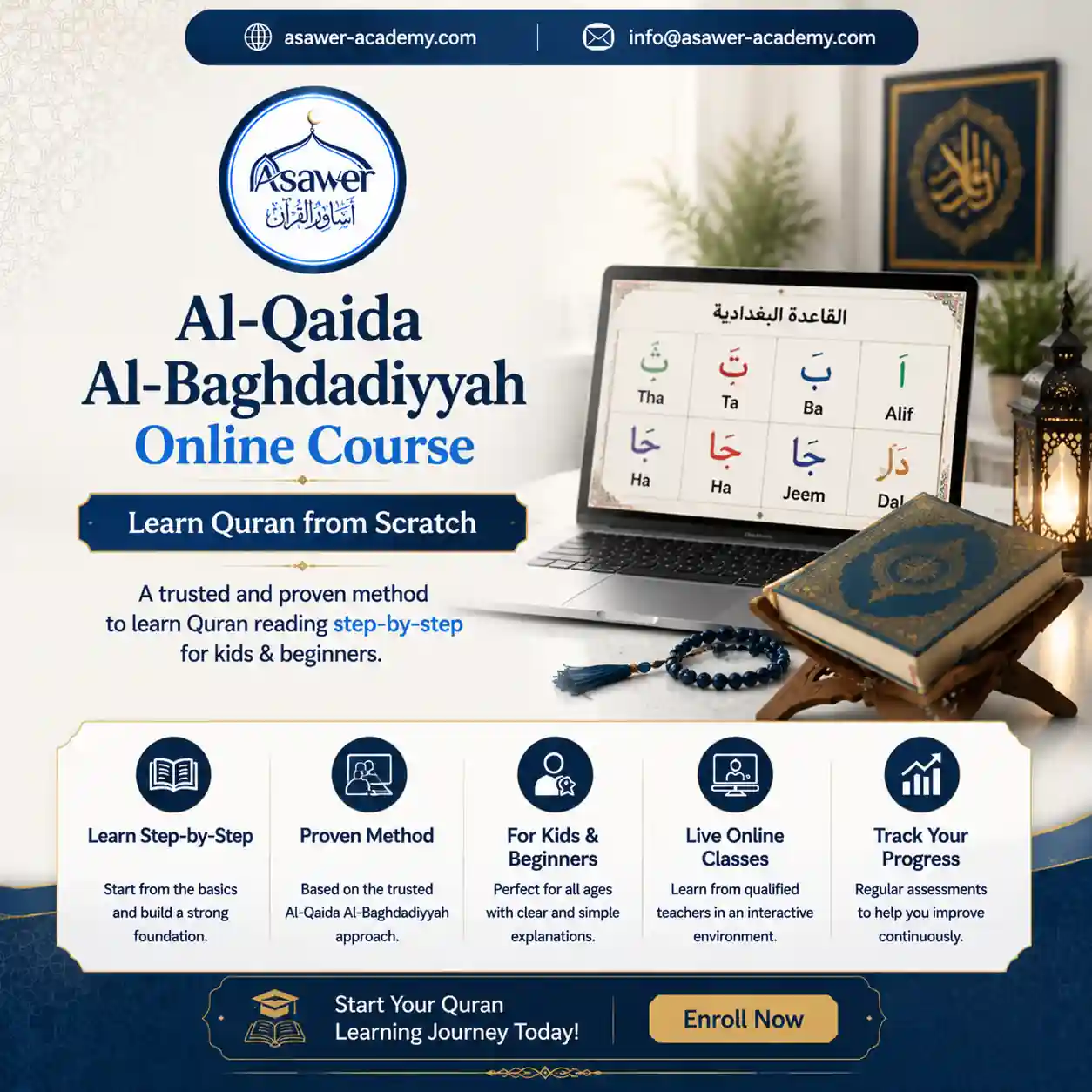
Al-Qaida Al-Baghdadiyyah Online Course: Learn Quran Reading Step by Step

Learn Quran reading through the traditional Baghdadi Qaida sequence with live teaching that follows the book, reinforces every lesson through educational games, and builds steady reading confidence from letters to Quranic words.

What Is the Al-Qaida Al-Baghdadiyyah Online Course?

Al-Qaida Al-Baghdadiyyah is a traditional beginner reading method that teaches Arabic and Quran reading in a deliberate sequence. The learner begins with Arabic letters and correct recognition, then moves through the main reading signs and gradually learns how to combine sounds into words.

One of the strengths of the Baghdadi approach is its analytical style. Instead of asking the learner to memorize how a whole word sounds, the teacher can break the word into visible parts, identify the letters and reading signs, build the sound step by step, and then return to normal reading.

The final goal is not to remain dependent on spelling. The goal is to create a learner who can look at a new word, recognize the pattern, and read it with increasing independence before moving into direct Quran reading.

How We Teach Baghdadi Qaida Online at Asawer Academy

At Asawer Academy, we follow the Baghdadi Qaida book in its proper sequence. The book remains the main curriculum: the teacher explains the assigned lesson, practises its examples with the learner, and checks that the skill is understood before moving forward.

What changes is the way the learner practises. We reinforce the same lesson with educational games and interactive digital activities that match the exact skill being taught. The game does not replace the book; it helps the learner repeat, recognize and apply the book lesson in a more enjoyable way.

Every class includes a review of previous material. Homework can include a short educational game for practice and a listening assignment so the learner hears the target sounds or examples again between lessons. The teacher then follows up the assigned work and begins the next class with review before introducing the next step.

Al-Qaida Al-Baghdadiyyah Course Curriculum: 7 Learning Levels

The traditional Baghdadi sequence moves from letters into the main reading signs and then into increasingly complete words. Our levels organize that progression so parents can understand what the learner is building at each stage.

Level 1 — Arabic Letters & Correct Pronunciation

Recognize Arabic letters confidently, distinguish similar shapes and dots, and build accurate basic pronunciation before moving into longer combinations.

Level 2 — Connected Forms & Harakat

Recognize letters inside connected Arabic words and read Fathah, Kasrah and Dammah accurately in simple combinations.

Level 3 — Madd & Leen

Distinguish short sounds from long vowel patterns and practise controlled word building without stretching short vowels.

Level 4 — Tanween

Read Fathatayn, Kasratayn and Dammatayn and apply them inside graded words while keeping earlier skills active.

Level 5 — Sukoon

Join moving and still letters correctly, read closed syllables and avoid inserting an extra vowel after a silent letter.

Level 6 — Shaddah & Complex Word Building

Understand doubled consonant structure, combine Shaddah with previously learned signs, and read increasingly complex words and short phrases.

Level 7 — From Baghdadi Qaida to Quran Reading

Apply the learned patterns to Quranic words and selected Mushaf passages, gradually reducing spelling support and increasing direct reading.

Baghdadi Qaida for Kids, Adults, Beginners and New Muslims

This Baghdadi Qaida course can start from zero, so it is suitable for children who are meeting Arabic letters for the first time, adults returning to Quran reading, new Muslims, and non-Arabic speakers who need a clear reading foundation.

It is also useful for learners who previously studied a Qaida but still depend on memorized pages, hesitate when letter shapes change, confuse short and long sounds, or struggle to apply Sukoon and Shaddah in unfamiliar words.

By the end of the foundation, the learner should be increasingly able to recognize letters in connected text, read the main vowel and reading signs, build unfamiliar words with less prompting, and begin moving from the Qaida page into selected Quranic text. Full Tajweed study can then continue as the learner’s reading becomes stable.

Why Learn Baghdadi Qaida Online with Asawer Academy?

Learning the book matters, but the teacher, follow-up and practice system are what turn the book into real progress. Asawer Academy combines the traditional Baghdadi sequence with live guidance and clear communication with the family.

Why Families Choose Asawer Academy

Learning the book matters, but the teacher, follow-up and practice system are what turn the book into real progress. Asawer Academy combines the traditional Baghdadi sequence with live guidance and clear communication with the family.

Qualified teaching team

most of our teachers come from Al-Azhar backgrounds, and many hold Quranic Ijazahs together with education or teaching qualifications.

Male and female teachers

families can request a suitable teacher and ask for a teacher change when another match is needed.

Teacher Change When Needed

families can request a suitable teacher and ask for a teacher change when another match is needed.

One-to-one and suitable group options

the class format can be matched to the learner’s level, age and needs.

Book + games + review

the Baghdadi Qaida book stays central, while educational games reinforce the lesson and every class includes review.

Game-based and listening homework

learners continue practising between lessons in more than one format.

Clear progress reporting

families can receive a report after each lesson plus a monthly report showing progress, recurring mistakes and next targets.

Ongoing WhatsApp and scheduling support

communication stays open for learning, homework and class-arrangement questions.

Baghdadi Qaida Online Course FAQs

Answers to the questions parents and adult beginners usually ask before starting Al-Qaida Al-Baghdadiyyah online.

Al-Qaida Al-Baghdadiyyah is a traditional beginner method for learning Arabic and Quran reading step by step. It commonly moves from letters into Harakat, Madd, Tanween, Sukoon and Shaddah before the learner applies these patterns in increasingly complete words and Quranic text.

Yes. A learner can start from the Arabic alphabet. The free trial and level assessment help the teacher decide the correct starting point.

Yes. The course can be taught to non-Arabic speakers with clear English-supported explanation while keeping the Arabic reading sequence central.

The games provide extra repetition, recognition and application in an engaging format. The learner still studies the book, but practises the same skill through a different activity so the lesson is easier to remember and apply.

Yes. Each lesson includes review before new material is introduced. This helps the teacher see whether the previous skill is stable or still needs more practice.

The course supports correct pronunciation and foundational Quran-reading habits, but a full Tajweed curriculum is a separate stage. Once connected reading becomes stable, the learner can continue into more detailed practical Tajweed.

Asawer Academy offers one-to-one lessons and suitable group options. The best format depends on the learner’s level, age, goals and schedule.

Yes. A family can request a teacher change when another teaching style, schedule or teacher match would better support the learner.

Yes. Scheduling and rescheduling options are available according to the learner’s class arrangement, notice policy and teacher availability.

The next step may be direct Mushaf reading, fluency development, practical Tajweed, Quran memorization or another Quran-learning pathway based on the learner’s assessment.

The method uses a gradual, analytical approach. The learner identifies letters and reading signs, builds the sound or word in stages, practises it repeatedly, and then works toward reading the whole word directly without permanent spelling support.

Yes. Children, teenagers, adults and new Muslims can study the same reading foundation, while the teacher adapts the pace, explanation style and practice method to the learner.

Yes. The book is the main curriculum and lessons follow its sequence. Educational games and digital activities are used to reinforce the exact lesson, not to replace the book.

Homework can include a short educational game linked to the lesson together with a listening assignment. The exact task is adjusted to the learner’s age and current level.

The learner progresses through Arabic letters, connected forms, Harakat, Madd, Tanween, Sukoon, Shaddah, word building and a gradual transition toward reading selected Quranic text.

Both are Quran-reading foundations. Baghdadi teaching is commonly associated with more explicit analytical spelling or word construction and graded repetition, while Noorani Qaida often uses a more compact Quran-reading sound sequence. The best fit depends on the learner.

Yes. Male and female teacher options are available subject to teacher availability and scheduling.

Families can receive a report after each lesson and a monthly progress report. These can show what was studied, recurring mistakes, homework, strengths and the next learning target.

There is no responsible fixed duration for every learner. Starting level, age, lesson frequency, attendance, pronunciation needs and home practice all affect the timeline.

FREQUENTLY ASKED QUESTIONS

Questions families and adult beginners ask about Baghdadi Qaida

It is a traditional graded method for beginner Arabic and Quran reading. Common versions begin with letters, then reading signs and analysed or spelled combinations, before progressing to words, sentences and Quranic text.
Baghdadi teaching commonly gives greater emphasis to letter names, analytical spelling or Tahajji, cumulative repetition and movement into words and sentences. Noorani Qaida commonly uses a more compact Quran-specific sound sequence. Editions and teachers vary.
No. Children, adult beginners and new Muslims can study it. The teacher should adapt the pace, explanation language, repetition length and prayer priorities.
No. Analytical spelling is a scaffold. The learner should eventually remove the scaffold and read the complete word naturally. The teacher checks when analysis is still useful and when it has become unnecessary.
Yes, it can begin with the alphabet. The trial may place a learner later if they already recognize letters or read simple words.
Some primers include letter-position examples and writing practice, while others focus mainly on reading. The selected book and the role of writing are explained before enrolment.
It can include foundational pronunciation and selected reading rules. A complete Tajweed curriculum normally continues after the learner can read connected Quranic text.
Standard Arabic print follows normal spelling conventions, while the Mushaf contains Uthmani orthographic forms and recitation signs. A good transition helps the learner recognize both without treating them as unrelated scripts.
There is no responsible fixed duration before assessment. Age, starting point, class frequency, repetition, pronunciation and the selected primer all affect the timeline.
Yes, with a teacher who can explain the spelling formula and pronunciation clearly in the learner’s language. English-guided Baghdadi primers also exist.
Readiness varies at early ages. The free assessment checks attention, speech, visual tracking and participation before recommending a lesson length and starting route.
The learner should identify, analyse, assemble and transfer the pattern. A familiar page read from memory is not enough evidence.
Yes, when the assessment shows gaps in connected forms, vowels, Sukoon, Shaddah or word assembly. A fluent reader with mainly Tajweed errors may need a different course.
A small listening-based memorization target may run alongside the reading foundation. It should not replace development of independent decoding.
The exact Baghdadi primer and its digital or physical format are explained before enrolment, together with any worksheets, audio practice or writing resources required for the selected route.
The learner may move into direct Mushaf reading, practical Tajweed, Quran memorization or a broader Arabic reading course, depending on the assessment result.

Start Your Free Trial Now

Fill out the form below and we’ll contact you shortly.

Asawer Academy

Asawer Academy specializes in teaching the Quran, Arabic, and Islamic Studies to non-Arabic speakers through live one-to-one online lessons..

📞

Phone / WhatsApp

+20 102 830 2494
✉️

Email Address

info@asawer-academy.com
🌐

No credit card required. We'll confirm your lesson via email and phone.
