A STRUCTURED ADULT PATH THROUGH AQEEDAH, FIQH, QURAN, HADITH, SEERAH AND DAILY LIFE

Online Islamic Studies for Adults: Build a Personal Foundation Across the Core Disciplines

This broad adult programme is for learners who need an organised foundation across Aqeedah, worship, Quran awareness, Sunnah, Seerah, character and daily Muslim life. The first assessment maps existing knowledge and unanswered questions, then selects a manageable sequence that fits the learner’s time and background. The course helps adults understand how the disciplines connect and where specialist depth begins. A learner who needs detailed Hadith texts, Mustalah, Tafseer, inheritance or another advanced subject is directed to the relevant dedicated course rather than receiving a compressed version inside the general programme.
The course can support complete beginners, new Muslims, adults rebuilding their foundations and learners who want guided reading in the Islamic sciences. The free trial identifies prior knowledge, questions, preferred depth, Fiqh background, learning style and available study time.
Asawer Academy video overlay.webp

Islamic Courses Video

مَصْدَر → مَعْنًى → حُكْم → عَمَل → مُراجَعَة
Every topic moves from evidence and explanation to responsible practice.
4
LEARNER ROUTES
8
CORE DISCIPLINES
32
CURRICULUM UNITS
1:1
PRIVATE LIVE STUDY

Source Awareness

Learners identify Quran, authentic Hadith, scholarly explanation and personal opinion instead of blending them.

Adult Questions Welcome

The lesson creates space for sincere questions without turning every class into an instant fatwa service.

Fiqh with Clarity

Agreed foundations and recognised differences are labelled rather than mixed or presented as personal certainty.

Sustainable Study

The plan respects work, family and the learner’s real capacity for reading, review and practice.
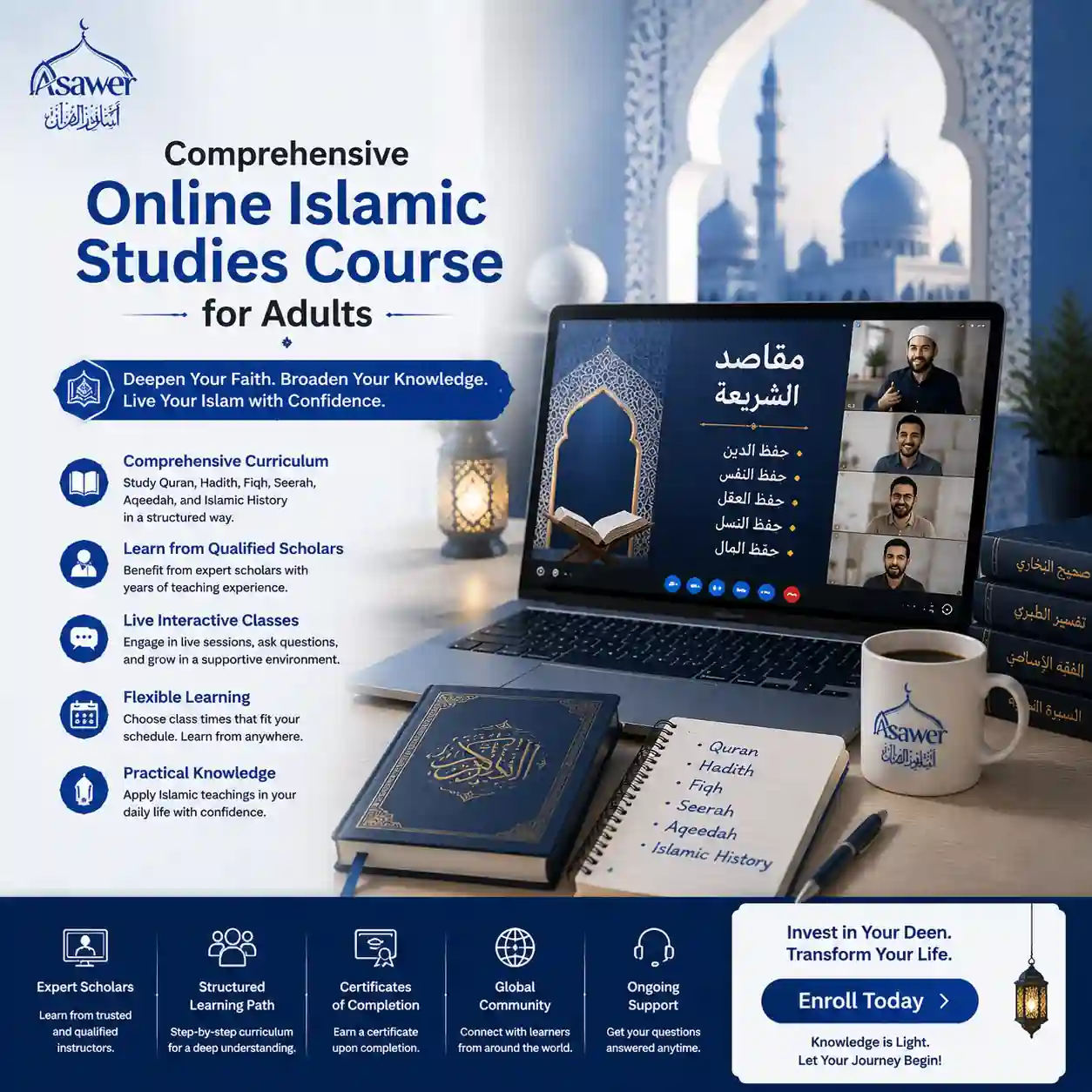
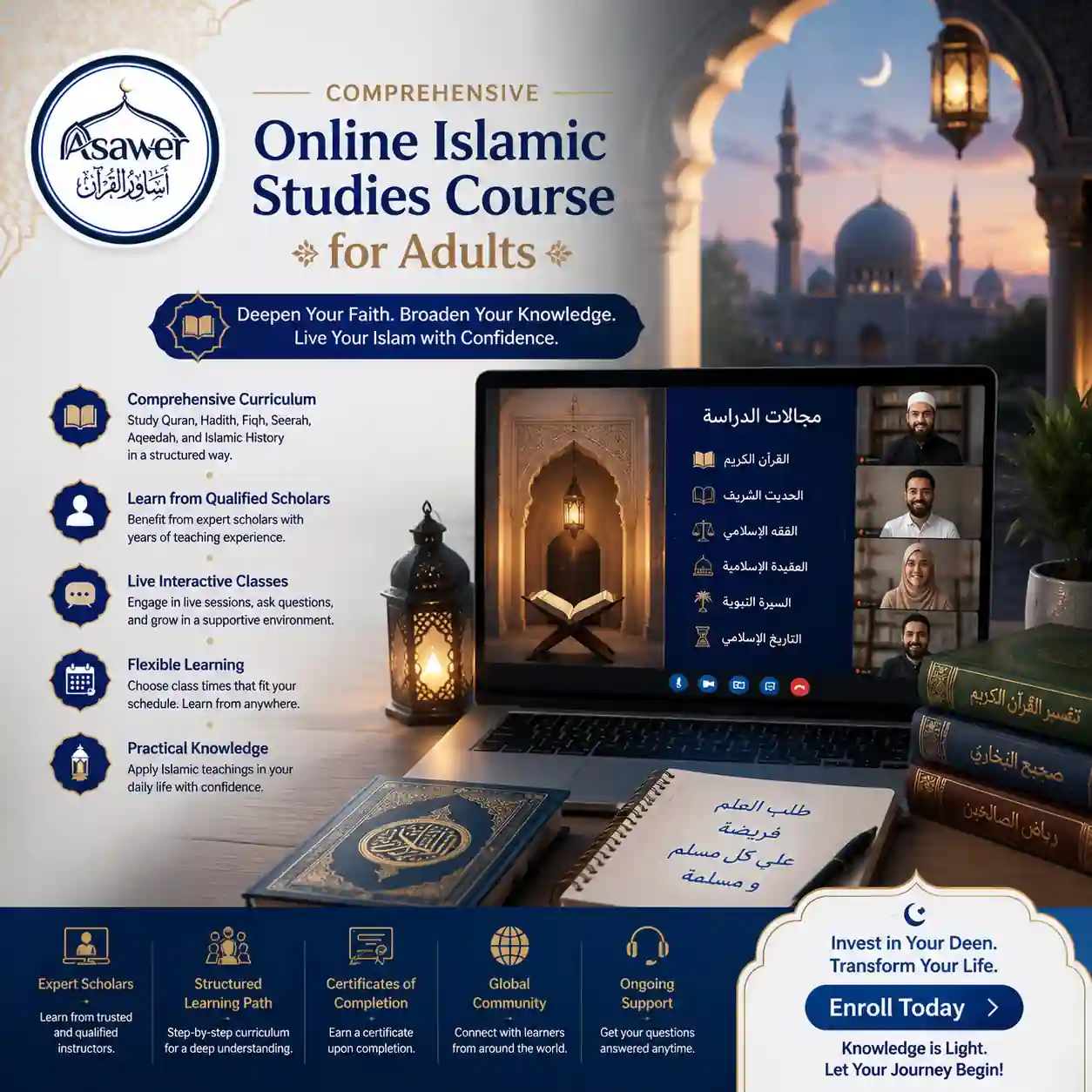
Comprehensive Online Islamic Studies Course for Adults
FROM FRAGMENTED ANSWERS TO A CONNECTED MAP

Adult learners often know many pieces but cannot see how the disciplines fit together

A person may know selected rulings, lectures, stories or social-media answers yet still feel unsure about foundations, evidence, priorities and valid differences. The course begins by organising knowledge before adding more information.
FOUR ADULT LEARNING ROUTES

Begin at the right depth instead of repeating what you already know

The placement trial determines the route and whether the learner needs a broad programme or one specialist subject.
01

New Muslim Foundations

Essential belief, worship, Quran context, Prophetic life and daily practice without assumed vocabulary.
02

Rebuild the Foundations

For adults who grew up Muslim but want to organise, verify and strengthen what they learned informally.
03

Structured Practising Adult

A broader route through Aqeedah, Fiqh, Tafsir, Hadith, Seerah, ethics and contemporary questions.
04

Guided Reading Track

For learners ready to study selected introductory texts with commentary, terminology and scholarly boundaries.
THE 32-UNIT ADULT CURRICULUM

Eight connected disciplines from foundations to contemporary life

Explore the complete 32-unit curriculum across eight connected disciplines, from foundations and source literacy to contemporary life.
1. What Islamic Studies Includes
Map Aqeedah, Fiqh, Tafsir, Hadith, Seerah, history, ethics and spirituality without collapsing them into one subject.

2. Quran, Sunnah and Scholarly Explanation
Understand the roles of revelation, Hadith authenticity, Tafsir, juristic reasoning and scholarly transmission.

3. Essential Knowledge and Specialist Questions
Identify what every Muslim needs for belief and worship and what requires a qualified specialist.

4. How to Ask a Religious Question
State facts, distinguish education from a Fatwa and recognise when law, medicine, finance or family mediation is also needed.

Evidence: classify example questions by discipline, source and appropriate referral.
5. Tawheed and Worship
Understand Allah’s right to worship, dependence, love, fear and hope without reducing Aqeedah to slogans.

6. The Pillars of Iman
Allah, angels, books, messengers, the Last Day and divine decree in a connected framework.

7. Revelation, Prophethood and the Unseen
How Muslims know, what belongs to the unseen and the limits of speculation.

8. Doubt, Certainty and Responsible Inquiry
Differentiate sincere questions, emotional difficulty, intellectual objections and specialist theological debate.

Evidence: explain one belief using a primary text and a clear scholarly explanation.
9. Legal Responsibility and Intention
Obligation, conditions, ability, intention and the difference between general teaching and personal rulings.

10. Purification
Core principles of cleanliness, Wudu, Ghusl and common adult questions with a stated Fiqh framework.

11. Salah
Prayer times, conditions, pillars, concentration, congregation and a practical correction plan.

12. Mistakes, Excuses and Consistency
Missed prayers, uncertainty, travel, illness and recurring difficulties are introduced with appropriate referral boundaries.

Evidence: audit one worship routine and identify the next correction or question.
13. Ramadan and Fasting
Purpose, conditions, invalidators, exemptions and the boundary between Fiqh education and medical advice.

14. Zakah and Financial Worship
Core concepts, wealth categories, Nisab and the need for current calculations and qualified review.

15. Hajj and ‘Umrah Literacy
Ability, sequence, major rites and how to prepare for a detailed practical programme.

16. Oaths, Vows, Sacrifice and Other Worship Questions
Introduce common categories without issuing case-specific rulings from incomplete facts.

Evidence: distinguish the universal principle, the required facts and the specialist question.
17. How the Quran Guides
Themes, Makki and Madani context, commands, stories, parables and the relationship between recitation and understanding.

18. Reading Translation and Tafsir
Translation limits, reliable commentary, context and the danger of isolated proof-texting.

19. Selected Short Surahs
Study meaning, structure, worship lessons and daily application through guided Tafsir.

20. Quran Questions in Daily Life
Connect verses carefully without claiming every modern event has one direct scriptural label.

Evidence: explain a passage using context and a named Tafsir source.
21. What Is Hadith?
Text, chain, collections, authenticity and the difference between Hadith study and social-media quotation.

22. How Hadith Is Understood
Context, related narrations, juristic explanation and avoiding personal legal conclusions from one translation.

23. Selected Hadith on Intention, Worship and Character
Study a small set deeply rather than memorising many disconnected narrations.

24. Weak, Fabricated and Popular Reports
Source checking, responsible sharing and how to say “I do not know.”

Evidence: identify the source status and explain one narration in context.
25. The Seerah as a Connected Journey
Makkah, Madinah, revelation, community formation and the limits of disputed historical details.

26. Prophetic Character and Daily Relationships
Worship, family, teaching, mercy, courage and covenant without reducing Seerah to motivational slogans.

27. The Companions and Early Community
Major personalities, historical method and respectful treatment of disagreement.

28. Akhlaq and Tazkiyah
Intention, repentance, gratitude, patience, envy, anger and habits through evidence and accountable practice.

Evidence: connect one historical event to a sourced ethical lesson without forcing a false modern equivalence.
29. Family and Relationships
Rights, responsibilities, communication and when a question needs counselling, mediation or a personal Fatwa.

30. Work, Money and Consumption
Ethical principles, contracts, interest, uncertainty and the difference between general literacy and transaction review.

31. Living as a Muslim in Contemporary Society
Identity, neighbours, citizenship, online life, disagreement and responsible participation.

32. Personal Islamic Knowledge Map
Create a sustainable plan: essential revision, one specialist course, a reading list, worship goals and referral questions.

Final evidence: explain a new issue by separating source, principle, facts, applicable ruling and professional boundary.
THREE ADULT STUDY MODES

Choose how the live lesson uses your available time

The teacher can adjust the mode as the learner’s reading confidence and schedule change.
01

Teacher-Led Study

The teacher introduces, reads and explains the material inside the live lesson. Suitable for busy beginners.
02

Prepare and Discuss

The learner reads or watches a short assigned resource before class, then uses the lesson for questions and depth.
03

Assignment and Review

Short summaries, memorisation, case analysis or reflection are completed between lessons and reviewed live.
THE ADULT LESSON FRAME

Read the evidence, understand the principle, test the application and record the remaining question

Adult lessons should make room for questions while protecting the difference between education, counselling, specialist research and a personal Fatwa.
Online Islamic Studies Course for Adults
SCHOLARLY CLARITY WITHOUT FALSE CERTAINTY

A serious adult course teaches the limits of a general lesson

Some questions depend on personal facts, Madhhab, country, health, contracts or family circumstances and need the correct specialist.

Madhhab Transparency

The course should state whether it teaches one school, agreed foundations or a comparative approach. Positions are not mixed silently.

No Instant Fatwa

The teacher can explain principles and identify missing facts, but a personal ruling may require a qualified Mufti who reviews the case.

Professional Boundaries

Medical, legal, financial and mental-health questions may need licensed professionals alongside Islamic guidance.

Source Verification

Translations, viral quotations and AI answers are not treated as evidence without checking the Quran, Hadith source and scholarly explanation.
PROGRESS ADULTS CAN DEMONSTRATE

Completion means more than attending lessons

The learner should become better at organising knowledge, explaining evidence and knowing when to ask for specialist guidance.
01

Explain

Describe the central belief, ruling, event or ethical principle in clear words.
02

Source

Identify whether the lesson rests on Quran, authentic Hadith or scholarly reasoning.
03

Distinguish

Separate consensus, recognised difference, personal preference and unresolved facts.
04

Practise and Refer

Apply the general lesson honestly and identify questions that require a qualified specialist.
islamic studies courses
THE ADULT WEEKLY RHYTHM

A sustainable study plan is more valuable than an ambitious plan that stops

The lesson frequency and homework load should match the learner’s work, family, language level and previous Islamic study.
PRIVATE ADULT LEARNING ACROSS TIME ZONES

Flexible study for the USA, Canada and Australia

The final schedule is confirmed according to teacher availability and a realistic time for attention and review.
US

United States

Choose a study time that fits work, family and local prayer routines.
CA

Canada

Confirm time zone, teacher continuity and a manageable reading load.
AU

Australia

Check AEST, ACST or AWST compatibility before final teacher matching.
FREQUENTLY ASKED QUESTIONS

What adult learners ask before starting Islamic Studies online

Clear answers about levels, Fiqh, sources, Arabic, homework, contemporary questions and specialist pathways.
It is a structured programme covering core Islamic disciplines such as Aqeedah, Fiqh, Quran and Tafsir, Hadith, Seerah, ethics and daily practice.
Yes. The New Muslim Foundations and Rebuild routes begin with essential vocabulary, belief and worship without assuming previous formal study.
Yes. Many adults know separate topics but want a connected framework, stronger sources and a more organised study plan.
The curriculum includes source literacy, Aqeedah, worship Fiqh, Quran and Tafsir, Hadith, Seerah, history, character and contemporary life.
Agreed foundations are taught clearly, while recognised Fiqh differences are labelled and discussed without silently mixing positions.
The teacher can explain principles and identify the relevant facts. A personal ruling may require a qualified Mufti who reviews the full case.
Quran meaning and Tafsir literacy are included. Learners needing reading or Tajweed correction may combine this with a specialist Quran course.
Yes. The new-Muslim route prioritises belief, prayer, daily worship, Quran context, the Prophetic life and a manageable vocabulary.
Yes. A male or female teacher preference can be requested, subject to subject fit, schedule and availability.
The course separates the Islamic principle, verified facts and specialist boundaries instead of giving instant answers from incomplete information.
It introduces the ethical and Fiqh foundations. Detailed family, legal, tax or financial cases may require specialist review.
A live teacher can organise the sequence, check understanding, answer questions, correct assumptions and adapt depth to the learner.
No. The course can begin in English. Arabic terminology and selected texts can be introduced gradually according to level.
The learner can choose teacher-led study, prepare-and-discuss or assignment-and-review according to schedule and goals.
Progress is reviewed through explanation, source identification, distinguishing valid difference and applying or referring questions responsibly.
Yes. The placement trial can recommend the full foundation or a specialist Seerah, Hadith, Dua or inheritance path.
The 32-unit map is a curriculum framework. Duration depends on route, depth, lesson length, frequency and between-class study.
No course can guarantee spiritual change, family outcomes or mental-health recovery. It provides knowledge, guided reflection and responsible practice.

Asawer Academy

Asawer Academy specializes in teaching the Quran, Arabic, and Islamic Studies to non-Arabic speakers through live one-to-one online lessons.

📞

Phone / WhatsApp

+20 102 830 2494
✉️

Email Address

[email protected]
🌐

No credit card required. We'll confirm your lesson via email and phone.
